501 posters, 2 videos, 1 audios, 8 topics, 37 sessions, 395 authors, 307 institutions
ePostersLive by SciGen Technologies S.A. All rights reserved.
23rd Annual Pain Medicine Meeting 2024
November 21-23, 2024 | Caesars Palace, Las Vegas, Nevada

5987
SENSORIMOTOR CHANGES AFTER SURGERY: NEUROPATHY OR DURAL ARTERIOVENOUS FISTULA?
Poster Presenter
Authors
Affiliations
Part of Topic
Scientific Abstracts > Education
SENSORIMOTOR CHANGES AFTER SURGERY: NEUROPATHY OR DURAL ARTERIOVENOUS FISTULA?
David Pilkington, DO; Chris McMullen, MD
Key takeaways:
Spinal dural arteriovenous fistulas cause spinal cord ischemia and present as insidious myelopathy.
Patients who develop unexpected post-surgical complications warrant broad workup.
Early AV fistula embolization/ligation may halt symptom progression, but recovery depends on pre-surgical neurologic severity/duration.
Intro:
Neurologic injury after total knee replacement is usually from mechanical traction, compression, arterial injury.
A rare injury is concurrent spinal dural arteriovenous fistula bypassing spinal capillary beds leading to venous congestion/hypertension, reduced arteriovenous pressure, and vascular wall remodeling causing reduced spinal cord perfusion and eventually insidious myelopathic symptoms.
Case:
79M with lumbar stenosis and bilateral S1 subacute motor radiculopathy undergoes left TKA for OA
Immediately post-op, he develops back pain with ascending bilateral foot numbness and quad/glute weakness
Exam shows myelopathic gait, bilateral distal sensory loss, unilateral hyperreflexia, proximal leg weakness
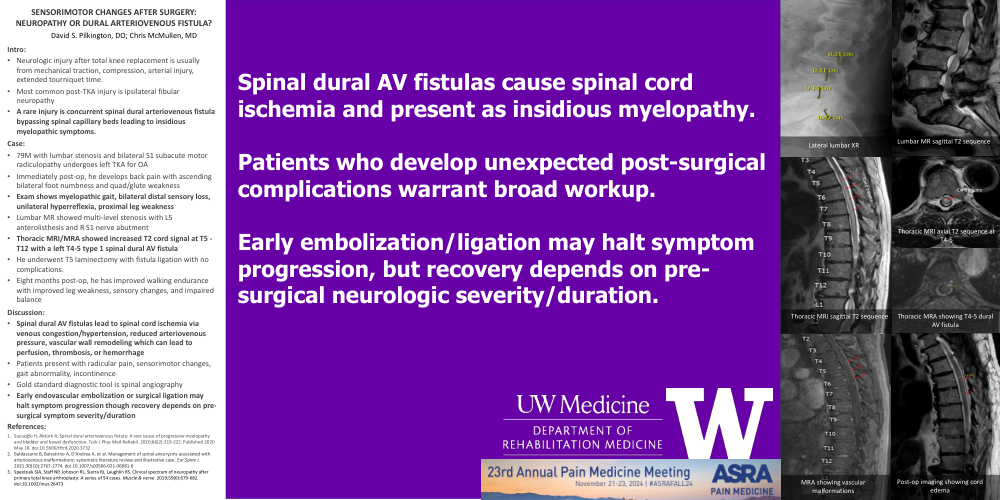
Lumbar MR showed multi-level stenosis with L5 anterolisthesis and R S1 nerve abutment
Thoracic MRI/MRA showed increased T2 cord signal at T5 - T12 with a left T4-5 type 1 spinal dural AV fistula
He underwent T5 laminectomy with fistula ligation with no complications.
Eight months post-op, he has improved walking endurance with improved leg weakness, sensory changes, and impaired balance
Discussion:
Spinal dural AV fistulas lead to spinal cord ischemia via reduced perfusion, thrombosis, or hemorrhage
Patients present with radicular pain, sensorimotor changes, gait abnormality, incontinence
Gold standard diagnostic tool is spinal angiography
Early endovascular embolization or surgical ligation may halt symptom progression though recovery depends on pre-surgical symptom severity/duration