501 posters, 2 videos, 1 audios, 8 topics, 37 sessions, 395 authors, 307 institutions
ePostersLive by SciGen Technologies S.A. All rights reserved.
23rd Annual Pain Medicine Meeting 2024
November 21-23, 2024 | Caesars Palace, Las Vegas, Nevada

6204
CAN A CONTINUOUS EPIDURAL TRIAL PREDICT THE SUCCESS RATE OF INTRATHECAL THERAPY THREE YEARS AFTER IMPLANTATION?
Poster Presenter
Authors
Affiliations
Part of Topic
Scientific Abstracts > Chronic Pain
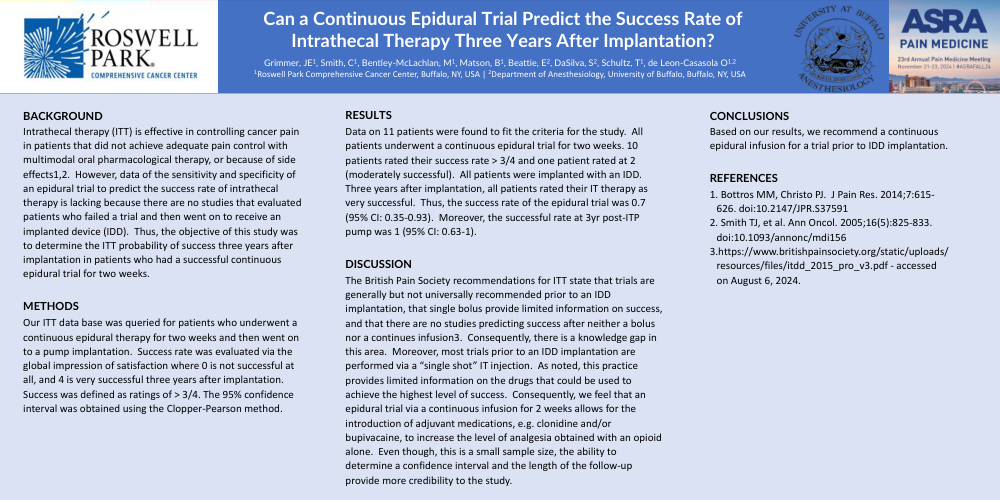
Can a Continuous Epidural Trial Predict the Success Rate of Intrathecal Therapy Three Years After Implantation?
Grimmer, JE1, Smith, C1, Bentley-McLachlan, M1, Matson, B1, Beattie, E2, DaSilva, S2, Schultz, T1, de Leon-Casasola O1,2
1Roswell Park Comprehensive Cancer Center, Buffalo, NY, USA | 2Department of Anesthesiology, University of Buffalo, Buffalo, NY, USA
BACKGROUND
Intrathecal therapy (ITT) is effective in controlling cancer pain in patients that did not achieve adequate pain control with multimodal oral pharmacological therapy, or because of side effects1,2. However, data of the sensitivity and specificity of an epidural trial to predict the success rate of intrathecal therapy is lacking because there are no studies that evaluated patients who failed a trial and then went on to receive an implanted device (IDD). Thus, the objective of this study was to determine the ITT probability of success three years after implantation in patients who had a successful continuous epidural trial for two weeks.
METHODS
Our ITT data base was queried for patients who underwent a continuous epidural therapy for two weeks and then went on to a pump implantation. Success rate was evaluated via the global impression of satisfaction where 0 is not successful at all, and 4 is very successful three years after implantation. Success was defined as ratings of > 3/4. The 95% confidence interval was obtained using the Clopper-Pearson method.
RESULTS
Data on 11 patients were found to fit the criteria for the study. All patients underwent a continuous epidural trial for two weeks. 10 patients rated their success rate > 3/4 and one patient rated at 2 (moderately successful). All patients were implanted with an IDD. Three years after implantation, all patients rated their IT therapy as very successful. Thus, the success rate of the epidural trial was 0.7 (95% CI: 0.35-0.93). Moreover, the successful rate at 3yr post-ITP pump was 1 (95% CI: 0.63-1).
DISCUSSION
The British Pain Society recommendations for ITT state that trials are generally but not universally recommended prior to an IDD implantation, that single bolus provide limited information on success, and that there are no studies predicting success after neither a bolus nor a continues infusion3. Consequently, there is a knowledge gap in this area. Moreover, most trials prior to an IDD implantation are performed via a “single shot” IT injection. As noted, this practice provides limited information on the drugs that could be used to achieve the highest level of success. Consequently, we feel that an epidural trial via a continuous infusion for 2 weeks allows for the introduction of adjuvant medications, e.g. clonidine and/or bupivacaine, to increase the level of analgesia obtained with an opioid alone. Even though, this is a small sample size, the ability to determine a confidence interval and the length of the follow-up provide more credibility to the study.
CONCLUSIONS
Based on our results, we recommend a continuous epidural infusion for a trial prior to IDD implantation.
REFERENCES