501 posters, 2 videos, 1 audios, 8 topics, 37 sessions, 395 authors, 307 institutions
ePostersLive by SciGen Technologies S.A. All rights reserved.
23rd Annual Pain Medicine Meeting 2024
November 21-23, 2024 | Caesars Palace, Las Vegas, Nevada

6222
PHARMACOGENOMICS OF OPIOID CONSUMPTION AFTER ANTERIOR CRUCIATE LIGAMENT RECONSTRUCTION
Poster Presenter
Authors
Affiliations
Part of Topic
Scientific Abstracts > Acute Pain
PHARMACOGENOMICS OF OPIOID CONSUMPTION AFTER ACL RECONSTRUCTION
•As declared by the Centers for Disease Control and Prevention (CDC), the United States is in the midst of an opioid epidemic. There remains a paucity of research regarding how one’s individual genetic composition may affect opioid consumption patterns.
•This study aims to further the field of personalized medicine by analyzing pharmacogenomics to predict patient’s drug response in opioid consumption patterns post ACL reconstruction surgery.
•Oxycodone is metabolized by CYP2D6, CYP3A4, and CYP3A5, primarily.1
•We are interested in why some people take more opioids post-surgery than others
•We are incorporating ancestry information, age, sex, previous drug use, and many other covariables to reduce confounding bias
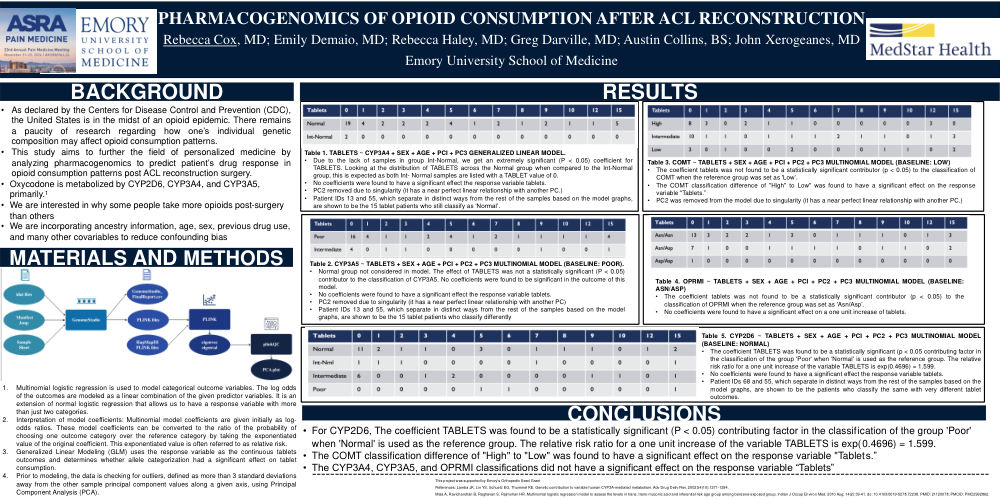
1.Multinomial logistic regression is used to model categorical outcome variables. The log odds of the outcomes are modeled as a linear combination of the given predictor variables. It is an extension of normal logistic regression that allows us to have a response variable with more than just two categories.
2.Interpretation of model coefficients: Multinomial model coefficients are given initially as log-odds ratios. These model coefficients can be converted to the ratio of the probability of choosing one outcome category over the reference category by taking the exponentiated value of the original coefficient. This exponentiated value is often referred to as relative risk.
3.Generalized Linear Modeling (GLM) uses the response variable as the continuous tablets outcomes and determines whether allele categorization had a significant effect on tablet consumption.
4.Prior to modeling, the data is checking for outliers, defined as more than 3 standard deviations away from the other sample principal component values along a given axis, using Principal Component Analysis (PCA).
•For CYP2D6, The coefficient TABLETS was found to be a statistically significant (P < 0.05) contributing factor in the classification of the group 'Poor' when 'Normal' is used as the reference group. The relative risk ratio for a one unit increase of the variable TABLETS is exp(0.4696) = 1.599.
•The COMT classification difference of "High" to "Low" was found to have a significant effect on the response variable "Tablets.”
•The CYP3A4, CYP3A5, and OPRMI classifications did not have a significant effect on the response variable “Tablets”