501 posters, 2 videos, 1 audios, 8 topics, 37 sessions, 395 authors, 307 institutions
ePostersLive by SciGen Technologies S.A. All rights reserved.
23rd Annual Pain Medicine Meeting 2024
November 21-23, 2024 | Caesars Palace, Las Vegas, Nevada

5947
EVALUATING PHOSPHATIDYLETHANOL (PETH) AS A RELIABLE BIOMARKER FOR ALCOHOL USE IN CHRONIC PAIN PATIENTS
Poster Presenter
Authors
Affiliations
Part of Topic
Scientific Abstracts > Chronic Pain
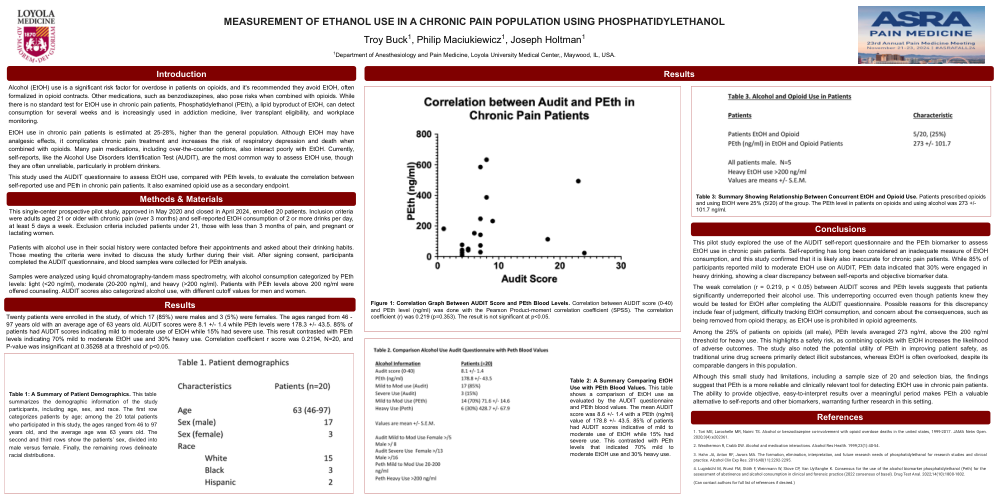
Alcohol (EtOH) use is a significant risk factor for overdose in patients on opioids, and it's recommended they avoid EtOH, often formalized in opioid contracts. Other medications, such as benzodiazepines, also pose risks when combined with opioids. While there is no standard test for EtOH use in chronic pain patients, Phosphatidylethanol (PEth), a lipid byproduct of EtOH, can detect consumption for several weeks and is increasingly used in addiction medicine, liver transplant eligibility, and workplace monitoring. EtOH use in chronic pain patients is estimated at 25-28%, higher than the general population. Although EtOH may have analgesic effects, it complicates chronic pain treatment and increases the risk of respiratory depression and death when combined with opioids. Many pain medications, including over-the-counter options, also interact poorly with EtOH. Currently, self-reports, like the Alcohol Use Disorders Identification Test (AUDIT), are the most common way to assess EtOH use, though they are often unreliable, particularly in problem drinkers. This study used the AUDIT questionnaire to assess EtOH use, compared with PEth levels, to evaluate the correlation between self-reported use and PEth in chronic pain patients. It also examined opioid use as a secondary endpoint. Introduction Methods & Materials This single-center prospective pilot study, approved in May 2020 and closed in April 2024, enrolled 20 patients. Inclusion criteria were adults aged 21 or older with chronic pain (over 3 months) and self-reported EtOH consumption of 2 or more drinks per day, at least 5 days a week. Exclusion criteria included patients under 21, those with less than 3 months of pain, and pregnant or lactating women. Patients with alcohol use in their social history were contacted before their appointments and asked about their drinking habits. Those meeting the criteria were invited to discuss the study further during their visit. After signing consent, participants completed the AUDIT questionnaire, and blood samples were collected for PEth analysis. Samples were analyzed using liquid chromatography-tandem mass spectrometry, with alcohol consumption categorized by PEth levels: light (<20 ng/ml), moderate (20-200 ng/ml), and heavy (>200 ng/ml). Patients with PEth levels above 200 ng/ml were offered counseling. AUDIT scores also categorized alcohol use, with different cutoff values for men and women. This pilot study explored the use of the AUDIT self-report questionnaire and the PEth biomarker to assess EtOH use in chronic pain patients. Self-reporting has long been considered an inadequate measure of EtOH consumption, and this study confirmed that it is likely also inaccurate for chronic pain patients. While 85% of participants reported mild to moderate EtOH use on AUDIT, PEth data indicated that 30% were engaged in heavy drinking, showing a clear discrepancy between self-reports and objective biomarker data. The weak correlation (r = 0.219, p < 0.05) between AUDIT scores and PEth levels suggests that patients significantly underreported their alcohol use. This underreporting occurred even though patients knew they would be tested for EtOH after completing the AUDIT questionnaire. Possible reasons for this discrepancy include fear of judgment, difficulty tracking EtOH consumption, and concern about the consequences, such as being removed from opioid therapy, as EtOH use is prohibited in opioid agreements. Among the 25% of patients on opioids (all male), PEth levels averaged 273 ng/ml, above the 200 ng/ml threshold for heavy use. This highlights a safety risk, as combining opioids with EtOH increases the likelihood of adverse outcomes. The study also noted the potential utility of PEth in improving patient safety, as traditional urine drug screens primarily detect illicit substances, whereas EtOH is often overlooked, despite its comparable dangers in this population. Although this small study had limitations, including a sample size of 20 and selection bias, the findings suggest that PEth is a more reliable and clinically relevant tool for detecting EtOH use in chronic pain patients. The ability to provide objective, easy-to-interpret results over a meaningful period makes PEth a valuable alternative to self-reports and other biomarkers, warranting further research in this setting. Results Conclusions References Results 1. Tori ME, Larochelle MR, Naimi TS. Alcohol or benzodiazepine co-involvement with opioid overdose deaths in the united states, 1999-2017. JAMA Netw Open. 2020;3(4):e202361. 2. Weathermon R, Crabb DW. Alcohol and medication interactions. Alcohol Res Health. 1999;23(1):40-54. 3. Hahn JA, Anton RF, Javors MA. The formation, elimination, interpretation, and future research needs of phosphatidylethanol for research studies and clinical practice. Alcohol Clin Exp Res. 2016;40(11):2292-2295. 4. Luginbühl M, Wurst FM, Stöth F, Weinmann W, Stove CP, Van Uytfanghe K. Consensus for the use of the alcohol biomarker phosphatidylethanol (Peth) for the assessment of abstinence and alcohol consumption in clinical and forensic practice (2022 consensus of basel). Drug Test Anal. 2022;14(10):1800-1802