501 posters, 2 videos, 1 audios, 8 topics, 37 sessions, 395 authors, 307 institutions
ePostersLive by SciGen Technologies S.A. All rights reserved.
23rd Annual Pain Medicine Meeting 2024
November 21-23, 2024 | Caesars Palace, Las Vegas, Nevada

5911
ULTRASOUND-GUIDED PERIARTICULAR RADIOFREQUENCY ABLATION FOR REFRACTORY ELBOW JOINT PAIN
Poster Presenter
Authors
Affiliations
Part of Topic
Scientific Abstracts > Chronic Pain
Chronic elbow pain due to post-traumatic elbow osteoarthritis is acomplicated condition to treatand can be a cause for significantfunctional impairment for the patient. Frequently these patients donot respond well to basic conservative management such as activitymodification, over-the-counter pharmacological treatment (NSAID,acetaminophen), and physical therapy. Standard interventionaltreatments such as intraarticular steroid injection and orthobiologictreatment can be helpful but are generally limited in their effect anddurability. Surgical treatments such as debridement and arthroplastyfrequently have limited utility due to their technically challengingnature (1).
Joint denervation by radiofrequency ablation is a well-knowntechnique that has been applied to the management of chronic jointpain due to advanced osteoarthritis. It is well-validated in the paintreatment of lumbar and cervical facet syndrome, knee pain and hippain. To date, no technique for elbow radiofrequency denervationhas been reported due to the complexity elbow joint innervation.The anterior lateral elbow joint is innervated by the radial nerve,
Here we present a case report of elbow joint denervation byradiofrequency ablation to for the management of chronic pain dueto post-traumatic elbow osteoarthritis.
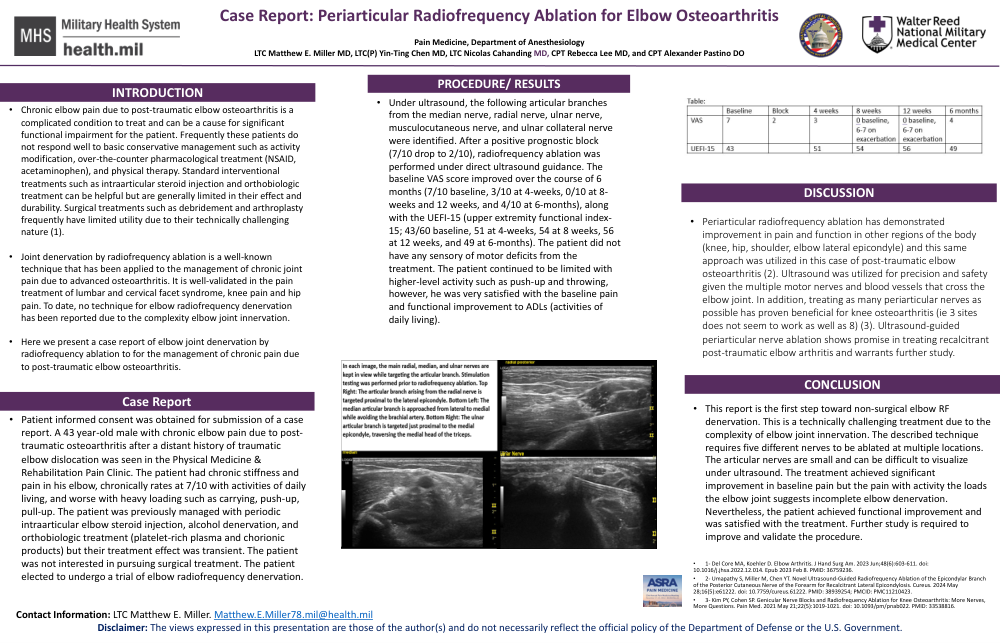
A 43 year-old male with chronic elbow pain due to post-traumatic osteoarthritis after a distant history of traumatic elbow dislocation was seen in the Physical Medicine & Rehabilitation Pain Clinic. The patient had chronic stiffness and pain in his elbow, chronically rates at 7/10 with activities of daily living, and worse with heavy loading such as carrying, push-up, pull-up. The patient was previously managed with periodic intraarticular elbow steroid injection, alcohol denervation, and orthobiologic treatment (platelet-rich plasma and chorionic products) but their treatment effect was transient. The patient was not interested in pursuing surgical treatment. The patient elected to undergo a trial of elbow radiofrequency denervation.
Under ultrasound, the following articular branchesfrom the median nerve, radial nerve, ulnar nerve,musculocutaneous nerve, and ulnar collateral nervewere identified. After a positive prognostic block(7/10 drop to 2/10), radiofrequency ablation wasperformed under direct ultrasound guidance. Thebaseline VAS score improved over the course of 6months (7/10 baseline, 3/10 at 4-weeks, 0/10 at 8-weeks and 12 weeks, and 4/10 at 6-months), alongwith the UEFI-15 (upper extremity functional index-15; 43/60 baseline, 51 at 4-weeks, 54 at 8 weeks, 56at 12 weeks, and 49 at 6-months). The patient did nothave any sensory of motor deficits from thetreatment. The patient continued to be limited withhigher-level activity such as push-up and throwing,however, he was very satisfied with the baseline painand functional improvement to ADLs (activities ofdaily living).
Periarticular radiofrequency ablation has demonstratedimprovement in pain and function in other regions of the body(knee, hip, shoulder, elbow lateral epicondyle) and this sameapproach was utilized in this case of post-traumatic elbowosteoarthritis (2). Ultrasound was utilized for precision and safetygiven the multiple motor nerves and blood vessels that cross theelbow joint. In addition, treating as many periarticular nerves aspossible has proven beneficial for knee osteoarthritis (ie3 sitesdoes not seem to work as well as 8) (3). Ultrasound-guidedperiarticular nerve ablation shows promise in treating recalcitrantpost-traumatic elbow arthritis and warrants further study.
This report is the first step toward non-surgical elbow RFdenervation. This is a technically challenging treatment due to thecomplexity of elbow joint innervation. The described techniquerequires five different nerves to be ablated at multiple locations. Thearticular nerves are small and can be difficult to visualize underultrasound. The treatment achieved significant improvement inbaseline pain but the pain with activity the loads the elbow jointsuggests incomplete elbow denervation. Nevertheless, the patientachieved functional improvement and was satisfied with thetreatment. Further study is required to improve and validate theprocedure.
•1- Del Core MA, Koehler D. Elbow Arthritis. J Hand Surg Am. 2023 Jun;48(6):603-611. doi:10.1016/j.jhsa.2022.12.014. Epub 2023 Feb 8. PMID: 36759236.•2- Umapathy S, Miller M, Chen YT. Novel Ultrasound-Guided Radiofrequency Ablationof the Epicondylar Branch of the Posterior Cutaneous Nerve of the Forearmfor Recalcitrant Lateral Epicondylosis. Cureus. 2024 May 28;16(5):e61222. doi: 10.7759/cureus.61222.PMID: 38939254; PMCID: PMC11210423.•3- Kim PY, Cohen SP. Genicular Nerve Blocks and Radiofrequency Ablation for Knee Osteoarthritis: More Nerves,More Questions. Pain Med. 2021 May 21;22(5):1019-1021. doi: 10.1093/pm/pnab022. PMID: 33538816.