501 posters, 2 videos, 1 audios, 8 topics, 37 sessions, 395 authors, 307 institutions
ePostersLive by SciGen Technologies S.A. All rights reserved.
23rd Annual Pain Medicine Meeting 2024
November 21-23, 2024 | Caesars Palace, Las Vegas, Nevada

5879
BALANCING OPIOID USE WITH THE PAINAD SCALE
Poster Presenter
Authors
Affiliations
Part of Topic
Scientific Abstracts > Case Series
Balancing Opioid Use with the PAINAD Scale
Henry Dinh MS1, Loriann Hom MPH2, Kyaw Lin DO3
Touro University, Vallejo, CA, USA1 2
Sutter Health, Palo Alto, , CA,USA3
Introduction
-
The widespread abuse and overuse of opioids can be further complicated when treating patients with cognitive impairments such as Alzheimer’s disease1.
-
These patients have limitations in accurately perceiving their pain and expressing their pain level to their physician.
-
Therefore, it can become hazardous when there is no clear indication for opioids or when the use of opioids does not adequately address the patient’s pain.
Patient Case #1
-
94-year-old female with a past medical history of Alzheimer's disease, overactive bladder, and insomnia. She was admitted to the hospital for lethargy and coughing.
-
Her complications led to a urinary tract infection and metabolic encephalopathy. She continued to endorse no pain.
-
However, her family was concerned she was undermedicated for pain because of her altered mental status.
Patient Case #2
-
98-year-old female with a past medical history of Alzheimer's disease presented to the hospital for a left femur fracture caused by a fall.
-
She was a poor historian and required Tagalog translation services during hospitalization.
-
There was concern that she was overmedicated with tramadol due to her inability to communicate her pain level effectively.
Results
-
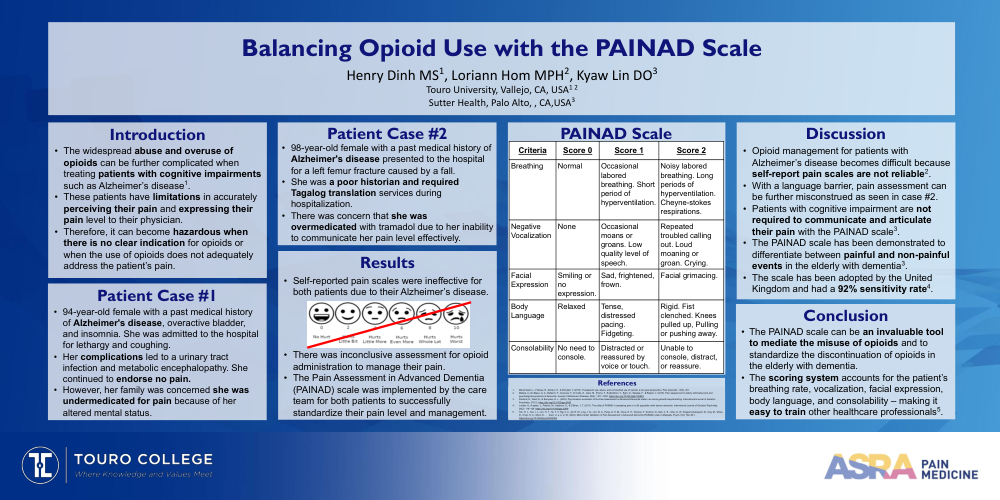
Self-reported pain scales were ineffective for both patients due to their Alzheimer’s disease.
-
There was inconclusive assessment for opioid administration to manage their pain.
-
The Pain Assessment in Advanced Dementia (PAINAD) scale was implemented by the care team for both patients to successfully standardize their pain level and management.
PAINAD Scale
Discussion
-
Opioid management for patients with Alzheimer’s disease becomes difficult because self-report pain scales are not reliable2.
-
With a language barrier, pain assessment can be further misconstrued as seen in case #2.
-
Patients with cognitive impairment are not required to communicate and articulate their pain with the PAINAD scale3.
-
The PAINAD scale has been demonstrated to differentiate between painful and non-painful events in the elderly with dementia3.
-
The scale has been adopted by the United Kingdom and had a 92% sensitivity rate4.
-
The PAINAD scale can be an invaluable tool to mediate the misuse of opioids and to standardize the discontinuation of opioids in the elderly with dementia.
-
The scoring system accounts for the patient’s breathing rate, vocalization, facial expression, body language, and consolability – making it easy to train other healthcare professionals5.
-
Manchikanti, L., Fellows, B., Ailinani, H., & Pampati, V. (2010). Therapeutic use, abuse, and nonmedical use of opioids: a ten-year perspective. Pain physician, 13(5), 401.
-
Malara, A., De Biase, G. A., Bettarini, F., Ceravolo, F., Di Cello, S., Garo, M., Praino, F., Settembrini, V., Sgrò, G., Spadea, F., & Rispoli, V. (2016). Pain assessment in elderly with behavioral and psychological symptoms of dementia. Journal of Alzheimer’s Disease, 50(4), 1217–1225. https://doi.org/10.3233/jad-150808
-
Dunford, E., West, E., & Sampson, E. L. (2022). Psychometric evaluation of the Pain Assessment in Advanced Dementia scale in an acute general hospital setting. International Journal of Geriatric Psychiatry, 37(12). https://doi.org/10.1002/gps.5830
-
Jordan, A., Hughes, J., Pakresi, M., Hepburn, S., & O’Brien, J. T. (2011). The utility of PAINAD in assessing pain in a UK population with severe dementia. International Journal of Geriatric Psychiatry, 26(2), 118–126. https://doi.org/10.1002/gps.2489
-
Teh, H. L., Tan, I. J., Lim, H. T., Ho, Y. Y., Ng, C. C., Ali, R. M., Ling, J. N., Lim, W. C., Pang, G. H. M., Chua, H. H., Norizan, F., Ibrahim, N., Goh, C. E., Chai, G. W., Suppamutharwyam, M., Ang, M., Musa, D., Chan, S. C., Obet, N., . . . Zam, U. a. a. U. M. (2023). Multi-Center Validation of Pain Assessment in Advanced Dementia (PAINAD) scale in Malaysia. Psych, 5(3), 792–801. https://doi.org/10.3390/psych5030052