501 posters, 2 videos, 1 audios, 8 topics, 37 sessions, 395 authors, 307 institutions
ePostersLive by SciGen Technologies S.A. All rights reserved.
23rd Annual Pain Medicine Meeting 2024
November 21-23, 2024 | Caesars Palace, Las Vegas, Nevada

5951
EXTERNAL OBLIQUE INTERCOSTAL CATHETER FOR POST-OPERATIVE ANALGESIA IN OPEN HEART TRANSPLANT PATIENT WITH PECTUS EXCAVATUM
Poster Presenter
Authors
Affiliations
Part of Topic
Scientific Abstracts > Regional Anesthesia
Title: External Oblique Intercostal Catheter for Post-Operative Analgesia in Open Heart Transplant Patient with Pectus Excavatum
Authors: Michelle Z. Chiu, B.S.1, Najla Beydoun, M.D.2, Benjamin J. Moor, M.D.2
1Tufts University School of Medicine, 2Department of Anesthesiology, Tufts Medical Center, Boston, Massachusetts
Introduction:
• Open heart transplant (OHT) is a painful surgery requiring a multi-modal analgesic approach for successful post-operative rehabilitation and recovery.
• Thoracic epidural analgesia (TEA) is the gold standard for pain relief after thoracic surgery but carries anticoagulation concern and positioning difficulty.
• Subcostal incisions have provided an additional challenge for regional techniques.
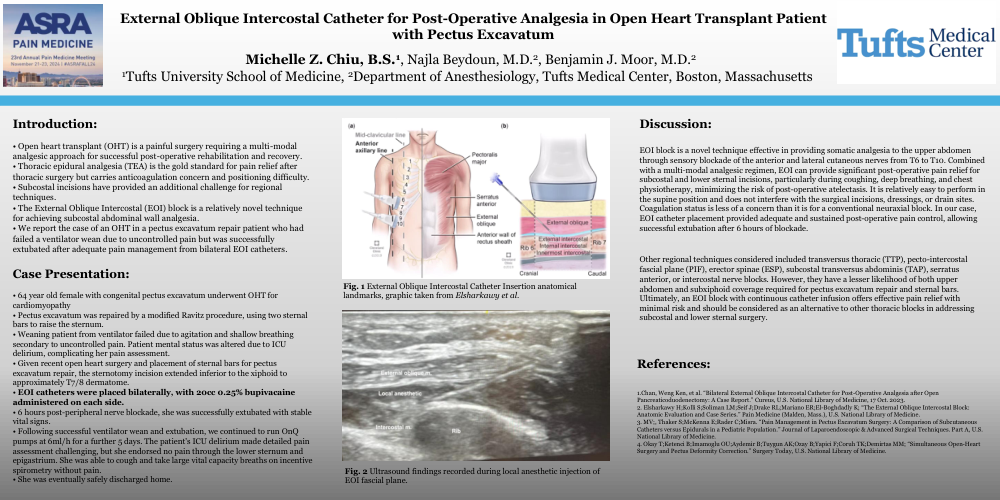
• The External Oblique Intercostal (EOI) block is a relatively novel technique for achieving subcostal abdominal wall analgesia.
• We report the case of an OHT in a pectus excavatum repair patient who had failed a ventilator wean due to uncontrolled pain but was successfully extubated after adequate pain management from bilateral EOI catheters.
Case Presentation:
• 64 year old female with congenital pectus excavatum underwent OHT for cardiomyopathy
• Pectus excavatum was repaired by a modified Ravitz procedure, using two sternal bars to raise the sternum.
• Weaning patient from ventilator failed due to agitation and shallow breathing secondary to uncontrolled pain. Patient mental status was altered due to ICU delirium, complicating her pain assessment.
• Given recent open heart surgery and placement of sternal bars for pectus excavatum repair, the sternotomy incision extended inferior to the xiphoid to approximately T7/8 dermatome.
• EOI catheters were placed bilaterally, with 20cc 0.25% bupivacaine administered on each side.
• 6 hours post-peripheral nerve blockade, she was successfully extubated with stable vital signs.
• Following successful ventilator wean and extubation, we continued to run OnQ pumps at 6ml/h for a further 5 days. The patient's ICU delirium made detailed pain assessment challenging, but she endorsed no pain through the lower sternum and epigastrium. She was able to cough and take large vital capacity breaths on incentive spirometry without pain.
• She was eventually safely discharged home.
Discussion:
EOI block is a novel technique effective in providing somatic analgesia to the upper abdomen through sensory blockade of the anterior and lateral cutaneous nerves from T6 to T10. Combined with a multi-modal analgesic regimen, EOI can provide significant post-operative pain relief for subcostal and lower sternal incisions, particularly during coughing, deep breathing, and chest physiotherapy, minimizing the risk of post-operative atelectasis. It is relatively easy to perform in the supine position and does not interfere with the surgical incisions, dressings, or drain sites. Coagulation status is less of a concern than it is for a conventional neuraxial block. In our case, EOI catheter placement provided adequate and sustained post-operative pain control, allowing successful extubation after 6 hours of blockade.
Other regional techniques considered included transversus thoracic (TTP), pecto-intercostal fascial plane (PIF), erector spinae (ESP), subcostal transversus abdominis (TAP), serratus anterior, or intercostal nerve blocks. However, they have a lesser likelihood of both upper abdomen and subxiphoid coverage required for pectus excavatum repair and sternal bars. Ultimately, an EOI block with continuous catheter infusion offers effective pain relief with minimal risk and should be considered as an alternative to other thoracic blocks in addressing subcostal and lower sternal surgery.