501 posters, 2 videos, 1 audios, 8 topics, 37 sessions, 395 authors, 307 institutions
ePostersLive by SciGen Technologies S.A. All rights reserved.
23rd Annual Pain Medicine Meeting 2024
November 21-23, 2024 | Caesars Palace, Las Vegas, Nevada

5737
DELAYED ONSET SPINAL ANESTHESIA IN AN OBSTETRIC PATIENT
Poster Presenter
Authors
Affiliations
Part of Topic
Scientific Abstracts > Regional Anesthesia
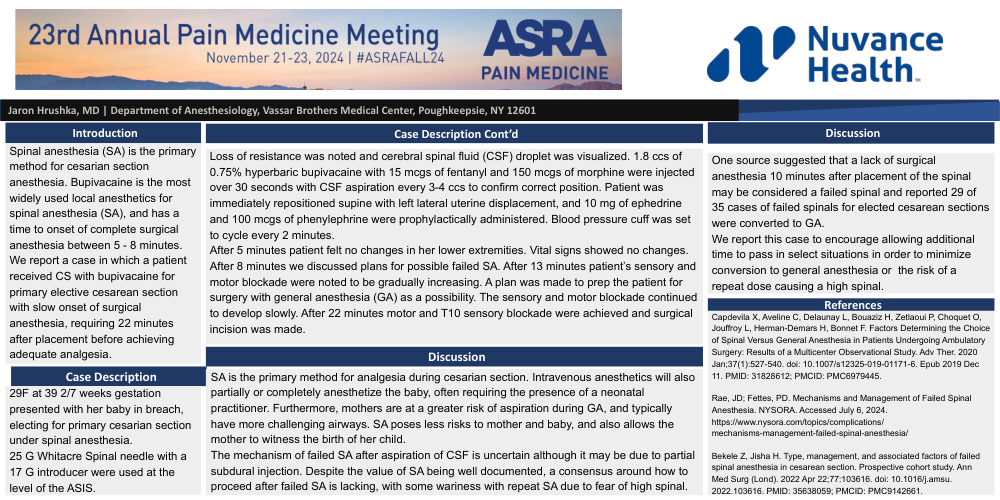
Spinal anesthesia (SA) is the primary method for cesarian section anesthesia. Bupivacaine is the most widely used local anesthetics for spinal anesthesia (SA), and has a time to onset of complete surgical anesthesia between 5 - 8 minutes. We report a case in which a patient received CS with bupivacaine for primary elective cesarean section with slow onset of surgical anesthesia, requiring 22 minutes after placement before achieving adequate analgesia.
SA is the primary method for analgesia during cesarian section. Intravenous anesthetics will also partially or completely anesthetize the baby, often requiring the presence of a neonatal practitioner. Furthermore, mothers are at a greater risk of aspiration during GA, and typically have more challenging airways. SA poses less risks to mother and baby, and also allows the mother to witness the birth of her child.
The mechanism of failed SA after aspiration of CSF is uncertain although it may be due to partial subdural injection. Despite the value of SA being well documented, a consensus around how to proceed after failed SA is lacking, with some wariness with repeat SA due to fear of high spinal. One source suggested that a lack of surgical anesthesia 10 minutes after placement of the spinal may be considered a failed spinal and reported 29 of 35 cases of failed spinals for elected cesarean sections were converted to GA.
We report this case to encourage allowing additional time to pass before proceeding to GA in select situations.