501 posters, 2 videos, 1 audios, 8 topics, 37 sessions, 395 authors, 307 institutions
ePostersLive by SciGen Technologies S.A. All rights reserved.
23rd Annual Pain Medicine Meeting 2024
November 21-23, 2024 | Caesars Palace, Las Vegas, Nevada

5807
EDUCATING APRNS AND PAS IN PAIN MANAGEMENT - A NEEDS ASSESSMENT
Poster Presenter
Authors
Affiliations
Part of Topic
Scientific Abstracts > Education
AMANDA ZIMMERMAN, PA-C | WEST FORSYTH PAIN MANAGEMENT, CLEMMONS, NC
THERESA MALLICK-SEARLE, NP | STANFORD HEALTH CARE, DIVISION PAIN MEDICINE, REDWOOD CITY, CA, CO-CHAIR APRN/PAS IN PAIN MEDICINE SIG AAPM
HEATHER JACKSON, PHD, APRN, NEA-BC, FAANP | VANDERBILT UNIVERSITY MEDICAL CENTER, NASHVILLE, TN, DIVISION OF HEMATOLOGY/ONCOLOGY, CHAIR NP/PA/RN SIG ASRA
PURPOSE
This survey is the first attempt to
assess pain education for advanced
practice registered nurses (APRNs)
and physician associates (PAs) as
reported by novice and experienced
clinicians and present the opportunity
to enhance pain management training
for future clinicians.
BACKGROUND
Current evidence suggests a gap
in pain management education for
physicians.1-6 The Institute of
Medicine7 and the National Pain
Strategy8 have called for better
training for all health care clinicians.
There is a lack of information
known about the education in pain
management care provided in
primary APRN and PA training, and
how prepared these clinicians are
to provide basic pain management
after graduation.9-10
METHODS
A Descriptive Survey Design was employed; ten survey
questions were formulated and disseminated among
APRNs/PAs nationwide.
A brief (10 question) survey was administered online to
APRNs and PAs nationwide using various databases to
ensure diversity.
RESULTS
Of the 470 respondents, 276 (58%) were APRNs and 194
(41%) were PAs, representing 47 states, D.C., Canada, and the
Netherlands, with 57% practicing for 5+ years.
248 respondents (53%) report they spend at least 50%
clinical time managing pain. Of those, 165 work in a pain
management or palliative care specialty. The remainder work
in other specialties, with the majority working in family/
internal medicine.
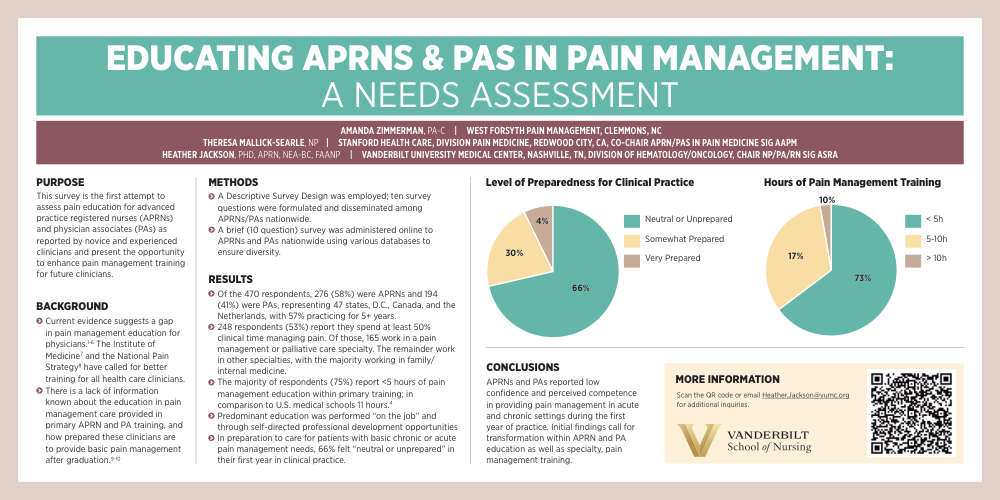
The majority of respondents (75%) report <5 hours of pain
management education within primary training; in
comparison to U.S. medical schools 11 hours.4
Predominant education was performed “on the job” and
through self-directed professional development opportunities
In preparation to care for patients with basic chronic or acute
pain management needs, 66% felt “neutral or unprepared” in
their first year in clinical practice.
APRNs and PAs reported low
confidence and perceived competence
in providing pain management in acute
and chronic settings during the first
year of practice. Initial findings call for
transformation within APRN and PA
education as well as specialty, pain
management training.