Loading...

501 posters, 2 videos, 1 audios, 8 topics, 37 sessions, 395 authors, 307 institutions

ePostersLive by SciGen Technologies S.A. All rights reserved.

23rd Annual Pain Medicine Meeting 2024

November 21-23, 2024 | Caesars Palace, Las Vegas, Nevada

23rd Annual Pain Medicine Meeting 2024 banner

5679

ENHANCING SPINAL CORD STIMULATOR PLACEMENT CONFIDENCE THROUGH SIMULATION TRAINING
Poster Presenter

Shan Ali

Authors

Shan Ali

Affiliations

Mayo Clinic

Part of Topic

Scientific Abstracts > Education

Introduction:

•Cadavers have a high cost, potential inaccuracies in tactile feedback and limited durability.
•Ionizing radiation used in live fluoroscopy can damage DNA. fellows typically receive about 31% higher radiation doses than a fully trained physician. [1]
•46% of pain fellows in the US felt a lack of sufficient case volume for effective training in spinal cord stimulator (SCS) procedures as of 2017. [2]
•3D SCS simulator training systems offer unlimited practice, no radiation exposure, and immediate feedback, potentially addressing the gap in procedural training.
 
Objective:

This pilot study aimed to examine the effectiveness of a spinal cord stimulator (SCS) simulator training system in improving the confidence of pain fellows in SCS placement.

Methods:

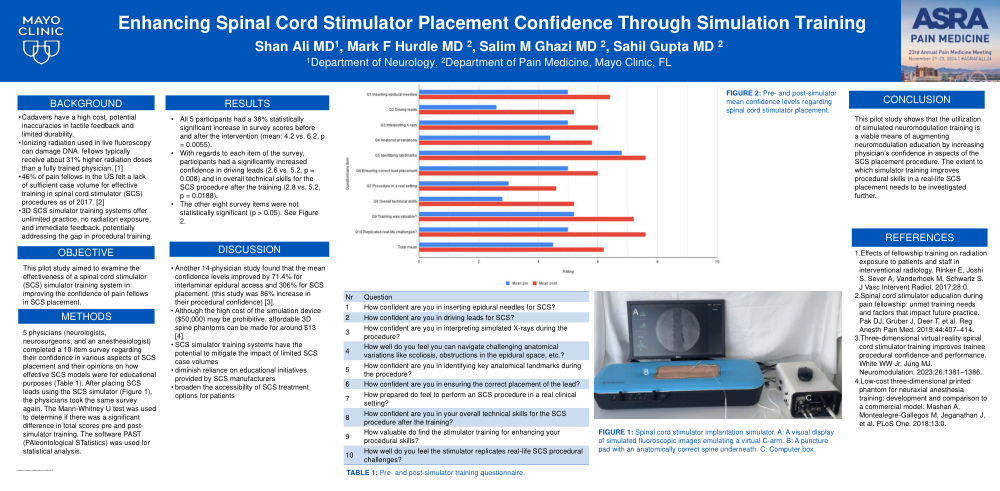
5 physicians (neurologists, neurosurgeons, and an anesthesiologist) completed a 10-item survey regarding their confidence in various aspects of SCS placement and their opinions on how effective SCS models were for educational purposes (Table 1). After placing SCS leads using the SCS simulator (Figure 1), the physicians took the same survey again. The Mann-Whitney U test was used to determine if there was a significant difference in total scores pre and post-simulator training. The software PAST (PAleontological STatistics) was used for statistical analysis.

Results:

•All 5 participants had a 38% statistically significant increase in survey scores before and after the intervention (mean: 4.2 vs. 6.2, p = 0.0055).
•With regards to each item of the survey, participants had a significantly increased confidence in driving leads (2.6 vs. 5.2, p = 0.008) and in overall technical skills for the SCS procedure after the training (2.8 vs. 5.2, p = 0.0188).
•The other eight survey items were not statistically significant (p > 0.05). See Figure 2.
 
Discussion:
•Another 14-physician study found that the mean confidence levels improved by 71.4% for interlaminar epidural access and 306% for SCS placement. (this study was 86% increase in their procedural confidence) [3].
•Although the high cost of the simulation device ($50,000) may be prohibitive, affordable 3D spine phantoms can be made for around $13 [4].
•SCS simulator training systems have the potential to mitigate the impact of limited SCS case volumes
•diminish reliance on educational initiatives provided by SCS manufacturers
•broaden the accessibility of SCS treatment options for patients
 
Conclusion:

This pilot study shows that the utilization of simulated neuromodulation training is a viable means of augmenting neuromodulation education by increasing physician’s confidence in aspects of the SCS placement procedure. The extent to which simulator training improves procedural skills in a real-life SCS placement needs to be investigated further.

23rd Annual Pain Medicine Meeting 2024 » banner
Copyright © 2015-2026, ePostersLive® SciGen is a registered trademark of SciGen Technologies S.A. Patent pending.

This website and third-party tools we use rely on cookies for the best user experience. By selecting "I agree", you agree to cookie usage as described in our Privacy Policy.