501 posters, 2 videos, 1 audios, 8 topics, 37 sessions, 395 authors, 307 institutions
ePostersLive by SciGen Technologies S.A. All rights reserved.
23rd Annual Pain Medicine Meeting 2024
November 21-23, 2024 | Caesars Palace, Las Vegas, Nevada

6279
RISK OF ANGIOGENESIS AND VASCULAR UPTAKE AMONG CERVICAL EPIDURAL STEROID INJECTION: A CASE REPORT
Poster Presenter
Authors
Affiliations
Part of Topic
Scientific Abstracts > Chronic Pain
Background:
Cervical epidural steroid injection (CESI) are a relatively safe treatment option in management of cervical pain. Noted adverse events following the procedure are usually minor, self-limited; however, significant adverse events such as neurovascular
Complications, space-occupying lesion and endocrinologic effects can occur [Schneider & Maybin, 2018]. In rare instances, repeated corticosteroid exposure in select patient populations may increase the risk of pronounced neuro-vascular complications.
Case Report:
Patient in their 80s with a past medical history notable for breast cancer s/p surgery/radiation therapy, left thyroid follicular adenoma s/p hemithyroidectomy, chronic neck pain s/p C2-C5 anterior spinal fusion, 10-year course of multiple cervical and lumbosacral interventions involving corticosteroid exposure for pain management presented with exacerbation of chronic cervical pain. Symptoms worsened with heavy object carrying, prolonged sitting, position changes. Denied bowel/bladder dysfunction or saddle anesthesia
Physical Examination: Neuro-physical examination notable for numbness, tingling in bilateral upper extremities extending to digits, unable to specify.
Imaging: MRI cervical spine demonstrated intact surgical instrumentation with post-surgical changes, diffuse facet degenerative changes in C1-C7 and posterior osteophyte-disc complex with uncinate hypertrophy at T1-T2.
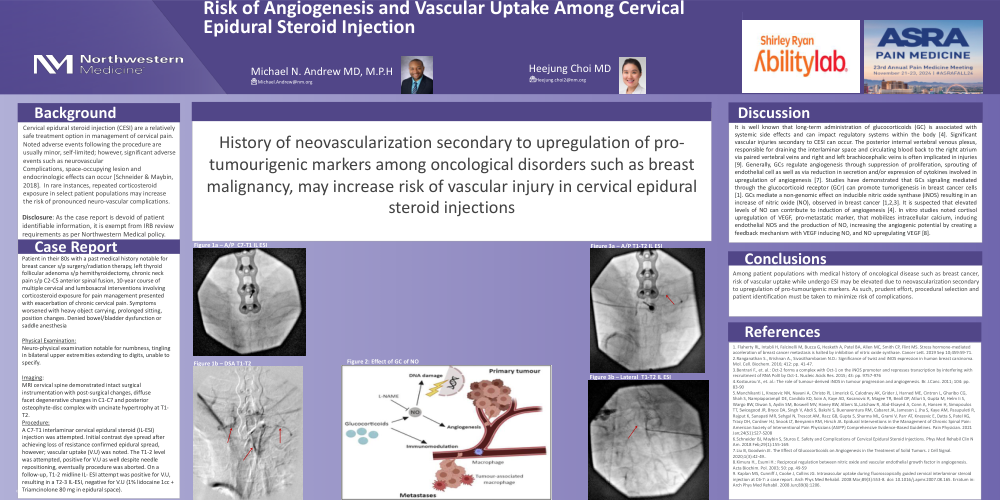
Procedure: A C7-T1 interlaminar cervical epidural steroid (IL-ESI) injection was attempted. Initial contrast dye spread after achieving loss of resistance confirmed epidural spread, however; vascular uptake (V.U) was noted. The T1-2 level was attempted, positive for V.U as well despite needle repositioning, eventually procedure was aborted. On a follow-up, T1-2 midline IL- ESI attempt was positive for V.U, resulting in a T2-3 IL-ESI, negative for V.U (1% lidocaine 1cc + Triamcinolone 80 mg in epidural space).
Discussion:
It is well known that long-term administration of glucocorticoids (GC) is associated with systemic side effects and can impact regulatory systems within the body [4]. Significant vascular injuries secondary to CESI can occur. The posterior internal vertebral venous plexus, responsible for draining the interlaminar space and circulating blood back to the right atrium via paired vertebral veins and right and left brachiocephalic veins is often implicated in injuries [9]. Generally, GCs regulate angiogenesis through suppression of proliferation, sprouting of endothelial cell as well as via reduction in secretion and/or expression of cytokines involved in upregulation of angiogenesis [7]. Studies have demonstrated that GCs signaling mediated through the glucocorticoid receptor (GCr) can promote tumorigenesis in breast cancer cells [1]. GCs mediate a non-genomic effect on inducible nitric oxide synthase (iNOS) resulting in an increase of nitric oxide (NO), observed in breast cancer [1,2,3]. It is suspected that elevated levels of NO can contribute to induction of angiogenesis [4]. In vitro studies noted cortisol upregulation of VEGF, pro-metastatic marker, that mobilizes intracellular calcium, inducing endothelial NOS and the production of NO, increasing the angiogenic potential by creating a feedback mechanism with VEGF inducing NO, and NO upregulating VEGF [8].
Conclusion:
Among patient populations with medical history of oncological disease such as breast cancer, risk of vascular uptake while undergo ESI may be elevated due to neovascularization secondary to upregulation of pro-tumourigenic markers. As such, prudent effort, procedural selection and patient identification must be taken to minimize risk of complications.
References:
1. Flaherty RL, Intabli H, Falcinelli M, Bucca G, Hesketh A, Patel BA, Allen MC, Smith CP, Flint MS. Stress hormone-mediated acceleration of breast cancer metastasis is halted by inhibition of nitric oxide synthase. Cancer Lett. 2019 Sep 10;459:59-71.
2.Ranganathan S., Krishnan A., Sivasithambaram N.D.: Significance of twist and iNOS expression in human breast carcinoma. Mol. Cell. Biochem. 2016; 412: pp. 41-47.
3.Bentrari F., et. al.: Oct-2 forms a complex with Oct-1 on the iNOS promoter and represses transcription by interfering with recruitment of RNA PolII by Oct-1. Nucleic Acids Res. 2015; 43: pp. 9757-976
4.Kostourou V., et. al.: The role of tumour-derived iNOS in tumour progression and angiogenesis. Br. J.Canc. 2011; 104: pp. 83-90
5.Manchikanti L, Knezevic NN, Navani A, Christo PJ, Limerick G, Calodney AK, Grider J, Harned ME, Cintron L, Gharibo CG, Shah S, Nampiaparampil DE, Candido KD, Soin A, Kaye AD, Kosanovic R, Magee TR, Beall DP, Atluri S, Gupta M, Helm Ii S, Wargo BW, Diwan S, Aydin SM, Boswell MV, Haney BW, Albers SL,Latchaw R, Abd-Elsayed A, Conn A, Hansen H, Simopoulos TT, Swicegood JR, Bryce DA, Singh V, Abdi S, Bakshi S, Buenaventura RM, Cabaret JA, Jameson J, Jha S, Kaye AM, Pasupuleti R, Rajput K, Sanapati MR, Sehgal N, Trescot AM, Racz GB, Gupta S, Sharma ML, Grami V, Parr AT, Knezevic E, Datta S, Patel KG, Tracy DH, Cordner HJ, Snook LT, Benyamin RM, Hirsch JA. Epidural Interventions in the Management of Chronic Spinal Pain: American Society of Interventional Pain Physicians (ASIPP) Comprehensive Evidence-Based Guidelines. Pain Physician. 2021 Jan;24(S1):S27-S208
6.Schneider BJ, Maybin S, Sturos E. Safety and Complications of Cervical Epidural Steroid Injections. Phys Med Rehabil Clin N Am. 2018 Feb;29(1):155-169.
7.Liu B, Goodwin JE. The Effect of Glucocorticoids on Angiogenesis in the Treatment of Solid Tumors. J Cell Signal. 2020;1(3):42-49..
8.Kimura H., Esumi H.: Reciprocal regulation between nitric oxide and vascular endothelial growth factor in angiogenesis. Acta Biochim. Pol. 2003; 50: pp. 49-59
9. Kaplan MS, Cunniff J, Cooke J, Collins JG. Intravascular uptake during fluoroscopically guided cervical interlaminar steroid injection at C6-7: a case report. Arch Phys Med Rehabil. 2008 Mar;89(3):553-8. doi: 10.1016/j.apmr.2007.08.165. Erratum in: Arch Phys Med Rehabil. 2008 Jun;89(6):1206.