501 posters, 2 videos, 1 audios, 8 topics, 37 sessions, 395 authors, 307 institutions
ePostersLive by SciGen Technologies S.A. All rights reserved.
23rd Annual Pain Medicine Meeting 2024
November 21-23, 2024 | Caesars Palace, Las Vegas, Nevada

6186
60-DAY PERCUTANEOUS PNS VS. STANDARD INTERVENTIONAL MANAGEMENT FOR CHRONIC LBP: RESET CLINICAL TRIAL PRIMARY ENDPOINT RESULTS
Poster Presenter
Authors
Affiliations
Part of Topic
Scientific Abstracts > Chronic Pain
Title: 60-Day Percutaneous PNS vs. Standard Interventional Management for Chronic LBP: RESET Clinical Trial Primary Endpoint Results
Authors: Zachary L. McCormick, MD1, Denise D. Lester, MD, FASAM2, Michael J. DePalma, MD3, Chris A. Gilmore, MD4, Sean Li, MD5, Jessica B. Jameson, MD, FASA6, Mehul J. Desai, MD, MPH7, Tristan E. Weaver, MD8, Shivanand P. Lad, MD, PhD9, Scott J. Davidoff, MD10, Drew M. Trainor, DO, MS11, Kasra Amirdelfan, MD12, Mitchell P. Engle, MD, PhD13, Timothy R. Deer, MD14, Thomas S. Lee, MD15, Francesco Vetri, MD, PhD16, Meenakshi Bindal, MD2, Melissa A. Tornero-Bold, MD8, Morad N. Nasseri, MD12, Steven P. Cohen, MD17, William H. Clark, PhD18, Meredith J. McGee, PhD18, Joseph W. Boggs, PhD18
Affiliations:
- University of Utah, Salt Lake City, UT
- Central Virginia VA Health System, Richmond, VA
- Virginia iSpine Physicians, Richmond, VA
- Center for Clinical Research, Winston Salem, NC
- Premier Pain Centers, Shrewsbury, NJ
- Axis Spine Center, Coeur d’Alene, ID
- International Spine, Pain & Performance Center, Washington, DC
- Ohio State University, Columbus, OH
- Duke University, Durham, NC
- Main Line Spine, King of Prussia, PA
- Denver Spine & Pain Institute, Greenwood Village, CO
- Boomerang Healthcare (formerly IPM Medical Group), Walnut Creek, CA
- Institute of Precision Pain Medicine, Corpus Christi, TX
- The Spine and Nerve Center, Charleston, WV
- LifeBridge Health, Baltimore, MD
- Millennium Pain Center, Bloomington, IL
- Northwestern University, Chicago, IL
- SPR Therapeutics, Cleveland, OH
Background: Treatments for chronic low back pain (CLBP) have varying levels of effectiveness, invasiveness, costs, and rates of complications [1,2] and include radiofrequency ablation (RFA), therapeutic injections, comprehensive care (e.g., physical therapy), neurostimulation (e.g., PNS, SCS), and surgical procedures. 60-day Percutaneous Peripheral Nerve Stimulation (PNS) is increasingly recognized as an effective treatment modality for a variety of pain conditions, following multiple prior successful studies [3,4]. This large, Level 1 randomized controlled trial (RCT) compares the effectiveness of 60-Day Percutaneous PNS to Standard Interventional Management for CLBP.
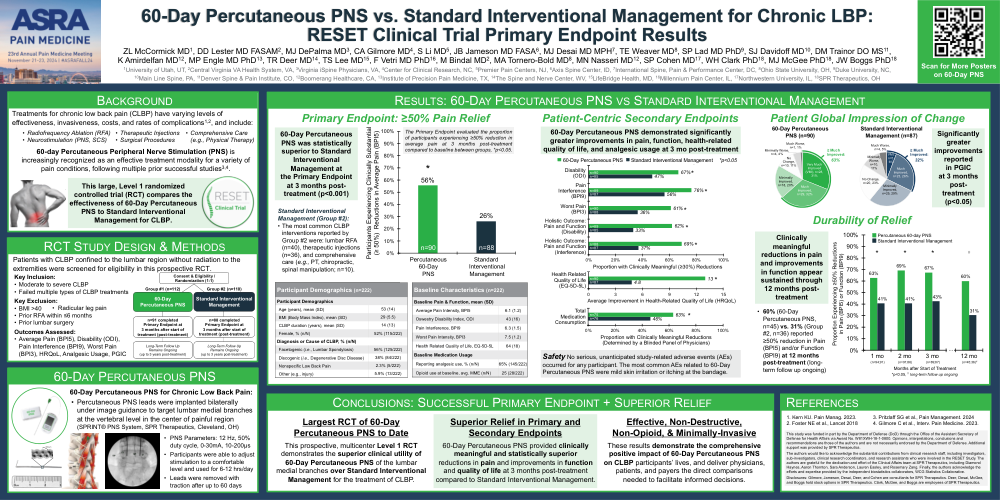
RCT Study Design & Methods: Patients with CLBP confined to the lumbar region without radiation to the extremities were screened for eligibility in this prospective RCT. Key inclusion include moderate to severe CLBP and failure of multiple types of CLBP treatments. Key exclusion include BMI >40, radicular leg pain, prior RFA £6 months, and prior lumbar surgery. Group #1 (n=112) received 60-Day Percutaneous PNS and Group #2 (n=110) received Standard Interventional Management. Primary endpoint was at 3 months after treatment (post-treatment).
60-Day Percutaneous PNS for Chronic Low Back Pain: Percutaneous PNS leads were implanted bilaterally under image guidance to target lumbar medial branches at the vertebral level in the center of painful region (SPRINT® PNS System, SPR Therapeutics, Cleveland, OH). PNS Parameters: 12 Hz, 50% duty cycle, 0-30mA, 10-200µs. Participants were able to adjust stimulation to a comfortable level and used for 6-12 hrs/day. Leads were removed with traction after up to 60 days.
Standard Interventional Management (Group #2): The most common CLBP interventions reported by Group #2 were: lumbar RFA (n=40), therapeutic injections (n=36), and comprehensive care (e.g., PT, chiropractic, spinal manipulation; n=10).
Results: 60-Day Percutaneous PNS was statistically superior to Standard Interventional Management at the Primary Endpoint at 3 months post- treatment (p<0.001). The Primary Endpoint evaluated the proportion of participants experiencing greater than or equal to 50% reduction in average pain at 3 months post-treatment compared to baseline between groups. 60-Day Percutaneous PNS demonstrated significantly greater improvements in pain, function, health-related quality of life, and analgesic usage at 3 months post-treatment. Group #1 reported significantly greater improvements in PGIC at 3 months post-treatment (p<0.05). Group #1 demonstrated clinically meaningful reductions in pain and improvements in function appear sustained through 12 months post-treatment. 60% (60-Day Percutaneous PNS, n=45) vs. 31% (Group #2, n=36) reported ≥50% reduction in Pain (BPI5) and/or Function (BPI9) at 12 months post-treatment (long-term follow up ongoing).
Safety: No serious, unanticipated study-related adverse events (AEs) occurred for any participant. The most common AEs related to 60-Day Percutaneous PNS were mild skin irritation or itching at the bandage.
Conclusions:
Largest RCT of 60-Day Percutaneous PNS to Date: This prospective, multicenter Level 1 RCT demonstrates the superior clinical utility of 60-Day Percutaneous PNS of the lumbar medial branches over Standard Interventional Management for the treatment of CLBP.
Superior Relief in Primary and Secondary Endpoints: 60-Day Percutaneous PNS provided clinically meaningful and statistically superior reductions in pain and improvements in function and quality of life at 3 months post-treatment compared to Standard Interventional Management.
Effective, Non-Destructive, Non-Opioid, & Minimally-Invasive: These results demonstrate the comprehensive positive impact of 60-Day Percutaneous PNS on CLBP participants’ lives, and deliver physicians, patients, and payers the direct comparisons needed to facilitate informed decisions.
1. Kern KU. Pain Manag. 2023.
2. Foster NE et al., Lancet 2018
3. Pritzlaff SG et al., Pain Management. 2024
4. Gilmore C et al., Interv. Pain Medicine. 2023.
This study was funded in part by the Department of Defense (DoD) through the Office of the Assistant Secretary of Defense for Health Affairs via Award No. W81XWH-18-1-0800. Opinions, interpretations, conclusions and recommendations are those of the authors and are not necessarily endorsed by the Department of Defense. Additional support was provided by SPR Therapeutics. The authors would like to acknowledge the substantial contributions from clinical research staff, including investigators, sub-investigators, clinical research coordinators, and research assistants who were involved in the RESET Study. The authors are grateful for the dedication and effort of the Clinical Affairs team at SPR Therapeutics, including Diamond Haynes, Aaron Thornton, Sara Anderson, Lauren Easley, and Rosemary Zang. Finally, the authors acknowledge the efforts and expertise provided by the independent biostatistics collaborators, WCG Statistics Collaborative. Disclosures: Gilmore, Jameson, Desai, Deer, and Cohen are consultants for SPR Therapeutics. Deer, Desai, McGee, and Boggs hold stock options in SPR Therapeutics. Clark, McGee, and Boggs are employees of SPR Therapeutics.