501 posters, 2 videos, 1 audios, 8 topics, 37 sessions, 395 authors, 307 institutions
ePostersLive by SciGen Technologies S.A. All rights reserved.
23rd Annual Pain Medicine Meeting 2024
November 21-23, 2024 | Caesars Palace, Las Vegas, Nevada

5988
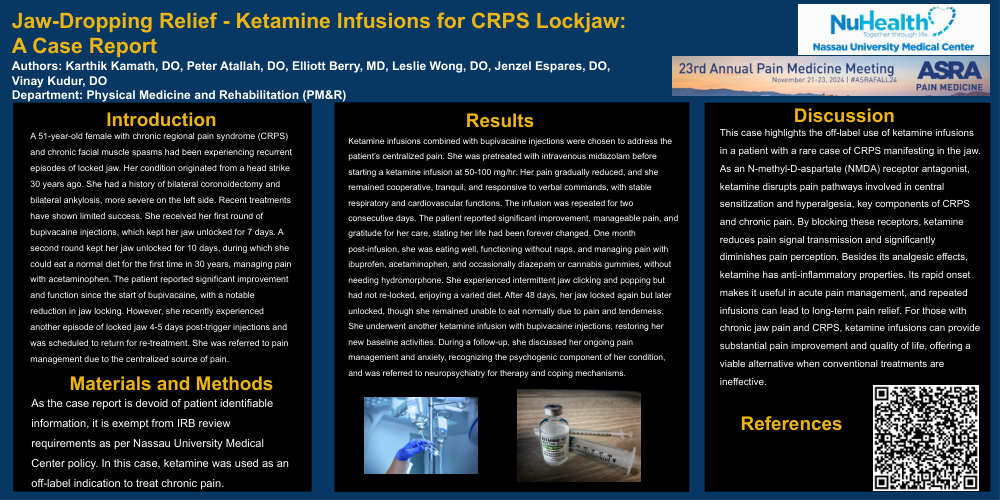
JAW-DROPPING RELIEF - KETAMINE INFUSIONS FOR CRPS LOCKJAW: A CASE REPORT
Poster Presenter
Part of Topic
Scientific Abstracts > Chronic Pain
Jaw-Dropping Relief - Ketamine Infusions for CRPS Lockjaw: A Case Report
Karthik Kamath, Peter Atallah, Elliott Berry, Leslie Wong, Jenzel Espares, Vinay Kudur Nassau University Medical Center
Introduction
A 51-year-old female with chronic regional pain syndrome and chronic facial muscle spasms had been experiencing recurrent episodes of locked jaw, typically following trigger injections. Her condition had originated from a head strike 30 years ago. She had a history of bilateral coronoidectomy and bilateral ankylosis, more severe on the left side. Recent treatments have shown limited success. She had received her first round of bupivacaine injections, which kept her jaw unlocked for 7 days. A second round resulted in her jaw staying unlocked for 10 days, during which she was able to eat a normal diet for the first time in 30 years, managing pain with Tylenol. The patient had reported significant improvement and function since the use of bupivacaine, with a notable reduction in jaw locking. However, she had recently experienced another episode of locked jaw 4-5 days post-trigger injections and was scheduled to return for re-treatment. The patient was referred to pain management due to the centralized source of pain.
Materials and Methods
As the case report is devoid of patient identifiable information, it is exempt from IRB review requirements as per Nassau University Medical Center policy. In this case, ketamine was used for the off-label indication to treat chronic pain.
Results/Case Report
Ketamine infusions in combination with bupivacaine injections were selected to address the patient’s centralized pain. The patient was pretreated with IV Midazolam before starting a Ketamine infusion at a target rate of 50-100mg/hr. The patient’s pain gradually reduced and the desired effects were achieved as the patient remained cooperative, tranquil, and responsive to verbal commands, with respiratory function being unaffected, and cardiovascular function staying within 20% of baseline. The infusion was repeated another two consecutive days. The patient reported significant improvement, minimal and manageable pain, and gratitude for her care, stating her life had been forever changed. One month post-Ketamine infusion therapy, she was eating well, functioning without naps, and managing pain with Advil, Tylenol, and occasionally extra Valium or cannabis gummies, without needing Dilaudid. She experienced intermittent jaw clicking and popping but had not re-locked, enjoying a varied diet including foods she hadn't eaten in decades. After 48 days, the patient reported her jaw had locked again but later unlocked, although she remained unable to eat normally due to pain and tenderness. Patient underwent another ketamine infusion with bupivacaine injections, restoring her new baseline activities of daily living. During a follow-up, she discussed her ongoing pain
management and anxiety, recognizing the psychogenic component of her condition and was referred to neuropsychiatry for therapy and coping mechanisms.
Discussion
This case highlights the use of ketamine infusions in a patient with a rare case of CRPS manifesting in the jaw. As an NMDA receptor antagonist, ketamine disrupts the pain pathways involved in central sensitization and hyperalgesia, which are key components of CRPS and chronic pain conditions. By blocking these receptors, ketamine reduces the transmission of pain signals and can significantly diminish the perception of pain. In addition to its analgesic effects, ketamine has anti-inflammatory properties. Its rapid onset of action makes it particularly useful in acute pain management, and repeated infusions can lead to long-term pain relief for chronic pain patients. For those suffering from chronic jaw pain and CRPS, ketamine infusions can provide substantial improvement in pain levels and overall quality of life, offering a viable alternative when conventional treatments are ineffective.
References
Busse JW, Casassus R, Carrasco-Labra A, et al. Management of chronic pain associated with temporomandibular disorders: a clinical practice guideline. BMJ 2023;383. https://doi.org/10.1136/bmj- 2023-076227.
Chitneni A, Patil A, Dalal S, et al. Use of ketamine infusions for treatment of complex regional pain syndrome: a systematic review. Cureus 2021;13. https://doi.org/10.7759/cureus.18910.
Claudino R, Nones C, Araya E, et al. Analgesic effects of intranasal ketamine in rat models of facial pain. J Oral Facial Pain Headache 2018;32(3).
Kirkpatrick AF, Saghafi A, Yang K, et al. Optimizing the treatment of CRPS with ketamine. Clin J Pain 2020;36:516-23. https://doi.org/10.1097/AJP.0000000000000831
Melis M, Zawawi K, Al-Badawi E, et al. Complex regional pain syndrome in the head and neck: a review of the literature. J Orofac Pain 2002;16(2):93-104.