501 posters, 2 videos, 1 audios, 8 topics, 37 sessions, 395 authors, 307 institutions
ePostersLive by SciGen Technologies S.A. All rights reserved.
23rd Annual Pain Medicine Meeting 2024
November 21-23, 2024 | Caesars Palace, Las Vegas, Nevada

6076
FOUR-YEAR FOLLOW-UP FROM A PROSPECTIVE, MULTICENTER STUDY OF 60-DAY MEDIAL BRANCH NERVE STIMULATION FOR CHRONIC AXIAL BACK PAIN
Poster Presenter
Authors
Affiliations
Part of Topic
Scientific Abstracts > Chronic Pain
Four-Year Follow-Up from a Prospective, Multicenter Study of 60-day Medial Branch Nerve Stimulation for the Treatment of Chronic Axial Back Pain
Christopher A. Gilmore, MD,1 Timothy R. Deer, MD,2 Mehul J. Desai, MD, MPH,3 Sean Li, MD,4 Michael J. DePalma, MD,5 Brandon D. Swan,6 Meredith J. McGee, PhD,6 Joseph W. Boggs, PhD6
1Center for Clinical Research, 2The Spine and Nerve Center of The Virginias, 3International Spine, Pain & Performance Center, 4Premier Pain Centers, 5Virginia iSpine Physicians, 6SPR Therapeutics, Inc.
INTRODUCTION
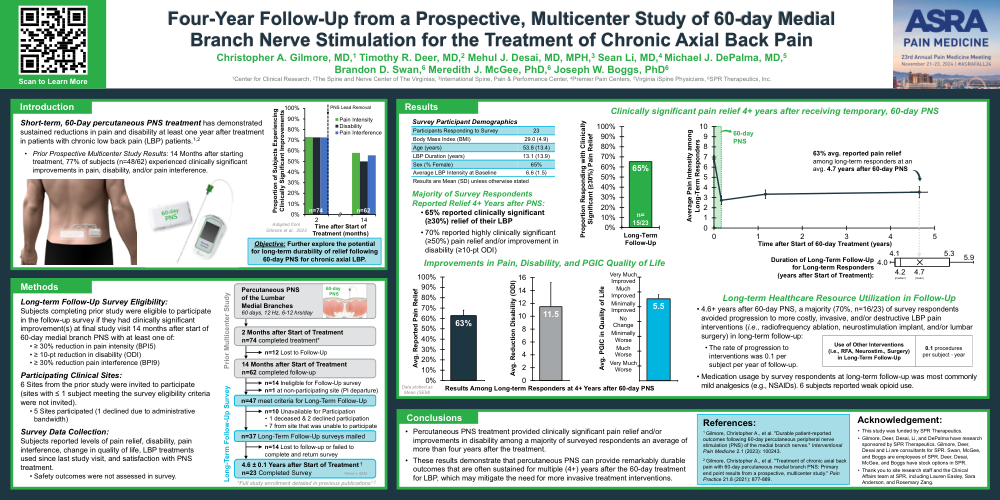
Short-term, 60-Day percutaneous PNS treatment has demonstrated sustained reductions in pain and disability at least one year after treatment in patients with chronic low back pain (LBP) patients.1,2
Prior Prospective Multicenter Study Results: 14 Months after starting treatment, 77% of subjects (n=48/62) experienced clinically significant improvements in pain, disability, and/or pain interference.
Objective: Further explore the potential for long-term durability of relief following 60-day PNS for chronic axial LBP.
METHODS
Long-term Follow-Up Survey Eligibility: Subjects completing prior study were eligible to participate in the follow-up survey if they had clinically significant improvement(s) at final study visit 14 months after start of 60-day medial branch PNS with at least one of:
•≥ 30% reduction in pain intensity (BPI5)
•≥ 10-pt reduction in disability (ODI)
•≥ 30% reduction pain interference (BPI9)
Participating Clinical Sites: 6 Sites from the prior study were invited to participate (sites with ≤ 1 subject meeting the survey eligibility criteria were not invited).
•5 Sites participated (1 declined due to administrative bandwidth)
Survey Data Collection: Subjects reported levels of pain relief, disability, pain interference, change in quality of life, LBP treatments used since last study visit, and satisfaction with PNS treatment.
•Safety outcomes were not assessed in survey.
RESULTS
Majority of Survey Respondents Reported Relief 4+ Years after PNS:
•65% reported clinically significant (≥30%) relief of their LBP
•70% reported highly clinically significant (≥50%) pain relief and/or improvement in disability (≥10-pt ODI)
63% avg. reported pain relief among long-term responders at an avg. 4.7 years after 60-day PNS
4.6+ years after 60-day PNS, a majority (70%, n=16/23) of survey respondents avoided progression to more costly, invasive, and/or destructive LBP pain interventions (i.e., radiofrequency ablation, neurostimulation implant, and/or lumbar surgery) in long-term follow-up:
•The rate of progression to interventions was 0.1 per subject per year of follow-up.
Medication usage by survey respondents at long-term follow-up was most commonly mild analgesics (e.g., NSAIDs). 6 subjects reported weak opioid use.
CONCLUSIONS
Percutaneous PNS treatment provided clinically significant pain relief and/or improvements in disability among a majority of surveyed respondents an average of more than four years after the treatment.
These results demonstrate that percutaneous PNS can provide remarkably durable outcomes that are often sustained for multiple (4+) years after the 60-day treatment for LBP, which may mitigate the need for more invasive treatment interventions.
REFERENCES
1Gilmore, Christopher A., et al. "Durable patient-reported outcomes following 60-day percutaneous peripheral nerve stimulation (PNS) of the medial branch nerves." Interventional Pain Medicine 2.1 (2023): 100243.
2Gilmore, Christopher A., et al. "Treatment of chronic axial back pain with 60‐day percutaneous medial branch PNS: Primary end point results from a prospective, multicenter study." Pain Practice 21.8 (2021): 877-889.
ACKNOWLEDGEMENT
This study was funded by SPR Therapeutics.
Gilmore, Deer, Desai, Li, and DePalma have research sponsored by SPR Therapeutics. Gilmore, Deer, Desai and Li are consultants for SPR. Swan, McGee, and Boggs are employees of SPR. Deer, Desai, McGee, and Boggs have stock options in SPR.
Thank you to site research staff and the Clinical Affairs team at SPR, including Lauren Easley, Sara Anderson, and Rosemary Zang.