501 posters, 2 videos, 1 audios, 8 topics, 37 sessions, 395 authors, 307 institutions
ePostersLive by SciGen Technologies S.A. All rights reserved.
23rd Annual Pain Medicine Meeting 2024
November 21-23, 2024 | Caesars Palace, Las Vegas, Nevada

6322
OSSIFICATION OF THE POSTERIOR LONGITUDINAL LIGAMENT: A MYELOPATHIC CHALLENGE MANAGED CONSERVATIVELY
Poster Presenter
Authors
Affiliations
Part of Topic
Scientific Abstracts > Acute Pain
Ossification of the Posterior Longitudinal Ligament: A Myelopathic Challenge Managed Conservatively
___________________________________
Peter Atallah, DO; Michael Atallah, BS; Jenzel Espares, DO; Karthik Kamath, DO; Elliott Berry, MD; Leslie Wong, DO; Thomas Pobre, MD
Department of Physical Medicine and Rehabilitation
Nassau University Medical Center, East Meadow, New York
Introduction:
A 73-year-old male presented to the emergency department with three days of left-sided upper and lower extremity weakness and gait instability.
Case Presentation:
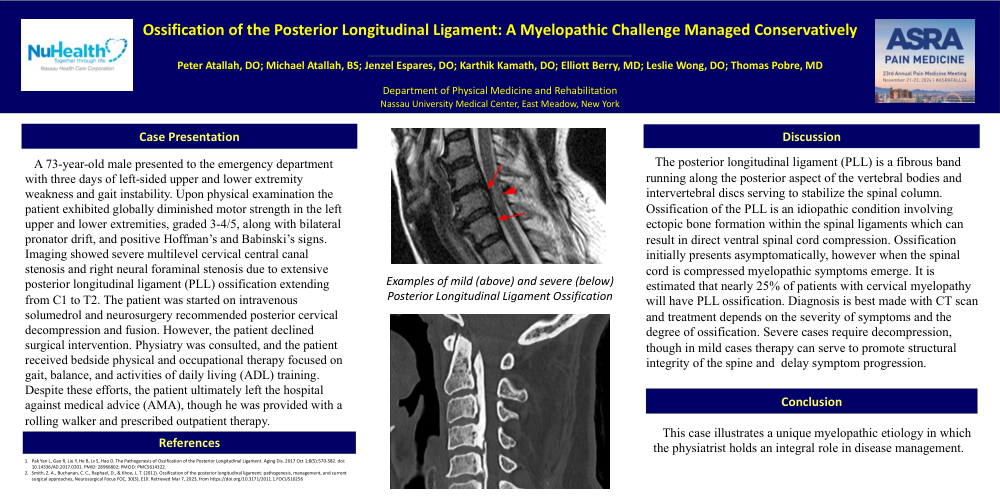
Upon physical examination the patient exhibited globally diminished motor strength in the left upper and lower extremities, graded 3-4/5, along with bilateral pronator drift, and positive Hoffman’s and Babinski’s signs. Imaging showed severe multilevel cervical central canal stenosis and right neural foraminal stenosis due to extensive posterior longitudinal ligament (PLL) ossification extending from C1 to T2. The patient was started on intravenous solumedrol and neurosurgery recommended posterior cervical decompression and fusion. However, the patient declined surgical intervention. Physiatry was consulted, and the patient received bedside physical and occupational therapy focused on gait, balance, and activities of daily living (ADL) training. Despite these efforts, the patient ultimately left the hospital against medical advice (AMA), though he was provided with a rolling walker and prescribed outpatient therapy.
Discussion:
The posterior longitudinal ligament (PLL) is a fibrous band running along the posterior aspect of the vertebral bodies and intervertebral discs serving to stabilize the spinal column. Ossification of the PLL is an idiopathic condition involving ectopic bone formation within the spinal ligaments which can result in direct ventral spinal cord compression. Ossification initially presents asymptomatically, however when the spinal cord is compressed myelopathic symptoms emerge. It is estimated that nearly 25% of patients with cervical myelopathy will have PLL ossification. Diagnosis is best made with CT scan and treatment depends on the severity of symptoms and the degree of ossification. Severe cases require decompression, though in mild cases therapy can serve to promote structural integrity of the spine and delay symptom progression.
Conclusion:
This case illustrates a unique myelopathic etiology in which the physiatrist holds an integral role in disease management.
References:
-
Pak Yan L, Gao R, Liu Y, He B, Lv S, Hao D. The Pathogenesis of Ossification of the Posterior Longitudinal Ligament. Aging Dis. 2017 Oct 1;8(5):570-582. doi: 10.14336/AD.2017.0201. PMID: 28966802; PMCID: PMC5614322.
-
Smith, Z. A., Buchanan, C. C., Raphael, D., & Khoo, L. T. (2011). Ossification of the posterior longitudinal ligament: pathogenesis, management, and current surgical approaches, Neurosurgical Focus FOC, 30(3), E10. Retrieved Mar 7, 2023, from https://doi.org/10.3171/2011.1.FOCUS10256