501 posters, 2 videos, 1 audios, 8 topics, 37 sessions, 395 authors, 307 institutions
ePostersLive by SciGen Technologies S.A. All rights reserved.
23rd Annual Pain Medicine Meeting 2024
November 21-23, 2024 | Caesars Palace, Las Vegas, Nevada

5723
CAUDAL EPIDURAL BLOOD PATCH IN A SURGERY-NAIVE POSTPARTUM PATIENT WITH POST-DURAL PUNCTURE HEADACHE: A CASE REPORT
Poster Presenter
Authors
Affiliations
Part of Topic
Scientific Abstracts > Regional Anesthesia
Caudal Epidural Blood Patch in a Surgery-Naïve Postpartum Patient with Post-Dural Puncture Headache: A Case Report
Katherine Chen, D.O. & Kimberly Youngren, M.D.
Department of Anesthesiology, Dartmouth Hitchcock Medical Center
INTRODUCTION
Dural puncture and subsequent post-dural puncture headaches (PDPH) are a known complication after an epidural. Although PDPH may improve and/or resolve without intervention, an epidural blood patch is indicated for patients who fail conservative therapy or are unable to tolerate the time it may take for the dural puncture to heal on its own and are unable to participate in activities of daily living. The caudal approach is often used when there is past lumbar instrumentation. To our knowledge, there are no reported cases of patients without significant past medical or surgical history having several dural punctures after epidural attempts and undergoing a caudal epidural blood patch with resolution of PDPH.
CASE DESCRIPTION
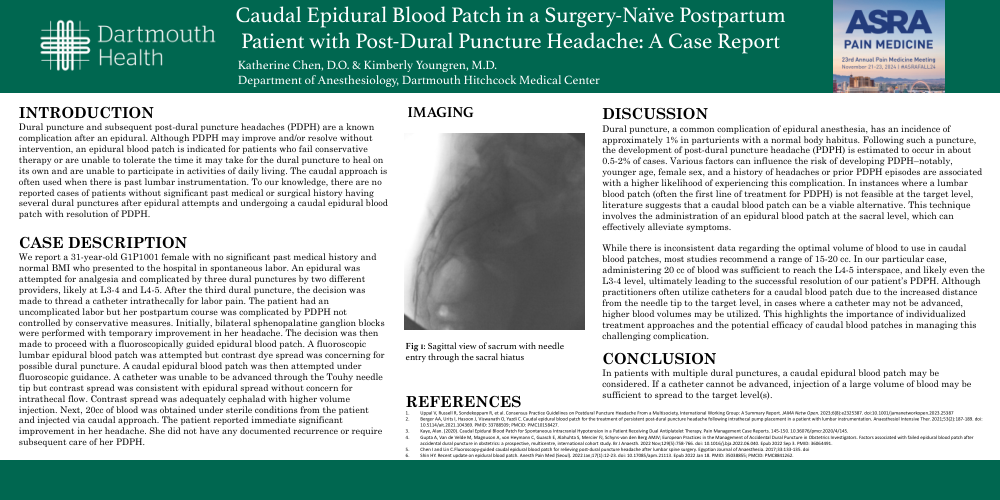
We report a 31-year-old G1P1001 female with no significant past medical history and normal BMI who presented to the hospital in spontaneous labor. An epidural was attempted for analgesia and complicated by three dural punctures by two different providers, likely at L3-4 and L4-5. After the third dural puncture, the decision was made to thread a catheter intrathecally for labor pain. The patient had an uncomplicated labor but her postpartum course was complicated by PDPH not controlled by conservative measures. Initially, bilateral sphenopalatine ganglion blocks were performed with temporary improvement in her headache. The decision was then made to proceed with a fluoroscopically guided epidural blood patch. A fluoroscopic lumbar epidural blood patch was attempted but contrast dye spread was concerning for possible dural puncture. A caudal epidural blood patch was then attempted under fluoroscopic guidance. A catheter was unable to be advanced through the Touhy needle tip but contrast spread was consistent with epidural spread without concern for intrathecal flow. Contrast spread was adequately cephalad with higher volume injection. Next, 20cc of blood was obtained under sterile conditions from the patient and injected via caudal approach. The patient reported immediate significant improvement in her headache. She did not have any documented recurrence or require subsequent care of her PDPH.
DISCUSSION
Dural puncture, a common complication of epidural anesthesia, has an incidence of approximately 1% in parturients with a normal body habitus. Following such a puncture, the development of post-dural puncture headache (PDPH) is estimated to occur in about 0.5-2% of cases. Various factors can influence the risk of developing PDPH–notably, younger age, female sex, and a history of headaches or prior PDPH episodes are associated with a higher likelihood of experiencing this complication. In instances where a lumbar blood patch (often the first line of treatment for PDPH) is not feasible at the target level, literature suggests that a caudal blood patch can be a viable alternative. This technique involves the administration of an epidural blood patch at the sacral level, which can effectively alleviate symptoms.
While there is inconsistent data regarding the optimal volume of blood to use in caudal blood patches, most studies recommend a range of 15-20 cc. In our particular case, administering 20 cc of blood was sufficient to reach the L4-5 interspace, and likely even the L3-4 level, ultimately leading to the successful resolution of our patient’s PDPH. Although practitioners often utilize catheters for a caudal blood patch due to the increased distance from the needle tip to the target level, in cases where a catheter may not be advanced, higher blood volumes may be utilized. This highlights the importance of individualized treatment approaches and the potential efficacy of caudal blood patches in managing this challenging complication.
CONCLUSION
In patients with multiple dural punctures, a caudal epidural blood patch may be considered. If a catheter cannot be advanced, injection of a large volume of blood may be sufficient to spread to the target level(s).
REFERENCES