501 posters, 2 videos, 1 audios, 8 topics, 37 sessions, 395 authors, 307 institutions
ePostersLive by SciGen Technologies S.A. All rights reserved.
23rd Annual Pain Medicine Meeting 2024
November 21-23, 2024 | Caesars Palace, Las Vegas, Nevada

6048
CHRONIC PAIN AND OVERLAPPING PAIN CONDITIONS IN GENDER MINORITIES
Poster Presenter
Authors
Affiliations
Part of Topic
Scientific Abstracts > Chronic Pain
Chronic Pain and Overlapping Pain Conditions in Gender Minorities
BACKGROUND
•Gender minority (GM) persons have a gender identity or expression that is different from their assigned sex at birth.
•0.6% of the adult population in the United States - or 1.4 million people – have a gender identity that differs from the sex they were assigned at birth.
•Many GM persons will access GM health services to obtain gender-affirming hormone therapy (GHT).
•Data suggests that there are higher rates of chronic pain in the GM population compared to cisgender populations.
•Common chronic pain issues reported in the GM population include headaches, breast pain, musculoskeletal pain, fibromyalgia (FM), pelvic pain, and abdominal pain.
•There is a lack of studies with rigorous methodology on how pain is subjectively and objectively impacted by GHT in GM persons.
PURPOSE/AIMS/HYPOTHESIS
•We sought to identify the prevalence and characteristics of chronic pain and presence of chronic overlapping pain conditions (COPCs) in GM individuals and how they are associated with gender identity and GHT use.
METHODS
•All study procedures were approved by the Institutional Review Board at the University of Kansas Medical Center.
•Inclusion criteria: 1) gender minority patients ages 18 years and older; 2) able to read and understand English; 3) agreed to participation in online surveys. Exclusion criteria: 1) non-English reading or speaking; 2) those who declined participation.
•Enrolled participants completed the following questionnaires:
•Demographic questionnaire
•GHT questionnaire
•Clinical pain assessments: 1) presence of chronic pain; 2) Brief Pain Inventory; 3) COPC Screener; 4) 2016 FM Diagnostic Survey; 5) Pain Catastrophizing (CSQ-CAT); 6) Perceived Stress Scale (PSS); 7) PROMIS measures (depression, anxiety, physical functioning, sleep impairment, fatigue; 8) UCLA Loneliness Scale; 9) Medical Mistrust Index
•Primary outcome: to identify how the presence of chronic pain differed among gender identity groups and GHT type.
•Secondary outcomes of interest were to evaluate how all other clinical pain assessments differed among gender identity groups and GHT type.
RESULTS
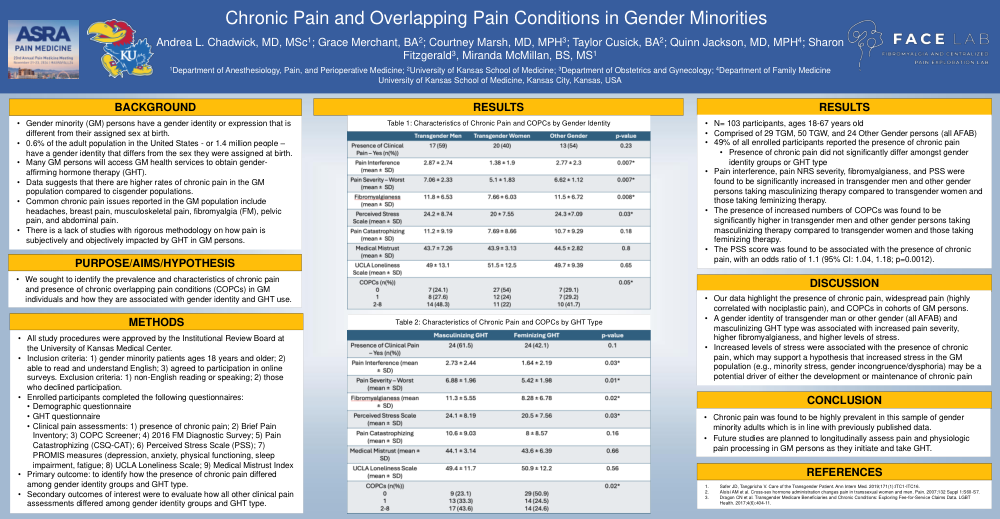
•N= 103 participants, ages 18-67 years old
•Comprised of 29 TGM, 50 TGW, and 24 Other Gender persons (all AFAB)
•49% of all enrolled participants reported the presence of chronic pain
•Presence of chronic pain did not significantly differ amongst gender identity groups or GHT type
•Pain interference, pain NRS severity, fibromyalgianess, and PSS were found to be significantly increased in transgender men and other gender persons taking masculinizing therapy compared to transgender women and those taking feminizing therapy.
•The presence of increased numbers of COPCs was found to be significantly higher in transgender men and other gender persons taking masculinizing therapy compared to transgender women and those taking feminizing therapy.
•The PSS score was found to be associated with the presence of chronic pain, with an odds ratio of 1.1 (95% CI: 1.04, 1.18; p=0.0012).
DISCUSSION
•Our data highlight the presence of chronic pain, widespread pain (highly correlated with nociplastic pain), and COPCs in cohorts of GM persons.
•A gender identity of transgender man or other gender (all AFAB) and masculinizing GHT type was associated with increased pain severity, higher fibromyalgianess, and higher levels of stress.
•Increased levels of stress were associated with the presence of chronic pain, which may support a hypothesis that increased stress in the GM population (e.g., minority stress, gender incongruence/dysphoria) may be a potential driver of either the development or maintenance of chronic pain
CONCLUSION
•Chronic pain was found to be highly prevalent in this sample of gender minority adults which is in line with previously published data.
•Future studies are planned to longitudinally assess pain and physiologic pain processing in GM persons as they initiate and take GHT.