501 posters, 2 videos, 1 audios, 8 topics, 37 sessions, 395 authors, 307 institutions
ePostersLive by SciGen Technologies S.A. All rights reserved.
23rd Annual Pain Medicine Meeting 2024
November 21-23, 2024 | Caesars Palace, Las Vegas, Nevada

6090
SURVEY OF PAIN MEDICINE EDUCATION DURING NEUROLOGY RESIDENCY
Poster Presenter
Authors
Affiliations
Part of Topic
Scientific Abstracts > Education
Survey of Pain Medicine Education During Neurology Residency
Introduction
Most neurologic conditions can cause chronic pain. This includes CNS inflammatory conditions, neurogenerative disorders, traumatic conditions like spinal cord injury, Multiple Sclerosis, Parkinson’s disease, peripheral neuropathy, stroke, neuromuscular disorders, orofacial pain, and headache disorders. Addressing pain in inpatient and outpatient settings is critical to improving patient outcomes.
Currently, ACGME does not require a pain medicine rotation during Neurology residency training. We aim to identify gaps in pain medicine education by surveying current Neurology residents nationwide. This survey will help us determine whether there is a need for a formal and mandatory pain medicine rotation during Neurology residency.
Methods
An IRB exemption was obtained before starting the project.
A short seven-question survey using Survey Monkey was distributed via email to Neurology residents enrolled in ACGME-accredited residency training programs in the United States during their PGY-2 to PGY-4 training years.
Results
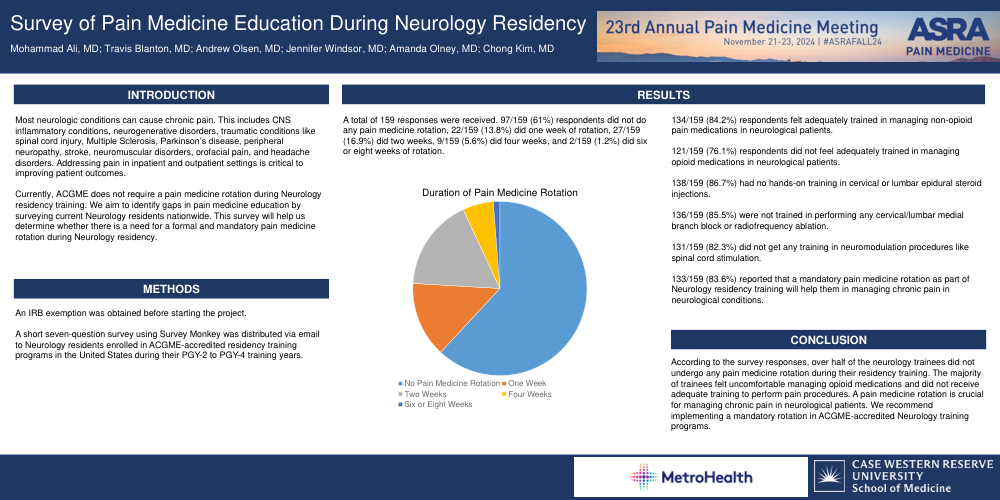
A total of 159 responses were received. 97/159 (61%) respondents did not do any pain medicine rotation, 22/159 (13.8%) did one week of rotation, 27/159 (16.9%) did two weeks, 9/159 (5.6%) did four weeks, and 2/159 (1.2%) did six or eight weeks of rotation.
134/159 (84.2%) respondents felt adequately trained in managing non-opioid pain medications in neurological patients.
121/159 (76.1%) respondents did not feel adequately trained in managing opioid medications in neurological patients.
138/159 (86.7%) had no hands-on training in cervical or lumbar epidural steroid injections.
136/159 (85.5%) were not trained in performing any cervical/lumbar medial branch block or radiofrequency ablation.
131/159 (82.3%) did not get any training in neuromodulation procedures like spinal cord stimulation.
133/159 (83.6%) reported that a mandatory pain medicine rotation as part of Neurology residency training will help them in managing chronic pain in neurological conditions.
Conclusion:
According to the survey responses, over half of the neurology trainees did not undergo any pain medicine rotation during their residency training. The majority of trainees felt uncomfortable managing opioid medications and did not receive adequate training to perform pain procedures. A pain medicine rotation is crucial for managing chronic pain in neurological patients. We recommend implementing a mandatory rotation in ACGME-accredited Neurology training programs.