501 posters, 2 videos, 1 audios, 8 topics, 37 sessions, 395 authors, 307 institutions
ePostersLive by SciGen Technologies S.A. All rights reserved.
23rd Annual Pain Medicine Meeting 2024
November 21-23, 2024 | Caesars Palace, Las Vegas, Nevada

6332
IMPROVEMENTS IN PAIN AND OVERALL SATISFACTION USING 60-DAY PNS OF FEMORAL AND SAPHENOUS NERVES FOR CHRONIC KNEE PAIN
Poster Presenter
Authors
Affiliations
Richmond VA Medical Center /Virginia Commonwealth University
Part of Topic
Scientific Abstracts > Chronic Pain
Video
Improvements in pain and overall satisfaction with therapy in a retrospective review of 60-day PNS of Femoral and Saphenous Nerves for Chronic Knee Pain
Authors:
Lester, D. Denise, MD; Syracuse, M. Kristal, MS; Cole, J. Debra, RT, Frasier, Levetta, RN; Bindal, Meenakshi, MD
Affiliations:
Central Virginia VA Health Center Services , Richmond, VA
Introduction: Chronic knee pain is costly and painful, and is the most common joint in adults associated with morbidity.It causes significant pain and disability in approximately 25% of the United States population (104 million people) and its prevalence has increased nearly 65% over past 20 years accounting for greater than 4 million primary care visits in addition to specialty visits such as orthopedics, rheumatology, pain clinics, and physical therapy. Hospitalizations for arthritis are the second most expensive costing roughly $20 billion and the US is estimated to spend $139.8 billion annually on outpatient care. There are a wide variety of treatments ranging from oral analgesics with physical therapy to surgical total knee replacements.The opportunity to delay and often prevent surgical interventions, permanent implants, and/or neurolytic procedures is a tremendous benefit while evading the addictive challenges presented by opioids. In normal bodily function, sensory and motor signals are coordinated to balance the central nervous system. After musculoskeletal diseases or trauma occur, peripheral pain signals activate protective mechanisms including arthrogenic inhibition, which reduces activity to protect and assist with recovery. After extended periods of inactivity, normal proprioceptive information to the cortex is diminished and central sensitization may play a larger role in refractory pain states.
Percutaneous peripheral nerve stimulation (PNS) targeting sensory nerve fibers may directly activate afferent signals that can balance and recondition the central pain state.
In our institution we retrospectively reviewed subjects who received either femoral nerve alone, saphenous nerve alone or a combined femoral and Saphenous 60-day PNS for chronic knee pain. We documented their reported baseline and end of treatment BPI 5 and 9 scores from the Short Brief Pain Inventory.
To our knowledge this is the largest reported data from a single facility using femoral and saphenous temporary PNS for knee pain..
Methods:
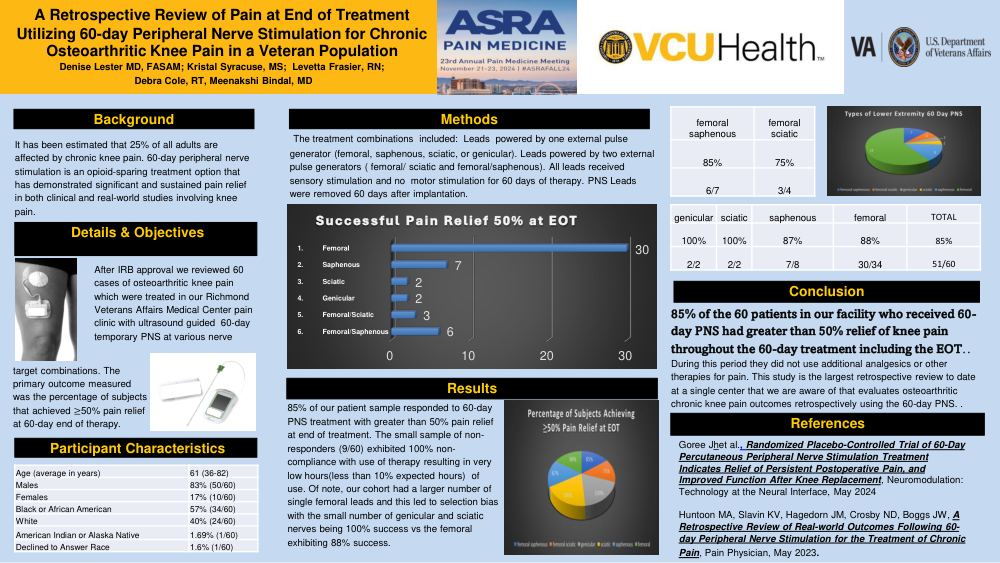
After IRB approval we reviewed 60 cases of osteoarthritic knee pain which were treated in our Richmond Veterans Affairs Medical Center pain clinic with ultrasound guided 60-day temporary PNS at various nerve target combinations.The primary outcome measured was the percentage of subjects that achieved ≥50% pain relief at 60-day end of therapy.
|
Age (average in years) |
61 (36-82) |
|
Males |
83% (50/60) |
|
Females |
17% (10/60) |
|
Black or African American |
57% (34/60) |
|
White |
40% (24/60) |
|
American Indian or Alaska Native |
1.69% (1/60) |
|
Declined to Answer Race |
1.6% (1/60) |
The treatment combinations included: Leads powered by one external pulse generator (femoral, saphenous, sciatic, or genicular). Leads powered by two external pulse generators ( femoral/ sciatic and femoral/saphenous). All leads received sensory stimulation and no motor stimulation for 60 days of therapy. PNS Leads were removed 60 days after implantationSixty records were reported on patients who received 60-day PNS via either 1) sensory stimulation of the Femoral nerve, 2) sensory stimulation of the Saphenous nerve, or 3) sensory stimulation of the both Femoral and Saphenous nerves. Baseline and end of treatment outcomes were reviewed, including mean average pain scores and the proportion demonstrating clinically meaningful relief. The percent of patients with atleast 50% relief at end of 60 day temporary PNS therapy was reported . Additional charactersitcs reported included 1) demographics, average BMI, the Keligren-Lawrence graing scale to assess the severity of osteoarthritis.
Results: A total of 60 subjects were reviewed.
85% of our patient sample responded to 60-day PNS treatment with greater than 50% pain relief at end of treatment. The small sample of non-responders (9/60) exhibited 100% non-compliance with use of therapy resulting in very low hours(less than 10% expected hours) of use. Of note, our cohort had a larger number of single femoral leads and this led to selection bias with the small number of genicular and sciatic nerves being 100% success vs the femoral exhibiting 88% success
85% of the 60 patients in our facility who received 60-day PNS had greater than 50% relief of knee pain throughout the 60-day treatment including the EOT. . During this period they did not use additional analgesics or other therapies for pain. This study is the largest retrospective review to date at a single center that we are aware of that evaluates osteoarthritic chronic knee pain outcomes retrospectively using the 60-day PNS.
Conclusion: The use of 60-day Combined Femoral and Saphenous PNS for chronic knee pain may provide a benefit for chronic knee osteoarthritic pain. While this observation is retrospective and variables are not controlled, it suggests the potential of benefit in future prospectively randomized controlled trials.This IRB approved retrospective study is to our knowledge the largest report of patient outcomes in a single facility after the use of 60-day PNS for chronic osteoarthritis knee pain. Our review demonstrates that ultrasound guided PNS is a promising tool for reducing chronic knee painful osteoarthritis.
References:
Goree Jhet al., Randomized Placebo-Controlled Trial of 60-Day Percutaneous Peripheral Nerve Stimulation Treatment Indicates Relief of Persistent Postoperative Pain, and Improved Function After Knee Replacement, Neuromodulation: Technology at the Neural Interface, May 2024
Huntoon MA, Slavin KV, Hagedorn JM, Crosby ND, Boggs JW, A Retrospective Review of Real-world Outcomes Following 60-day Peripheral Nerve Stimulation for the Treatment of Chronic Pain, Pain Physician, May 2023.
Poliwoda S, Noor N, Mousa B, et al. A comprehensive review of intraarticular knee injection therapy, geniculate injections and peripheral nerve stimulation for knee pain in clinical practice. Orthopedic Rev. 2022. Oct 13:14(4).
Lin CP, Chang KV, Wu WT, Ozcakar L, Ultrasound Guided Peripheral Nerve Stimulation for Knee Pain: A Mini-Review of the euro anatomy and the evidence from Clinical Studies. Pain Med. 2020;21(Suppl 1): 556-563.
Ilfeld BM, Said ET, Finneran JJ , et al Ultrasound Guided Percutaneous Peripheral Nerve Stimulation : Neuromodulation of the Femoral Nerve for Postoperative Analgesia Following Ambulatory Anterior Cruciate Ligament Reconstruction: A Proof of Concept Study.Neuromodulation, 2019;22(5):621-629.
Grahams, et al Associations of Healthcare Utilization and Costs with Increasing Pain and Treatment Intensity Levels in Osteoarthritis Patients: An 18-Year Retrospective Study: Rheumatol. Ther. 2022 Aug: 9(4): 1061-1078.