501 posters, 2 videos, 1 audios, 8 topics, 37 sessions, 395 authors, 307 institutions
ePostersLive by SciGen Technologies S.A. All rights reserved.
23rd Annual Pain Medicine Meeting 2024
November 21-23, 2024 | Caesars Palace, Las Vegas, Nevada

6288
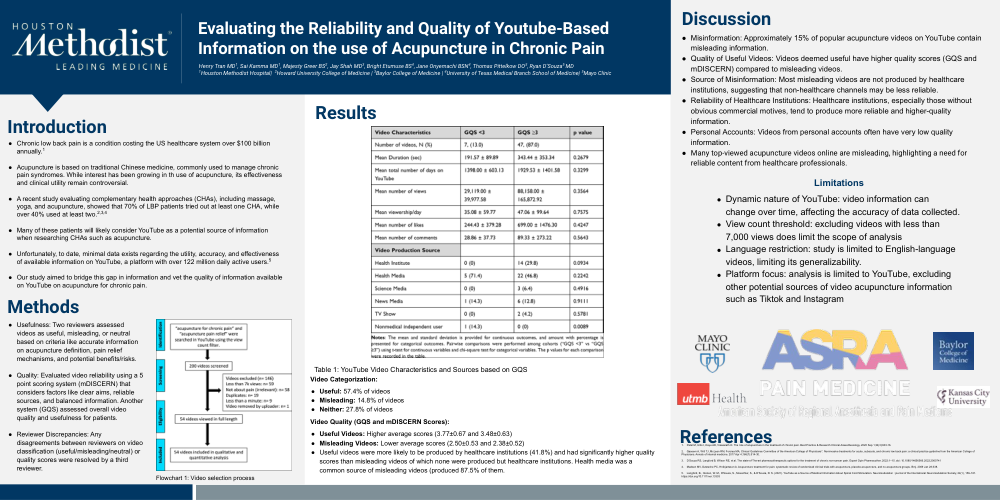
EVALUATING THE RELIABILITY AND QUALITY OF YOUTUBE-BASED INFORMATION ON THE USE OF ACUPUNCTURE FOR CHRONIC PAIN
Poster Presenter
Authors
Affiliations
Part of Topic
Scientific Abstracts > Chronic Pain
-
Chronic low back pain is a condition costing the US healthcare system over $100 billion annually.1
-
Acupuncture is based on traditional Chinese medicine, commonly used to manage chronic pain syndromes. While interest has been growing in th use of acupuncture, its effectiveness and clinical utility remain controversial.
-
A recent study evaluating complementary health approaches (CHAs), including massage, yoga, and acupuncture, showed that 70% of LBP patients tried out at least one CHA, while over 40% used at least two.2,3,4
-
Many of these patients will likely consider YouTube as a potential source of information when researching CHAs such as acupuncture.
-
Unfortunately, to date, minimal data exists regarding the utility, accuracy, and effectiveness of available information on YouTube, a platform with over 122 million daily active users.5
-
Our study aimed to bridge this gap in information and vet the quality of information available on YouTube on acupuncture for chronic pain.
-
Usefulness: Two reviewers assessed videos as useful, misleading, or neutral based on criteria like accurate information on acupuncture definition, pain relief mechanisms, and potential benefits/risks.
-
-
Quality: Evaluated video reliability using a 5 point scoring system (mDISCERN) that considers factors like clear aims, reliable sources, and balanced information. Another system (GQS) assessed overall video quality and usefulness for patients.
-
Reviewer Discrepancies: Any disagreements between reviewers on video classification (useful/misleading/neutral) or quality scores were resolved by a third reviewer.
-
Misinformation: Approximately 15% of popular acupuncture videos on YouTube contain misleading information.
-
Quality of Useful Videos: Videos deemed useful have higher quality scores (GQS and mDISCERN) compared to misleading videos.
-
Source of Misinformation: Most misleading videos are not produced by healthcare institutions, suggesting that non-healthcare channels may be less reliable.
-
Reliability of Healthcare Institutions: Healthcare institutions, especially those without obvious commercial motives, tend to produce more reliable and higher-quality information.
-
Personal Accounts: Videos from personal accounts often have very low quality information.
-
Many top-viewed acupuncture videos online are misleading, highlighting a need for reliable content from healthcare professionals.
-
Limitations
-
Dynamic nature of YouTube: video information can change over time, affecting the accuracy of data collected.
-
View count threshold: excluding videos with less than 7,000 views does limit the scope of analysis
-
Language restriction: study is limited to English-language videos, limiting its generalizability.
-
Platform focus: analysis is limited to YouTube, excluding other potential sources of video acupuncture information such as Tiktok and Instagram