501 posters, 2 videos, 1 audios, 8 topics, 37 sessions, 395 authors, 307 institutions
ePostersLive by SciGen Technologies S.A. All rights reserved.
23rd Annual Pain Medicine Meeting 2024
November 21-23, 2024 | Caesars Palace, Las Vegas, Nevada

6234
SAFETY AND ADVERSE EVENTS OF PERCUTANEOUS PERIPHERAL NERVE STIMULATION AT A MAJOR ACADEMIC MEDICAL CENTER
Poster Presenter
Authors
Affiliations
Part of Topic
Scientific Abstracts > Chronic Pain
Safety and Adverse Events of Percutaneous Peripheral Nerve Stimulation at a Major Academic Medical Center
Alex Wilkinson M.D.1, Reuben Horace, M.D.2, Muhammad Anwar, M.D.1, Peter Yi, M.D.1
1Dept. Of Anesthesiology, Critical Care and Pain Medicine, 2Dept. Of Emergency Medicine
Percutaneous peripheral nerve stimulation (PNS) represents an evolving treatment modality for chronic back or peripheral nerve pain, potentially offering an alternative to traditional therapies. Historically, nerve stimulation involved a brief (~7-day) trial followed by the implantation of a permanent device, with issues such as cost, permanence, and inconsistent outcomes limiting its use only as a last-resort option. Although early studies have suggested that PNS is both effective and safe, further investigation into its safety profile and adverse events is necessary as its use becomes more widespread.
Following institutional review board approval, we conducted a retrospective review of 90-day outcomes for peripheral nerve stimulator implants performed at our institution from 2021 to 2024 for axial, low back pain or implants into the multifidus muscles. Data were collected and analyzed from 219 instances of percutaneous nerve stimulation.
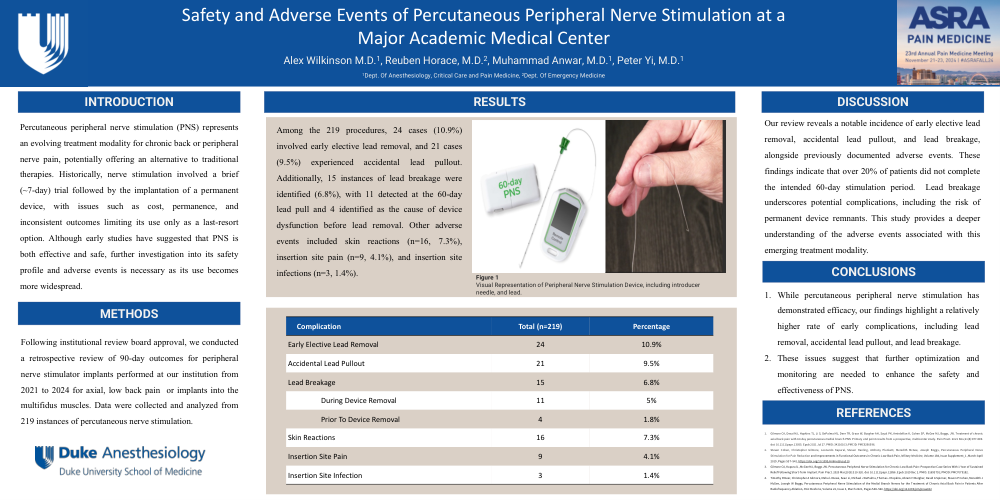
Among the 219 procedures, 24 cases (10.9%) involved early elective lead removal, and 21 cases (9.5%) experienced accidental lead pullout. Additionally, 15 instances of lead breakage were identified (6.8%), with 11 detected at the 60-day lead pull and 4 identified as the cause of device dysfunction before lead removal. Other adverse events included skin reactions (n=16, 7.3%), insertion site pain (n=9, 4.1%), and insertion site infections (n=3, 1.4%).
Our review reveals a notable incidence of early elective lead removal, accidental lead pullout, and lead breakage, alongside previously documented adverse events. These findings indicate that over 20% of patients did not complete the intended 60-day stimulation period. Lead breakage underscores potential complications, including the risk of permanent device remnants. This study provides a deeper understanding of the adverse events associated with this emerging treatment modality.
Conclusions: