501 posters, 2 videos, 1 audios, 8 topics, 37 sessions, 395 authors, 307 institutions
ePostersLive by SciGen Technologies S.A. All rights reserved.
23rd Annual Pain Medicine Meeting 2024
November 21-23, 2024 | Caesars Palace, Las Vegas, Nevada

5972
PREDICTORS OF DRUG RELAPSE AND CLINICAL IMPROVEMENTS IN CHRONIC PAIN PATIENTS AFTER A PAIN REHABILITATION PROGRAM
Poster Presenter
Authors
Affiliations
Part of Topic
Scientific Abstracts > Chronic Pain
Predictors of Drug Relapse and Clinical Improvements in Chronic Pain Patients After a Pain Rehabilitation Program: A Retrospective Review.
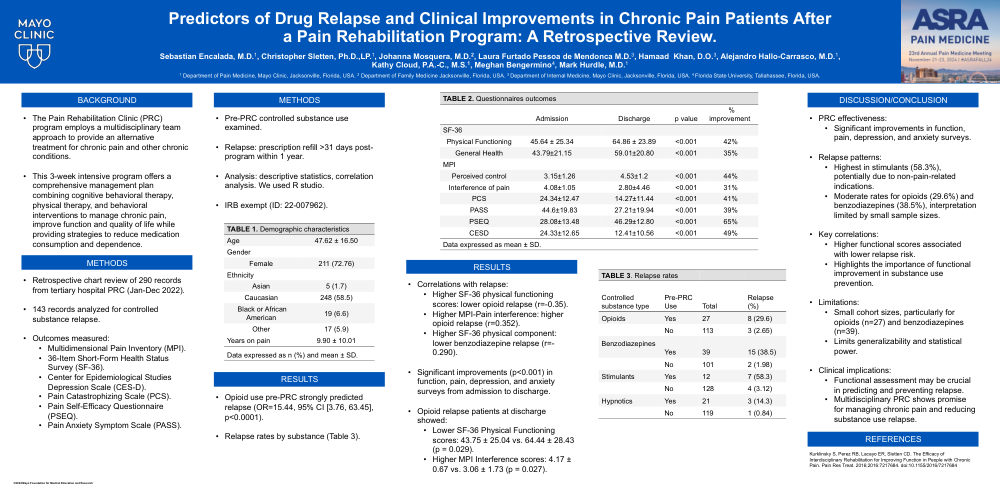
Background: The Pain Rehabilitation Clinic (PRC) program employs a multidisciplinary team approach to provide an alternative treatment for chronic pain and other chronic conditions. This 3-week intensive program offers a comprehensive management plan combining cognitive behavioral therapy, physical therapy, and behavioral interventions to manage chronic pain and improve function and quality of life while providing strategies to reduce medication consumption and dependence.
Methods: This study was exempt from IRB review, ID: 22-007962 and was conducted using the records of a tertiary hospital PRC from January to December 2022. We conducted a retrospective chart review of 290 records, analyzing 143 for controlled substance relapse based on available data. Outcomes encompassed the Multidimensional Pain Inventory (MPI), 36-Item Short-Form Health Status Survey (SF-36), Center for Epidemiological Studies Depression Scale (CES-D), Pain Catastrophizing Scale (PCS), Pain Self-Efficacy Questionnaire (PSEQ), and Pain Anxiety Symptom Scale (PASS) at admission and discharge. We examined pre-PRC chronic controlled substance use, including opioids, benzodiazepines, stimulants, and hypnotics. Relapse was defined as a prescription refill exceeding 31 days post-program completion within a year. We employed descriptive statistics, correlation analysis, and logistic regression models to identify relapse risk relationships within the cohort.
Results: Opioid use prior to PRC strongly predicted subsequent relapse (OR=15.44, 95% CI [3.76, 63.45], p<0.0001). Relapse rates varied by controlled substance type: stimulants (58.3%), benzodiazepines (38.5%), opioids (29.6%), and hypnotics (14.3%). Higher SF-36 physical functioning component scores at admission correlated moderately with lower opioid relapse risk (r=-0.35). MPI-Pain interference scores exhibited a moderate positive correlation with opioid relapse (r=0.352). Higher SF-36 physical component scores correlated with decreased likelihood of benzodiazepine relapse (r=-0.290). Non-chronic users demonstrated significantly lower relapse rates across all drug types. SF-36 General Health component, PSEQ, CES-D, PSC, and chronic pain duration failed to predict opioid or benzodiazepine relapse significantly. We observed significant improvements (p<0.001) in function, pain, depression, and anxiety questionnaires from admission to discharge.
Discussion: The PRC offers an effective approach to treating chronic pain. Stimulants exhibited the highest relapse rate, albeit with only 12 pre-PRC users, possibly due to chronic utilization for conditions unrelated to chronic pain. Moderate relapse rates for opioid and benzodiazepine users represent encouraging results. However, only a small proportion of our cohort were prescribed opioids (n=27) and benzodiazepines (n=39) pre-PRC. Increasing the sample size will yield more significant results and enable better estimates of correlations between potential relapse risk factors. Higher function questionnaire scores correlated with reduced opioid and benzodiazepine relapse post-PRC. The PRC's advantages were evidenced by improvements in function, pain, depression, and anxiety questionnaires following the 3-week program. Further analysis with larger sample sizes is warranted to identify stronger connections.