501 posters, 2 videos, 1 audios, 8 topics, 37 sessions, 395 authors, 307 institutions
ePostersLive by SciGen Technologies S.A. All rights reserved.
23rd Annual Pain Medicine Meeting 2024
November 21-23, 2024 | Caesars Palace, Las Vegas, Nevada

6145
USING UNSUPERVISED MACHINE LEARNING TO IDENTIFY PHENOTYPIC CLUSTERS OF SMALL FIBER NEUROPATHY
Poster Presenter
Authors
Affiliations
Part of Topic
Scientific Abstracts > Chronic Pain
Beyond Pain: Using Unsupervised Machine Learning to Identify Phenotypic Clusters of Small Fiber Neuropathy
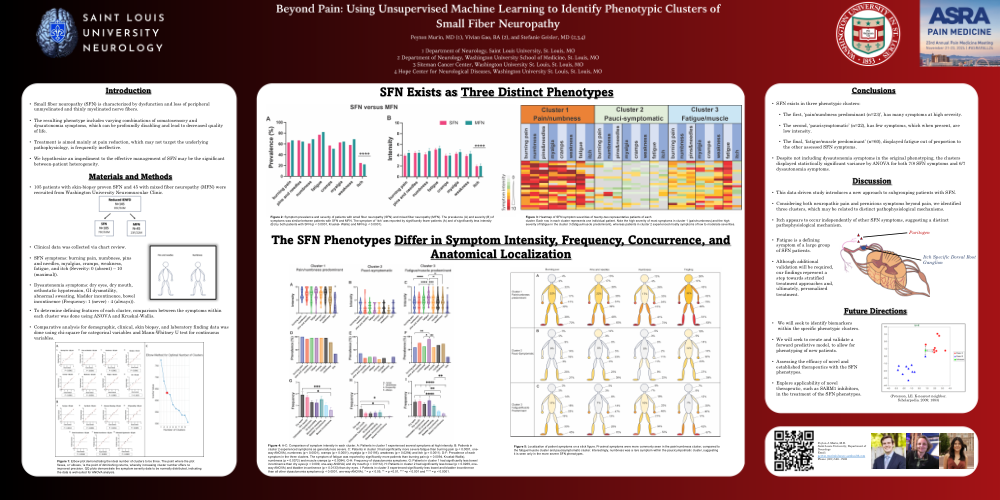
Introduction: Small fiber neuropathy (SFN) is characterized by dysfunction and loss of peripheral unmyelinated and thinly myelinated nerve fibers. The resulting phenotype includes varying combinations of somatosensory and dysautonomia symptoms, which can be profoundly disabling and lead to decreased quality of life. Treatment is aimed mainly at pain reduction, which may not target the underlying pathophysiology, is frequently ineffective. We hypothesize an impediment to the effective management of SFN may be the significant between-patient heterogeneity.
Materials and Methods: 105 patients with skin-biopsy proven SFN and 45 with mixed fiber neuropathy (MFN) were recruited from Washington University Neuromuscular Clinic. Clinical data was collected via chart review. SFN symptoms: burning pain, numbness, pins and needles, myalgias, cramps, weakness, fatigue, and itch (Severity: 0 (absent) – 10 (maximal)). Dysautonomia symptoms: dry eyes, dry mouth, orthostatic hypotension, GI dysmotility, abnormal sweating, bladder incontinence, bowel incontinence (Frequency: 1 (never) - 4 (always)). To determine defining features of each cluster, comparison between the symptoms within each cluster was done using ANOVA and Kruskal-Wallis. Comparative analysis for demographic, clinical, skin biopsy, and laboratory finding data was done using chi-square for categorical variables and Mann-Whitney U test for continuous variables.
Conclusions: SFN exists in three phenotypic clusters: The first, ‘pain/numbness predominant (n=23)’, has many symptoms at high severity. The second, ‘paucisymptomatic’ (n=22), has few symptoms, which when present, are low intensity. The final, ‘fatigue/muscle predominant’ (n=60), displayed fatigue out of proportion to the other assessed SFN symptoms. Despite not including dysautonomia symptoms in the original phenotyping, the clusters displayed statistically significant variance by ANOVA for both 7/8 SFN symptoms and 6/7 dysautonomia symptoms.
Discussion: This data-driven study introduces a new approach to subgrouping patients with SFN. Considering both neuropathic pain and pernicious symptoms beyond pain, we identified three clusters, which may be related to distinct pathophysiological mechanisms. Itch appears to occur independently of other SFN symptoms, suggesting a distinct pathophysiological mechanism. Fatigue is a defining symptom of a large group of SFN patients. Although additional validation will be required, our findings represent a step towards stratified treatment approaches and, ultimately, personalized treatment.