501 posters, 2 videos, 1 audios, 8 topics, 37 sessions, 395 authors, 307 institutions
ePostersLive by SciGen Technologies S.A. All rights reserved.
23rd Annual Pain Medicine Meeting 2024
November 21-23, 2024 | Caesars Palace, Las Vegas, Nevada

6128
SILENT GROWTH - DISCOVERING A CHONDROID LIPOMA BEHIND PERSISTENT KNEE PAIN: A CASE REPORT
Poster Presenter
Part of Topic
Scientific Abstracts > Chronic Pain
Silent Growth - Discovering a Chondroid Lipoma Behind Persistent Knee Pain: A Case Report
Karthik Kamath, Jenzel Espares, Leslie Wong, Peter Atallah, Elliott Berry, Thomas Pobre Nassau University Medical Center (NUMC)
Introduction
66-year-old woman with a history of hypertension, hyperlipidemia, and sleeve gastrectomy in 2017 sought a follow-up for low back pain and right shoulder pain. She also reported worsening right knee pain since a fall in 2014, with persistent swelling but no numbness or locking. The pain, aggravated by prolonged walking and relieved by Tylenol and rest, had not been previously imaged. On examination, her right knee showed swelling and tenderness but normal stress test results.
Materials and Methods
As the case report is devoid of patient identifiable information, it is exempt from IRB review requirements as per Nassau University Medical Center policy.
Results/Case Report
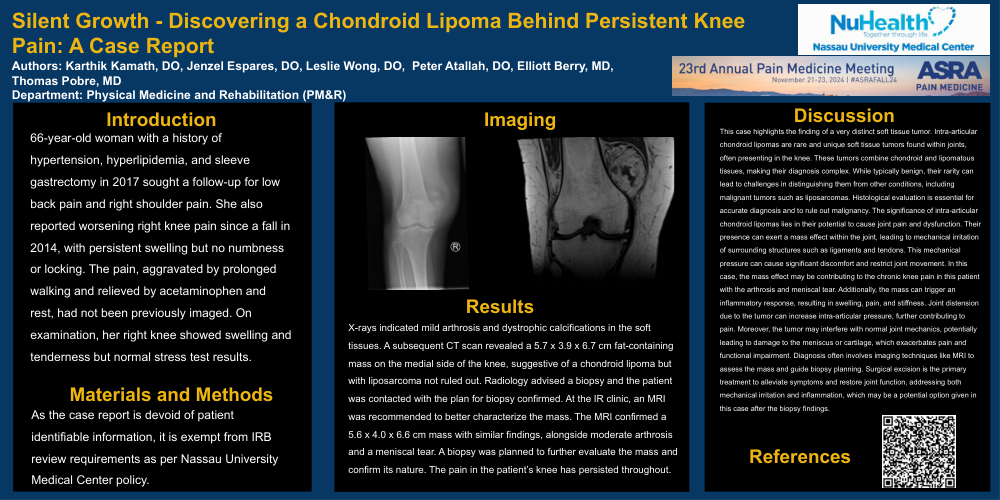
X-rays indicated mild arthrosis and dystrophic calcifications in the soft tissues. A subsequent CT scan revealed a 5.7 x 3.9 x 6.7 cm fat-containing mass on the medial side of the knee, suggestive of a chondroid lipoma but with liposarcoma not ruled out. Radiology advised a biopsy and the patient was contacted with the plan for biopsy confirmed. At the IR clinic, an MRI was recommended to better characterize the mass. The MRI confirmed a 5.6 x 4.0 x 6.6 cm mass with similar findings, alongside moderate arthrosis and a meniscal tear. A biopsy was planned to further evaluate the mass and confirm its nature. The pain in the patient’s knee has persisted throughout.
Discussion
This case highlights the finding of a very distinct soft tissue tumor. Intra-articular chondroid lipomas are rare and unique soft tissue tumors found within joints, often presenting in the knee. These tumors combine chondroid and lipomatous tissues, making their diagnosis complex. While typically benign, their rarity can lead to challenges in distinguishing them from other conditions, including malignant tumors such as liposarcomas. Histological evaluation is essential for accurate diagnosis and to rule out malignancy. The significance of intra-articular chondroid lipomas lies in their potential to cause joint pain and dysfunction. Their presence can exert a mass effect within the joint, leading to mechanical irritation of surrounding structures such as ligaments and tendons. This mechanical pressure can cause significant discomfort and restrict joint movement. In this case, the mass effect may be contributing to the chronic knee pain in this patient with the arthosis and meniscal tear. Additionally, the mass can
trigger an inflammatory response, resulting in swelling, pain, and stiffness. Joint distension due to the tumor can increase intra-articular pressure, further contributing to pain. Moreover, the tumor may interfere with normal joint mechanics, potentially leading to damage to the meniscus or cartilage, which exacerbates pain and functional impairment. Diagnosis often involves imaging techniques like MRI to assess the mass and guide biopsy planning. Surgical excision is the primary treatment to alleviate symptoms and restore joint function, addressing both mechanical irritation and inflammation, which may be a potential option given in this case after the biopsy findings.
References
Mertens K, Van Beeck A, Vanhoenacker F. Chondroid Lipoma Mimicking Malignancy. J Belg Soc Radiol. 2022;106(1):40. https://doi.org/10.5334/jbsr.2744
Nielsen GP, O'Connell JX, Dickersin GR, et al. Chondroid lipoma, a tumor of white fat cells. A brief report of two cases with ultrastructural analysis. Am J Surg Pathol. 1995;19(11):1272-6. https://doi.org/10.1097/00000478-199511000-00007
Tessi R, Oze KR, Imrani K, et al. Etiology of a painful knee: Primary synovial chondromatosis. Int J Case Rep Images. 2022;13:101310Z01RT2022. https://doi.org/10.5348/101310Z01RT2022