501 posters, 2 videos, 1 audios, 8 topics, 37 sessions, 395 authors, 307 institutions
ePostersLive by SciGen Technologies S.A. All rights reserved.
23rd Annual Pain Medicine Meeting 2024
November 21-23, 2024 | Caesars Palace, Las Vegas, Nevada

5957
COMPARISON OF MEDIAL BRANCH BLOCK AND RADIOFREQUENCY ABLATION OUTCOMES BY USING A PAIN SCALE VS A DISABILITY FUNCTION SCALE
Poster Presenter
Authors
Affiliations
Part of Topic
Scientific Abstracts > Chronic Pain
Introduction
In 2023, Medicare mandated functional disability scores for medial branch blocks (MBB) and radiofrequency ablations (RFA) using a survey of choice, in addition to the standard of care pre and post pain scales using the Numerical Rating Scale (NRS). Standard of care requires two successful MBBs before proceeding to RFA. The most common functional survey used and subsequently studied is the Oswestry Disability Index (ODI). This requires more time, work, and administrative burden, with no known data concluding that this affects patient outcomes. This study assessed outcomes after the new requirement of adding functional surveys in the clinic visit.
Methods
This retrospective study is devoid of patient identifiable information and is exempt from IRB review requirements per MetroHealth policy.
Data was retrospectively collected from 2023 to 2024 including patients with all insurances with cervical, thoracic and lumbar pain that received MBBs and/or medial branch RFAs. The primary endpoint is the percentage of relief after the procedure compared to the NRS vs ODI. The secondary study endpoint is the scores that made a significant difference in outcomes as measured via percentage of relief. Other outcomes were measured as well.
Results
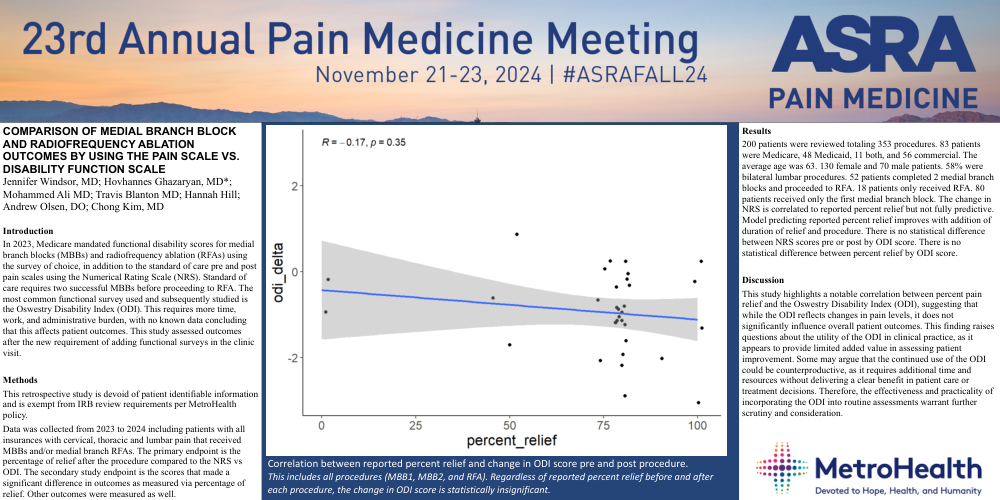
200 patients were reviewed totaling 353 procedures. 83 patients were Medicare, 48 Medicaid, 11 both, and 56 commercial. The average age was 63. 130 female and 70 male patients. 58% were bilateral lumbar procedures. 52 patients completed 2 medial branch blocks and proceeded to RFA. 18 patients only received RFA. 80 patients received only the first medial branch block. The change in NRS is correlated to reported percent relief but not fully predictive. Model predicting reported percent relief improves with addition of duration of relief and procedure. There is no statistical difference between NRS scores pre or post by ODI score. There is no statistical difference between percent relief by ODI score.
Discussion
This study highlights a notable correlation between percent pain relief and the Oswestry Disability Index (ODI), suggesting that while the ODI reflects changes in pain levels, it does not significantly influence overall patient outcomes. This finding raises questions about the utility of the ODI in clinical practice, as it appears to provide limited added value in assessing patient improvement. Some may argue that the continued use of the ODI could be counterproductive, as it requires additional time and resources without delivering a clear benefit in patient care or treatment decisions. Therefore, the effectiveness and practicality of incorporating the ODI into routine assessments warrant further scrutiny and consideration.
References
Centers for Medicare & Medicaid Services. (n.d.). “Local Coverage Article: Billing and Coding: Epidural Steroid Injections for Pain Management (A57787)”. https://www.cms.gov/medicare-coverage-database/view/article.aspx?articleId=57787&ver=26