501 posters, 2 videos, 1 audios, 8 topics, 37 sessions, 395 authors, 307 institutions
ePostersLive by SciGen Technologies S.A. All rights reserved.
23rd Annual Pain Medicine Meeting 2024
November 21-23, 2024 | Caesars Palace, Las Vegas, Nevada

6257
GENDER AND RACIAL DISPARITIES IN NEURAXIAL ANESTHESIA FOR TRAUMATIC HIP REPLACEMENT
Poster Presenter
Authors
Affiliations
Part of Topic
Scientific Abstracts > Acute Pain
•GENDER AND RACIAL DISPARITIES IN NEURAXIAL ANESTHESIA FOR TRAUMATIC HIP REPLACEMENT
Introduction
·Gender and racial disparities in accessing different aspects of healthcare have been well documented.
·The study goal is to determine if race and gender play a role in receiving neuraxial blocks during emergent and urgent hip replacement surgeries.
·Neuraxial blocks offer significant advantages in the setting of hip fracture surgery:
§Lower incidence of 1 month mortality and deep vein thrombosis.
§Shorter surgery time.
§Lower frequency of blood transfusion.
·Additionally, there seems to be associations with factors such as body mass index (BMI), insurance type, and age
Methods
•Retrospective cohort study using Trauma Quality Improvement Program (TQIP) database 2017-2019
• A total of 41,661 patients who underwent emergent and urgent hip replacement surgeries met the inclusion criteria
•21,456 Males, 20,205 Females; mean age 56.7 years
• Patients were categorized as recipients of either neuraxial or non-neuraxial anesthesia
•Normalized for patient age, sex, BMI, and insurance type
•Program used: GraphPad Prism Version 9.2.0 (GraphPad Software, San Diego, California USA)
Results
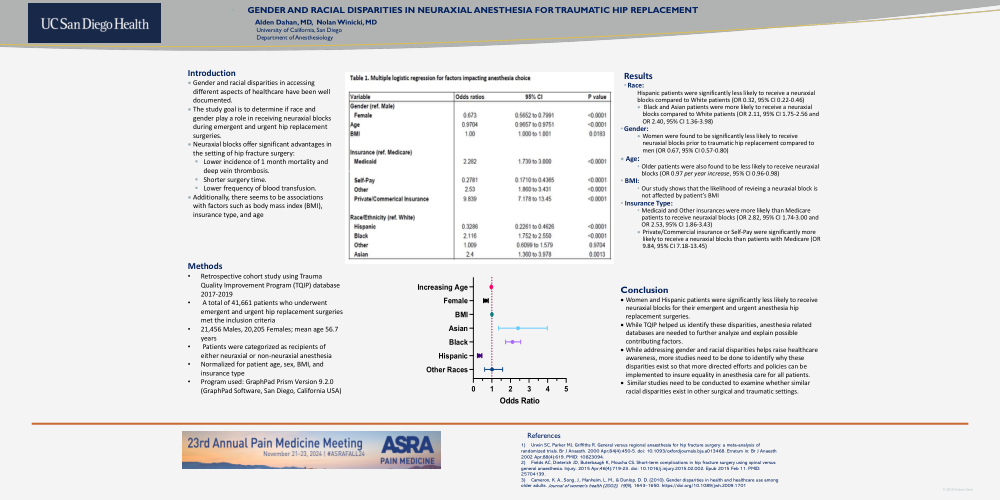
•Race:Hispanic patients were significantly less likely to receive a neuraxial blocks compared to White patients (OR 0.32, 95% CI 0.22-0.46)· Black and Asian patients were more likely to receive a neuraxial blocks compared to White patients (OR 2.11, 95% CI 1.75-2.56 and OR 2.40, 95% CI 1.36-3.98)
•Gender:
·Women were found to be significantly less likely to receive neuraxial blocks prior to traumatic hip replacement compared to men (OR 0.67, 95% CI 0.57-0.80)
·Age:
•Older patients were also found to be less likely to receive neuraxial blocks (OR 0.97 per year increase, 95% CI 0.96-0.98)
•BMI:
•Our study shows that the likelihood of revieing a neuraxial block is not affected by patient’s BMI
•Insurance Type:
•Medicaid and Other insurances were more likely than Medicare patients to receive neuraxial blocks (OR 2.82, 95% CI 1.74-3.00 and OR 2.53, 95% CI 1.86-3.43)
·Private/Commercial insurance or Self-Pay were significantly more likely to receive a neuraxial blocks than patients with Medicare (OR 9.84, 95% CI 7.18-13.45)
Conclusion
·Women and Hispanic patients were significantly less likely to receive neuraxial blocks for their emergent and urgent anesthesia hip replacement surgeries.
·While TQIP helped us identify these disparities, anesthesia related databases are needed to further analyze and explain possible contributing factors.
·While addressing gender and racial disparities helps raise healthcare awareness, more studies need to be done to identify why these disparities exist so that more directed efforts and policies can be implemented to insure equality in anesthesia care for all patients.
· Similar studies need to be conducted to examine whether similar racial disparities exist in other surgical and traumatic settings.