501 posters, 2 videos, 1 audios, 8 topics, 37 sessions, 395 authors, 307 institutions
ePostersLive by SciGen Technologies S.A. All rights reserved.
23rd Annual Pain Medicine Meeting 2024
November 21-23, 2024 | Caesars Palace, Las Vegas, Nevada

6016
SUCCESSFUL USE OF CERVICAL SYMPATHETIC BLOCK TO TREAT PTSD & ALCOHOL USE DISORDER WITHOUT WITHDRAWAL SYMPTOMS OR DELIRIUM TREMENS
Poster Presenter
Authors
Affiliations
Part of Topic
Scientific Abstracts > Regional Anesthesia
Successful Use of Cervical Sympathetic Block to Treat PTSD & Alcohol Use Disorder Without Withdrawal Symptoms or Delirium Tremens
Eugene Lipov, Zach Ciesielski, OMS-III
Background
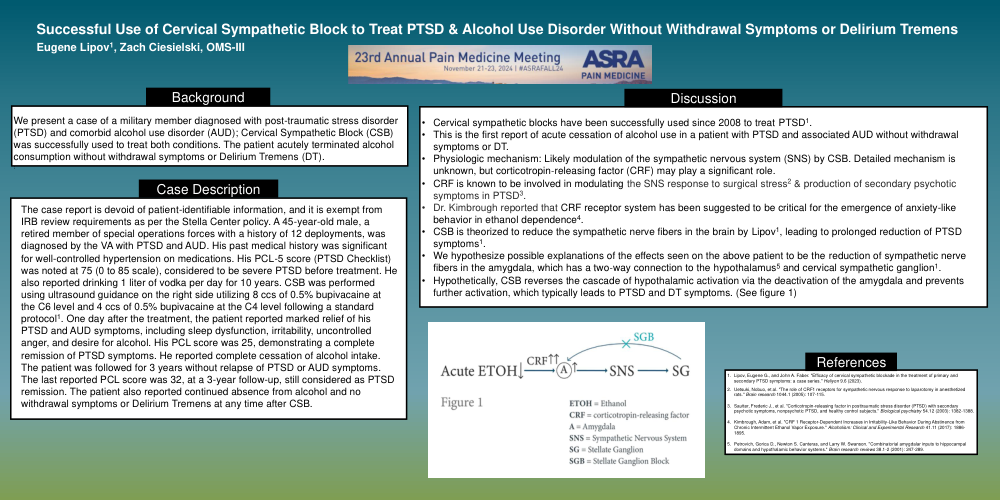
We present a case of a military member diagnosed with post-traumatic stress disorder (PTSD) and comorbid alcohol use disorder (AUD); Cervical Sympathetic Block (CSB) was successfully used to treat both conditions. The patient acutely terminated alcohol consumption without withdrawal symptoms or Delirium Tremens (DT).
Discussion
Cervical sympathetic blocks have been successfully used since 2008 to treat PTSD, with positive results demonstrated in multiple institutions(1). What makes this presentation unique is the first report of acute cessation of alcohol use in a patient with PTSD and associated AUD without withdrawal symptoms or DT. The physiology behind this clinical finding is likely modulation of the sympathetic system by CSB. While the detailed mechanism is unknown, corticotropin-releasing factor (CRF) may play a significant role. CRF is known to be involved in modulating sympathetic nervous response to surgical stress(2) as well production of secondary psychotic symptoms in PTSD(3). Dr.Kimbrough reported that CRF receptor system has been suggested to be critical for the emergence of anxiety-like behavior in ethanol dependence(4). CSB is theorized to reduce the sympathetic nerve fibers in the brain by Lipov(1), leading to prolonged reduction of PTSD symptoms(1). We hypothesize possible explanations of the effects seen on the above patient to be the reduction of sympathetic nerve fibers in the amygdala,which has a two-way connection to the hypothalamus(5) and cervical sympathetic ganglion(1). Hypothetically, CSB reverses the cascade of hypothalamic activation via the deactivation of the amygdala and prevents further activation, which typically leads to PTSDand DT symptoms.