501 posters, 2 videos, 1 audios, 8 topics, 37 sessions, 395 authors, 307 institutions
ePostersLive by SciGen Technologies S.A. All rights reserved.
23rd Annual Pain Medicine Meeting 2024
November 21-23, 2024 | Caesars Palace, Las Vegas, Nevada

6242
INTERCOSTAL NERVE CRYOABLATION FOR POSTOPERATIVE ANALGESIA FOLLOWING MINIMALLY INVASIVE LUNG RESECTION
Poster Presenter
Authors
Affiliations
Part of Topic
Scientific Abstracts > Emerging Technology
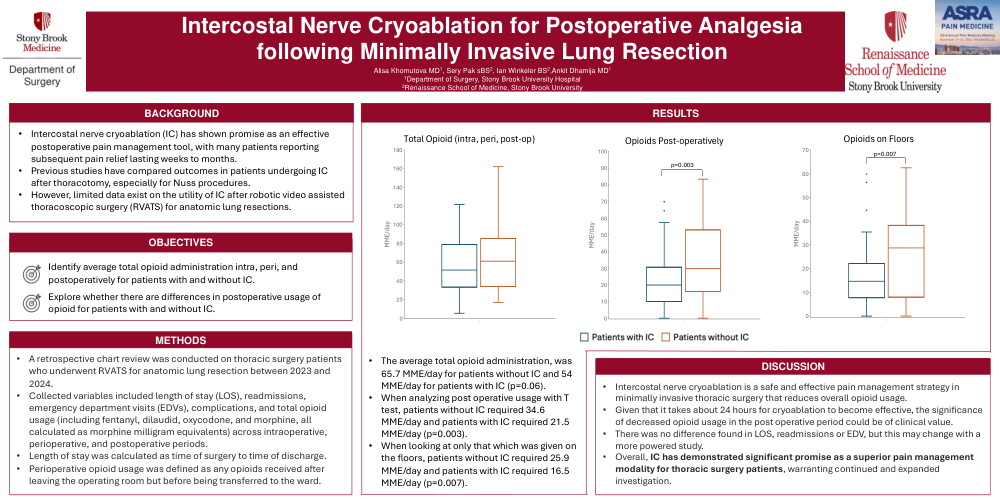
Intercostal Nerve Cryoablation for Postoperative Analgesia following Minimally Invasive Lung Resection
Intercostal nerve cryoablation (IC) has shown promise as an effective postoperative pain management tool, with many patients reporting subsequent pain relief lasting weeks to months. Previous studies have compared outcomes in patients undergoing IC after thoracotomy, especially for Nuss procedures. However, limited data exist on the utility of IC after robotic video assisted thoracoscopic surgery (RVATS) for anatomic lung resections.
A retrospective chart review was conducted on thoracic surgery patients who underwent RVATS for anatomic lung resection between 2023 and 2024. Collected variables included length of stay (LOS), readmissions, emergency department visits (EDVs), complications, and total opioid usage (including fentanyl, dilaudid, oxycodone, and morphine, all calculated as morphine milligram equivalents) across intraoperative, perioperative, and postoperative periods. Length of stay was calculated as time of surgery to time of discharge. Perioperative opioid usage was defined as any opioids received after leaving the operating room but before being transferred to the ward.
The average total opioid administration, was 65.7 MME/day for patients without IC and 54 MME/day for patients with IC (p=0.06). When analyzing post operative usage with T test, patients without IC required 34.6 MME/day and patients with IC required 21.5 MME/day (p=0.003). When looking at only that which was given on the floors, patients without IC required 25.9 MME/day and patients with IC required 16.5 MME/day (p=0.007). The median LOS was 3.14 days without IC and 3.15 days with IC.
Intercostal nerve cryoablation is a safe and effective pain management strategy in minimally invasive thoracic surgery that reduces overall opioid usage. Given that it takes about 24 hours for cryoablation to become effective, the significance of decreased opioid usage in the post operative period could be of clinical value. There was no difference found in LOS, readmissions or EDV, but this may change with a more powered study. Overall, IC has demonstrated significant promise as a superior pain management modality for thoracic surgery patients, warranting continued and expanded investigation.