501 posters, 2 videos, 1 audios, 8 topics, 37 sessions, 395 authors, 307 institutions
ePostersLive by SciGen Technologies S.A. All rights reserved.
23rd Annual Pain Medicine Meeting 2024
November 21-23, 2024 | Caesars Palace, Las Vegas, Nevada

6224
SUCCESSFUL PAIN MANAGEMENT WITH TAPENTADOL AFTER TRAMADOL-INDUCED SEROTONIN SYNDROME IN A PATIENT WITH SEVERE LOW BACK PAIN
Poster Presenter
Authors
Affiliations
Part of Topic
Scientific Abstracts > Chronic Pain
Successful Pain Management with Tapentadol After Tramadol-Induced Serotonin Syndrome
in a Patient with Severe Low Back Pain
___________________________________
Peter Atallah, DO; Karthik Kamath, DO; Leslie Wong, DO; Elliott Berry, MD; Michael Atallah, BS; Ajendra Sohal, MD
Department of Physical Medicine and Rehabilitation
Nassau University Medical Center, East Meadow, New York
Case Presentation:
A 43 year old female presented with severe chronic low back pain secondary to a lumbar epidural abscess that developed after a failed epidural steroid injection. Multiple treatment modalities and medications were unsuccessful in alleviating her severe pain. The patient reported moderate pain relief with Tramadol; however, she experienced significant nausea and vomiting as side effects. To manage her symptoms better, Tapentadol was introduced as an alternative. The patient responded favorably, with significant pain reduction and without the adverse effects of nausea or vomiting.
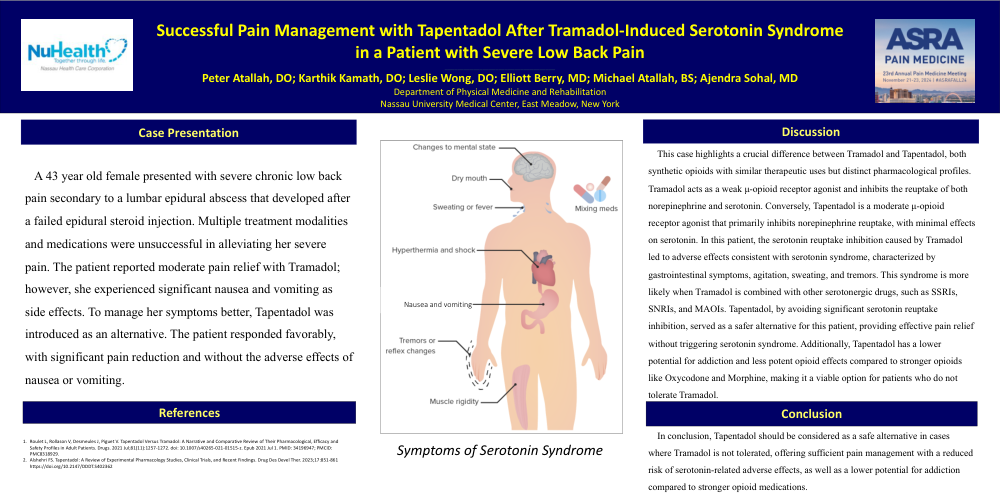
Discussion: This case highlights a crucial difference between Tramadol and Tapentadol, both synthetic opioids with similar therapeutic uses but distinct pharmacological profiles. Tramadol acts as a weak μ-opioid receptor agonist and inhibits the reuptake of both norepinephrine and serotonin. Conversely, Tapentadol is a moderate μ-opioid receptor agonist that primarily inhibits norepinephrine reuptake, with minimal effects on serotonin. In this patient, the serotonin reuptake inhibition caused by Tramadol led to adverse effects consistent with serotonin syndrome, characterized by gastrointestinal symptoms, agitation, sweating, and tremors. This syndrome is more likely when Tramadol is combined with other serotonergic drugs, such as SSRIs, SNRIs, and MAOIs. Tapentadol, by avoiding significant serotonin reuptake inhibition, served as a safer alternative for this patient, providing effective pain relief without triggering serotonin syndrome. Additionally, Tapentadol has a lower potential for addiction and less potent opioid effects compared to stronger opioids like Oxycodone and Morphine, making it a viable option for patients who do not tolerate Tramadol.
Conclusion: In conclusion, Tapentadol should be considered as a safe alternative in cases where Tramadol is not tolerated, offering sufficient pain management with a reduced risk of serotonin-related adverse effects, as well as a lower potential for addiction compared to stronger opioid medications.
References: