501 posters, 2 videos, 1 audios, 8 topics, 37 sessions, 395 authors, 307 institutions
ePostersLive by SciGen Technologies S.A. All rights reserved.
23rd Annual Pain Medicine Meeting 2024
November 21-23, 2024 | Caesars Palace, Las Vegas, Nevada

6130
ESTIMATING PATIENT DEMAND FOR PAIN PHYSICIANS IN THE UNITED STATES USING GOOGLE TRENDS DATA
Poster Presenter
Authors
Affiliations
Part of Topic
Scientific Abstracts > Chronic Pain
Estimating Patient Demand for Pain Physicians in the US Using Google Trends
Nivetha Srinivasan MD1, Aditi Master MD1, Vasanth Selvam DO2, Alejandro Hallo-Carrasco MD1, Jean Daniel Eloy MD1
Rutgers New Jersey Medical School1, Good Samaritan University Hospital2
Introduction
•The US population 75+ is expected to grow by 74% by 2034, leading to an increase in the number of individuals likely to develop chronic pain conditions.
•There is a potential discrepancy between supply and demand of pain physicians that needs to be evaluated to determine potential gaps in care.
•This study seeks to estimate demand for pain physicians using internet search engine data and identify potential shortages at the state level.
Methods
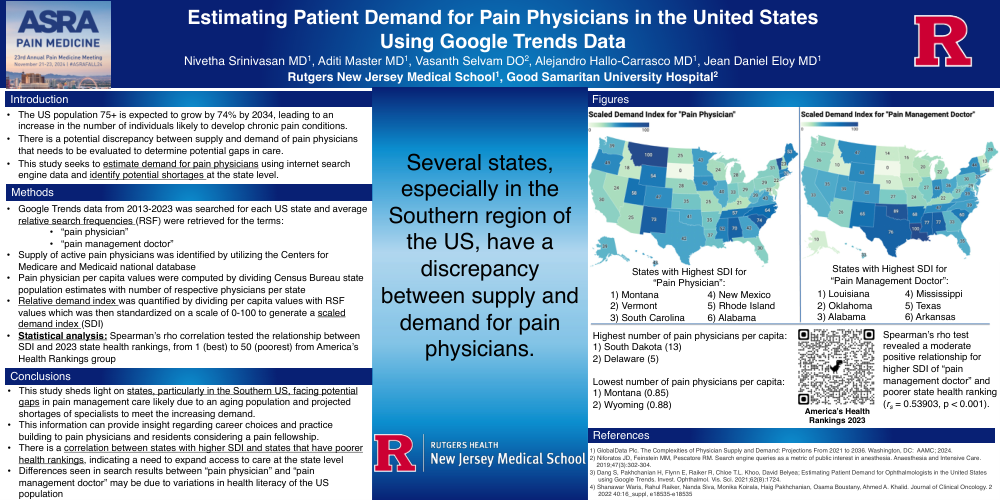
•Google Trends data from 2013-2023 was searched for each US state and average relative search frequencies (RSF) were retrieved for the terms:“pain physician”, “pain management doctor”
•Supply of active pain physicians was identified by utilizing the Centers for Medicare and Medicaid national database
•Pain physician per capita values were computed by dividing Census Bureau state population estimates with number of respective physicians per state
•Relative demand index was quantified by dividing per capita values with RSF values which was then standardized on a scale of 0-100 to generate a scaled demand index (SDI)
•Statistical analysis: Spearman’s rho correlation tested the relationship between SDI and 2023 state health rankings, from 1 (best) to 50 (poorest) from America’s Health Rankings group
Conclusions
•This study sheds light on states, particularly in the Southern US, facing potential gaps in pain management care likely due to an aging population and projected shortages of specialists to meet the increasing demand.
•This information can provide insight regarding career choices and practice building to pain physicians and residents considering a pain fellowship.
•There is a correlation between states with higher SDI and states that have poorer health rankings, indicating a need to expand access to care at the state level
•Differences seen in search results between “pain physician” and “pain management doctor” may be due to variations in health literacy of the US population