501 posters, 2 videos, 1 audios, 8 topics, 37 sessions, 395 authors, 307 institutions
ePostersLive by SciGen Technologies S.A. All rights reserved.
23rd Annual Pain Medicine Meeting 2024
November 21-23, 2024 | Caesars Palace, Las Vegas, Nevada

6013
PROCEDURAL MANAGEMENT AND COMPLICATIONS IN EPIDURAL BLOOD PATCH PROCEDURE IN A PATIENT WITH VON WILLEBRAND DISEASE
Poster Presenter
Authors
Affiliations
Part of Topic
Scientific Abstracts > Chronic Pain
Introduction
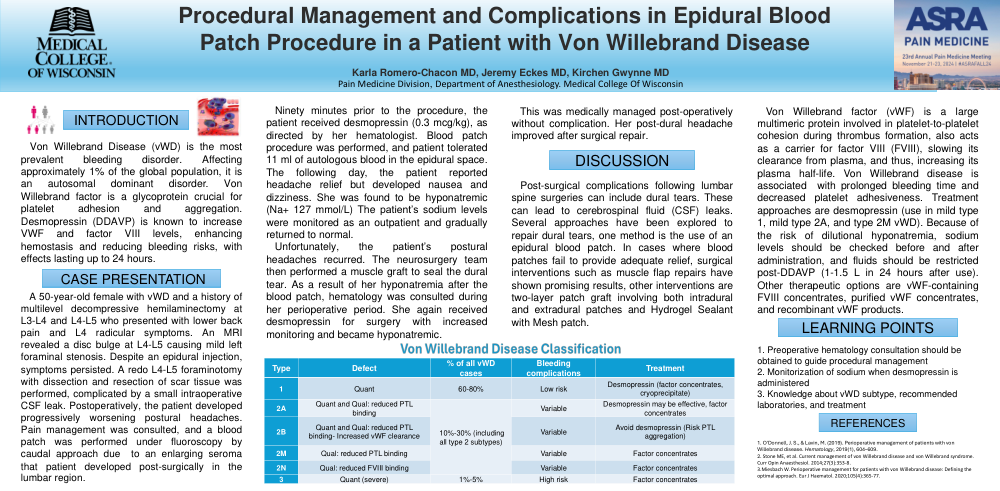
Von Willebrand Disease (vWD) is the most prevalent bleeding disorder. It affects approximately 1% of the global population and is an autosomal dominant disorder. Von Willebrand factor is a glycoprotein crucial for platelet adhesion and aggregation. Desmopressin (DDAVP) is known to increase VWF and factor VIII levels, enhancing hemostasis and reducing bleeding risks, with effects lasting up to 24 hours.
Case presentation
A 50-year-old female with vWD and history of multilevel decompressive hemilaminectomy at L3-L4 and L4-L5 presented with lower back pain and L4 radicular symptoms. An MRI revealed a disc bulge at L4-L5 causing mild left foraminal stenosis. Despite an epidural injection, symptoms persisted. A redo L4-L5 foraminotomy with dissection and resection of scar tissue was performed, complicated by a small intraoperative CSF leak. Postoperatively, the patient developed progressively worsening postural headaches. Pain management was consulted, and a blood patch was performed under fluoroscopy by caudal approach due to an enlarging seroma that the patient developed post-surgically in the lumbar region. Ninety minutes prior to the procedure, the patient received desmopressin (0.3 mcg/kg), as directed by her hematologist. A blood patch procedure was performed, and the patient tolerated 11 ml of autologous blood in the epidural space. The following day, the patient reported headache relief but developed nausea and dizziness. She was found to be hyponatremic (Na+ 127 mmol/L). The patient’s sodium levels were monitored as an outpatient and gradually returned to normal. Unfortunately, the patient’s postural headaches recurred. The neurosurgery team then performed a muscle graft to seal the dural tear. As a result of her hyponatremia after the blood patch, hematology was consulted during her perioperative period. She again received desmopressin for surgery with increased monitoring and became hyponatremic. This was medically managed post-operatively without complication. Her post-dural headache improved after surgical repair.
Discussion
Post-surgical complications following lumbar spine surgeries can include dural tears. These can lead to cerebrospinal fluid (CSF) leaks. Several approaches have been explored to repair dural tears, one method is the use of an epidural blood patch. In cases where blood patches fail to provide adequate relief, surgical interventions such as muscle flap repairs have shown promising results, other interventions are two-layer patch graft involving both intradural and extradural patches and Hydrogel Sealant with Mesh Patch. Von Willebrand factor (vWF) is a large multimeric protein involved in platelet-to-platelet cohesion during thrombus formation, also acts as a carrier for factor VIII (FVIII), slowing its clearance from plasma, and thus, increasing its plasma half-life. Von Willebrand disease is associated with prolonged bleeding time and decreased platelet adhesiveness. Treatment approaches are desmopressin (use in mild type 1, mild type 2A, and type 2M vWD). Because of the risk of dilutional hyponatremia, sodium levels should be checked before and after administration, and fluids should be restricted post-DDAVP (1-1.5 L in 24 hours after use). Other therapeutic options are vWF-containing FVIII concentrates, purified vWF concentrates, and recombinant vWF products.
Learning points
1. Preoperative hematology consultation should be obtained to guide procedural management
2. Monitorization of sodium when desmopressin is administered
3. Knowledge about vWD subtype, recommended laboratories, and treatment
References
1. O'Donnell, J. S., & Lavin, M. (2019). Perioperative management of patients with von Willebrand disease. Hematology, 2019(1), 604–609.
2. Stone ME, et al. Current management of von Willebrand disease and von Willebrand syndrome. Curr Opin Anaesthesiol. 2014;27(3):353-8.
3. Miesbach W. Perioperative management for patients with von Willebrand disease: Defining the optimal approach. Eur J Haematol. 2020;105(4):365-77.
'