501 posters, 2 videos, 1 audios, 8 topics, 37 sessions, 395 authors, 307 institutions
ePostersLive by SciGen Technologies S.A. All rights reserved.
23rd Annual Pain Medicine Meeting 2024
November 21-23, 2024 | Caesars Palace, Las Vegas, Nevada

5831
SI-6603 (CONDOLIASE) IN RADICULAR LEG PAIN ASSOCIATED WITH LUMBAR DISC HERNIATION: A PHASE 3, RANDOMIZED, SHAM-CONTROLLED TRIAL
Poster Presenter
Authors
Affiliations
Part of Topic
Scientific Abstracts > Chronic Pain
SI-6603 (Condoliase) in Patients With Radicular Leg Pain Associated With Lumbar Disc Herniation: A Phase 3, Randomized, Double-Blind, Sham-Controlled Trial
BACKGROUND
-Prolonged duration of LDH symptoms (ie, >6 months) is associated with worse outcomes2,3 , highlighting the clinical importance of rapid symptom control
-SI-6603 (condoliase) is a novel chemonucleolytic enzyme with high substrate specificity for degrading glycosaminoglycans (primarily chondroitin sulfate) in the nucleus pulposus4,5
-Condoliase was approved in Japan in 2018 as a single intradiscal injection for the treatment of radicular leg pain associated with LDH6,7
sham-controlled trial to evaluate the efficacy and safety of a single intradiscal injection of condoliase for radicular leg pain in individuals with LDH in the United States (US)
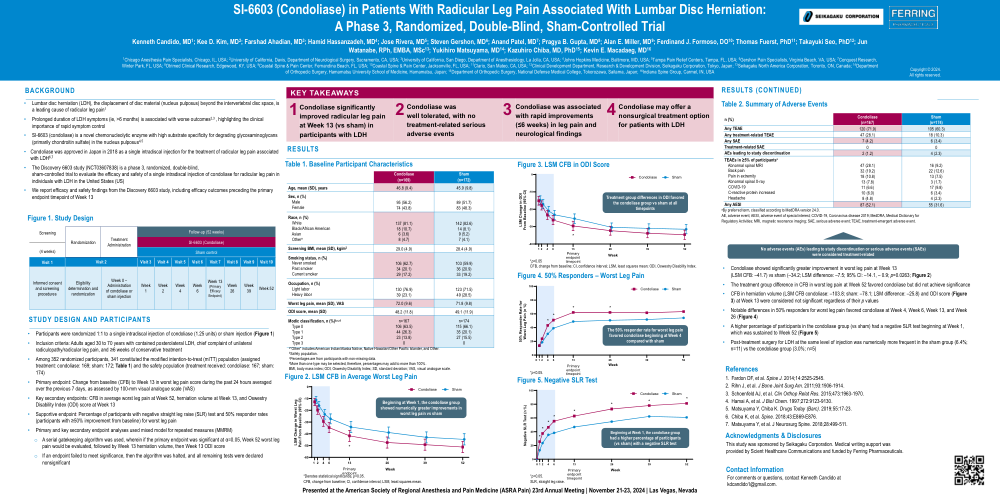
-Participants were randomized 1:1 to a single intradiscal injection of condoliase (1.25 units) or sham injection (Figure 1)
-Inclusion criteria: Adults aged 30 to 70 years with contained posterolateral LDH, chief complaint of unilateral radiculopathy/radicular leg pain, and ≥6 weeks of conservative treatment
-Among 352 randomized participants, 341 constituted the modified intention-to-treat (mITT) population (assigned treatment: condoliase: 169; sham: 172; Table 1) and the safety population (treatment received: condoliase: 167; sham: 174)
-Primary endpoint: Change from baseline (CFB) to Week 13 in worst leg pain score during the past 24 hours averaged over the previous 7 days, as assessed by 100-mm visual analogue scale (VAS)
-Key secondary endpoints: CFB in average worst leg pain at Week 52, herniation volume at Week 13, and Oswestry Disability Index (ODI) score at Week 13
-Supportive endpoint: Percentage of participants with negative straight leg raise (SLR) test and 50% responder rates (participants with ≥50% improvement from baseline) for worst leg pain
-Primary and key secondary endpoint analyses used mixed model for repeated measures (MMRM)
-Condoliase showed significantly greater improvement in worst leg pain at Week 13
(LSM CFB: –41.7) vs sham (–34.2; LSM difference: –7.5; 95% CI: –14.1, – 0.9; p=0.0263; Figure 2)
-The treatment group difference in CFB in worst leg pain at Week 52 favored condoliase but did not achieve significance
-CFB in herniation volume (LSM CFB condoliase: –103.8; sham: –78.1; LSM difference: –25.8) and ODI score (Figure 3) at Week 13 were considered not significant regardless of their p values
-Notable differences in 50% responders for worst leg pain favored condoliase at Week 4, Week 6, Week 13, and Week 26 (Figure 4)
-A higher percentage of participants in the condoliase group (vs sham) had a negative SLR test beginning at Week 1, which was sustained to Week 52 (Figure 5)
-Post-treatment surgery for LDH at the same level of injection was numerically more frequent in the sham group (6.4%; n=11) vs the condoliase group (3.0%; n=5)
KEY TAKEAWAYS