501 posters, 2 videos, 1 audios, 8 topics, 37 sessions, 395 authors, 307 institutions
ePostersLive by SciGen Technologies S.A. All rights reserved.
23rd Annual Pain Medicine Meeting 2024
November 21-23, 2024 | Caesars Palace, Las Vegas, Nevada

6330
DOUBLE TROUBLE - A CASE OF BILATERAL ANTERIOR GLENOHUMERAL JOINT DISLOCATIONS OF UNCERTAIN ORIGIN
Poster Presenter
Authors
Affiliations
Part of Topic
Scientific Abstracts > Acute Pain
Double Trouble - A Case of Bilateral Anterior Glenohumeral Joint Dislocations of Uncertain Origin
Peter Atallah, Leslie Wong, Simon Katz, Karthik Kamath, Elliott Berry, Adam Isaacson
Department of Physical Medicine and Rehabilitation
Nassau University Medical Center
Introduction:
A 37 year-old male was brought in from jail after being found unconscious in his cell with bilateral anterior shoulder dislocations.
Case Presentation:
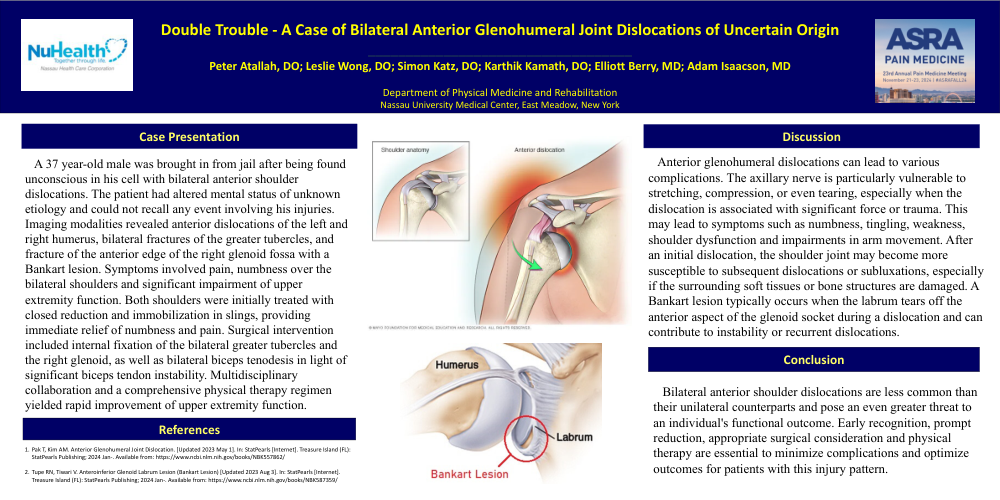
The patient had altered mental status of unknown etiology and could not recall any event involving his injuries. Imaging modalities revealed anterior dislocations of the left and right humerus, bilateral fractures of the greater tubercles, and fracture of the anterior edge of the right glenoid fossa with a Bankart lesion. Symptoms involved pain, numbness over the bilateral shoulders and significant impairment of upper extremity function. Both shoulders were initially treated with closed reduction and immobilization in slings, providing immediate relief of numbness and pain. Surgical intervention included internal fixation of the bilateral greater tubercles and the right glenoid, as well as bilateral biceps tenodesis in light of significant biceps tendon instability. Multidisciplinary collaboration and a comprehensive physical therapy regimen yielded rapid improvement of upper extremity function.
Discussion:
Anterior glenohumeral dislocations can lead to various complications. The axillary nerve is particularly vulnerable to stretching, compression, or even tearing, especially when the dislocation is associated with significant force or trauma. This may lead to symptoms such as numbness, tingling, weakness, shoulder dysfunction and impairments in arm movement. After an initial dislocation, the shoulder joint may become more susceptible to subsequent dislocations or subluxations, especially if the surrounding soft tissues or bone structures are damaged. A Bankart lesion typically occurs when the labrum tears off the anterior aspect of the glenoid socket during a dislocation and can contribute to instability or recurrent dislocations.
Conclusion:
Bilateral anterior shoulder dislocations are less common than their unilateral counterparts and pose an even greater threat to an individual's functional outcome. Early recognition, prompt reduction, appropriate surgical consideration and physical therapy are essential to minimize complications and optimize outcomes for patients with this injury pattern.
References: