501 posters, 2 videos, 1 audios, 8 topics, 37 sessions, 395 authors, 307 institutions
ePostersLive by SciGen Technologies S.A. All rights reserved.
23rd Annual Pain Medicine Meeting 2024
November 21-23, 2024 | Caesars Palace, Las Vegas, Nevada

6075
ESTABLISHING A PEDIATRIC ACUTE PAIN SERVICE: IMPACT ON RECOVERY AND PATIENT SATISFACTION IN PEDIATRIC POSTOPERATIVE CARE
Poster Presenter
Authors
Affiliations
Part of Topic
Scientific Abstracts > Regional Anesthesia
Title: Establishing a Pediatric Acute Pain Service: Impact on Recovery and Patient Satisfaction in Pediatric Postoperative Care
Authors: Lyndsay Martin1; Carol Dickerson MS, MBA1; Nicolas Avila, MD2; Ana C Mavarez, MD2
Institutions:
1. Department of Anesthesiology and Perioperative Medicine, Wellstar MCG Heath at Augusta University, Augusta, Georgia, US
2. Department of Anesthesiology and Perioperative Medicine, Wellstar MCG Heath at Augusta University, Childrens Hospital of Georgia, Augusta, Georgia, US
Introduction: The use of regional anesthesia blocks during surgery has shown potential to enhance post-operative recovery, decrease healthcare costs, shorter hospital stays, and improved patient outcomes. There has been limited experience in the use of regional anesthesia in pediatric cases. Research indicates that patients often experience optimal recovery at home, reporting greater comfort and satisfaction with their surgical experience and recovery1.
Methods: As the study is devoid of patient identifiable information, it is exempt from IRB review requirements as per Augusta University policy. This prospective, observational study, spanning October 2022 to March 2024, was performed in 333 children from 0 to 21 years of age. It evaluates the impact of pediatric regional anesthesia (PRA) blocks on post-operative recovery in patients at Children's Hospital of Georgia (CHOG) after the implementation of a formal PRA service. Several types of blocks, including peripheral nerve blocks, neuraxial blocks, and continuous catheter infusions, were employed to manage post-surgical pain. The purpose of the study is to assess data on postoperative pain scores and patient-reported satisfaction.
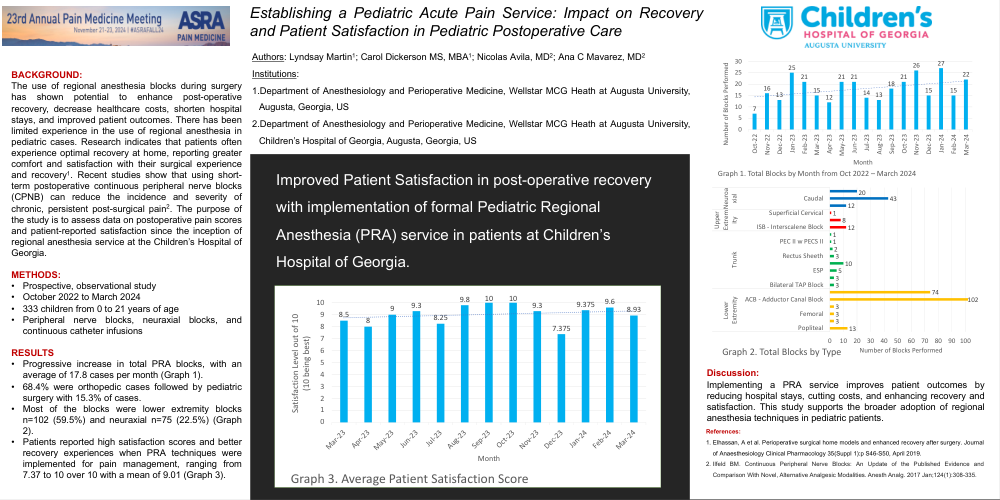
Results: There was progressive increase in total PRA blocks, with an average of 17.8 cases per month (Graph 1). 68.4% were orthopedic cases followed by pediatric surgery with 15.3% of cases. Most of the blocks were lower extremity blocks n=102 (59.5%) and neuraxial n=75 (22.5%) (Graph 2). Patients reported high satisfaction scores and better recovery experiences when PRA techniques were implemented for pain management, ranging from 7.37 to 10 over 10 with a mean of 9.01 (Graph 3).
Discussion: Enhanced recovery protocols and perioperative surgical home models improve patient outcomes by reducing hospital stays and promoting early mobility and home recovery1. Recent studies show that using short-term postoperative continuous peripheral nerve blocks (CPNB) can reduce the incidence and severity of chronic, persistent post-surgical pain2. Implementing a PRA service improves patient outcomes by reducing hospital stays, cutting costs, and enhancing recovery and satisfaction. This study supports the broader adoption of regional anesthesia techniques in pediatric patients.
References:
- Elhassan, A et al. Perioperative surgical home models and enhanced recovery after surgery. Journal of Anaesthesiology Clinical Pharmacology 35(Suppl 1):p S46-S50, April 2019.
- Ilfeld BM. Continuous Peripheral Nerve Blocks: An Update of the Published Evidence and Comparison With Novel, Alternative Analgesic Modalities. Anesth Analg. 2017 Jan;124(1):308-335.