501 posters, 2 videos, 1 audios, 8 topics, 37 sessions, 395 authors, 307 institutions
ePostersLive by SciGen Technologies S.A. All rights reserved.
23rd Annual Pain Medicine Meeting 2024
November 21-23, 2024 | Caesars Palace, Las Vegas, Nevada

6246
GEOGRAPHIC TRENDS IN PUBLICATION VOLUME AMONG SUCCESSFUL APPLICANTS IN PAIN MEDICINE FELLOWSHIP PROGRAMS
Poster Presenter
Authors
Affiliations
Part of Topic
Scientific Abstracts > Education
Geographic Trends in Publication Volume Among Successful Applicants in Pain Medicine Fellowship Programs
Dhiraj R. Sibala BS1, George A. Popa BS1, Damanveer Singh BS1, Colette B. Gazonas BS1, Marina Andrawis BS1, Nivetha Srinivasan MD1, Vasanth Selvam DO2, Jean D. Eloy MD1
1Rutgers New Jersey Medical School, 2Good Samaritan University Hospital
Pain medicine is a unique field in that any resident who has completed any of the following residency programs can apply: anesthesia, PM&R, neurology, psychiatry, radiology, emergency medicine, or psychiatry. Evaluating candidates for fellowship programs entails considering academic achievements, clinical experiences, letters of recommendation, and research contributions. Recent research has begun to explore factors distinguishing fellowship applicants. Despite the annual release of match data by the NRMP, specific details regarding research output are lacking. This study seeks to determine geographic trends based on region in publication volume and type among residents who secured a position at a pain medicine fellowship program.
The pain fellowship programs in the United States were identified using a combination of the ASRA fellowship directory and APPD directory. The residency program each of the pain fellows completed was identified. Each residency program was categorized based on geographical location. The regions were defined based on US Census-Bureau and included: Midwest, Northeast, South, and West. All fellows from the class of 2024 were identified from program websites, program social media platforms, and professional networking sites. Publication volume, encompassing first or second authorship in pain publications, publications in specialty-related and pain journals, and total publications, was recorded prior to the end of July in the application year for each fellow, utilizing PubMed and Google Scholar. Using ANOVA for statistical analysis, publication volumes were statistically compared against all geographical regions. Fellows who completed residency at a military program or internationally were not included due to lack of data points for analysis, as were those with unrelated research from a previously completed degree (e.g. PhD, MPH). IRB approval was not required as the study used publicly available data and no patient-protected health information was involved.
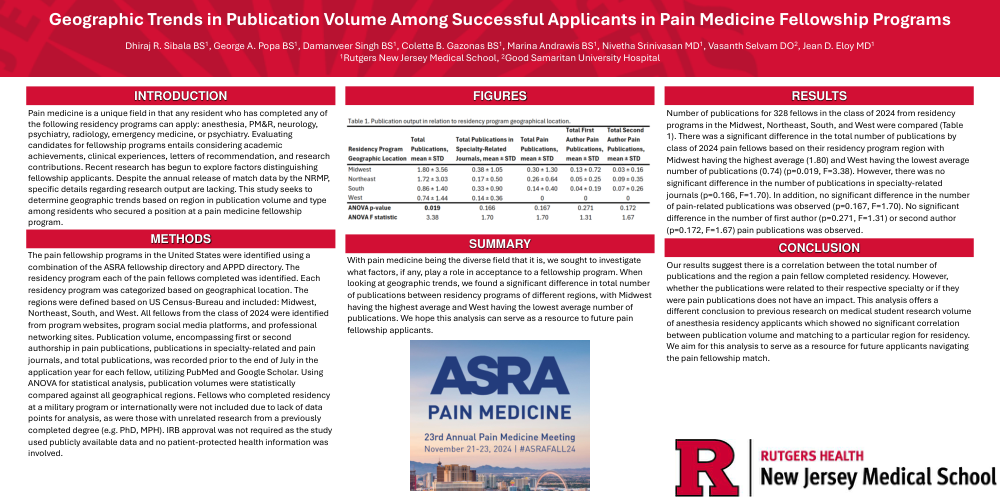
Number of publications for 328 fellows in the class of 2024 from residency programs in the Midwest, Northeast, South, and West were compared (Table 1). There was a significant difference in the total number of publications by class of 2024 pain fellows based on their residency program region with Midwest having the highest average (1.80) and West having the lowest average number of publications (0.74) (p=0.019, F=3.38). However, there was no significant difference in the number of publications in specialty-related journals (p=0.166, F=1.70). In addition, no significant difference in the number of pain-related publications was observed (p=0.167, F=1.70). No significant difference in the number of first author (p=0.271, F=1.31) or second author (p=0.172, F=1.67) pain publications was observed.
Our results suggest there is a correlation between the total number of publications and the region a pain fellow completed residency. However, whether the publications were related to their respective specialty or if they were pain publications does not have an impact. This analysis offers a different conclusion to previous research on medical student research volume of anesthesia residency applicants which showed no significant correlation between publication volume and matching to a particular region for residency. We aim for this analysis to serve as a resource for future applicants navigating the pain fellowship match.
With pain medicine being the diverse field that it is, we sought to investigate what factors, if any, play a role in acceptance to a fellowship program. When looking at geographic trends, we found a significant difference in total number of publications between residency programs of different regions, with Midwest having the highest average and West having the lowest average number of publications. We hope this analysis can serve as a resource to future pain fellowship applicants.