501 posters, 2 videos, 1 audios, 8 topics, 37 sessions, 395 authors, 307 institutions
ePostersLive by SciGen Technologies S.A. All rights reserved.
23rd Annual Pain Medicine Meeting 2024
November 21-23, 2024 | Caesars Palace, Las Vegas, Nevada

6243
PATIENT-REPORTED SYMPTOM ASSESSMENT IN IDIOPATHIC INTRACRANIAL HYPERTENSION PRIOR TO VENOUS SINUS STENTING: A PROSPECTIVE STUDY
Poster Presenter
Authors
Affiliations
Part of Topic
Scientific Abstracts > Chronic Pain
Patient-Reported Symptom Assessment in Refractory Idiopathic Intracranial Hypertension Prior to Venous Sinus Stenting: A Prospective Study
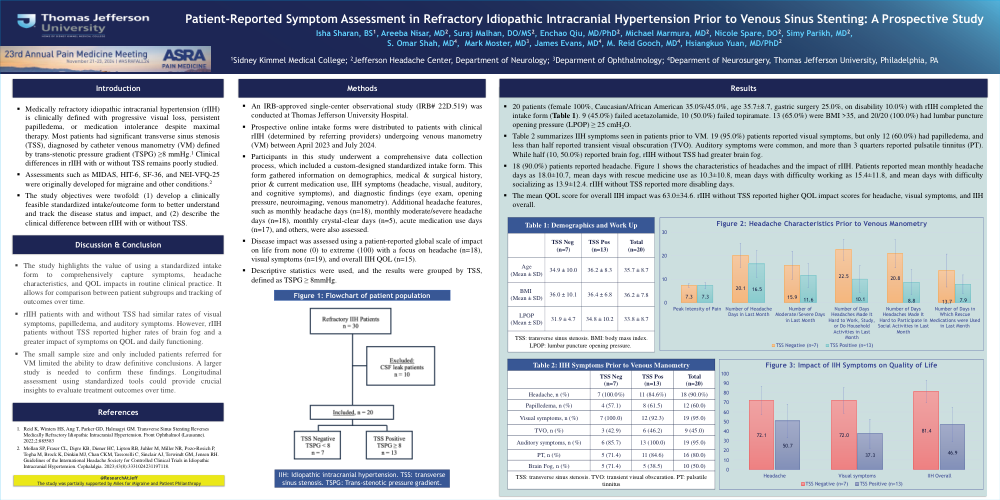
Medically refractory idiopathic intracranial hypertension (rIIH) is clinically defined with progressive visual loss, persistent papilledema, or medication intolerance despite maximal therapy. Most patients had significant transverse sinus stenosis (TSS), diagnosed by catheter venous manometry (VM) defined by trans-stenotic pressure gradient (TSPG) ≥8 mmHg. Clinical differences in rIIH with or without TSS remains poorly studied. Assessments such as MIDAS, HIT-6, SF-36, and NEI-VFQ-25 were originally developed for migraine and other conditions. The study objectives were twofold: (1) develop a clinically feasible standardized intake/outcome form to better understand and track the disease status and impact, and (2) describe the clinical difference between rIIH with or without TSS.
An IRB-approved single-center observational study (IRB# 22D.519) was conducted at Thomas Jefferson University Hospital. Prospective online intake forms were distributed to patients with clinical rIIH (determined by referring providers) undergoing venous manometry (VM) between April 2023 and July 2024. Participants in this study underwent a comprehensive data collection process, which included a custom-designed standardized intake form. This form gathered information on demographics, medical & surgical history, prior & current medication use, IIH symptoms (headache, visual, auditory, and cognitive symptoms), and diagnostic findings (eye exam, opening pressure, neuroimaging, venous manometry). Additional headache features, such as monthly headache days (n=18), monthly moderate/severe headache days (n=18), monthly crystal-clear days (n=5), acute medication use days (n=17), and others, were also assessed. Disease impact was assessed using a patient-reported global scale of impact on life from none (0) to extreme (100) with a focus on headache (n=18), visual symptoms (n=19), and overall IIH QOL (n=15). Descriptive statistics were used, and the results were grouped by TSS, defined as TSPG ≥ 8mmHg.
20 patients (female 100%, Caucasian/African American 35.0%/45.0%, age 35.7±8.7, gastric surgery 25.0%, on disability 10.0%) with rIIH completed the intake form (Table 1). 9 (45.0%) failed acetazolamide, 10 (50.0%) failed topiramate. 13 (65.0%) were BMI >35, and 20/20 (100.0%) had lumbar puncture opening pressure (LPOP) ≥ 25 cmH2O. Table 2 summarizes IIH symptoms seen in patients prior to VM. 19 (95.0%) patients reported visual symptoms, but only 12 (60.0%) had papilledema, and less than half reported transient visual obscuration (TVO). Auditory symptoms were common, and more than 3 quarters reported pulsatile tinnitus (PT). While half (10, 50.0%) reported brain fog, rIIH without TSS had greater brain fog. 18 (90.0%) patients reported headache. Figure 1 shows the characteristics of headaches and the impact of rIIH. Patients reported mean monthly headache days as 18.0±10.7, mean days with rescue medicine use as 10.3±10.8, mean days with difficulty working as 15.4±11.8, and mean days with difficulty socializing as 13.9±12.4. rIIH without TSS reported more disabling days. The mean QOL score for overall IIH impact was 63.0±34.6. rIIH without TSS reported higher QOL impact scores for headache, visual symptoms, and IIH overall.
The study highlights the value of using a standardized intake form to comprehensively capture symptoms, headache characteristics, and QOL impacts in routine clinical practice. It allows for comparison between patient subgroups and tracking of outcomes over time. rIIH patients with and without TSS had similar rates of visual symptoms, papilledema, and auditory symptoms. However, rIIH patients without TSS reported higher rates of brain fog and a greater impact of symptoms on QOL and daily functioning. The small sample size and only included patients referred for VM limited the ability to draw definitive conclusions. A larger study is needed to confirm these findings. Longitudinal assessment using standardized tools could provide crucial insights to evaluate treatment outcomes over time.