425 posters, 1 videos, 9 audios, 8 topics, 53 sessions, 340 authors, 286 institutions
ePostersLive by SciGen Technologies S.A. All rights reserved.
22nd Annual Pain Medicine Meeting 2023
November 10 - 11, 2023 | New Orleans Marriott | New Orleans, Louisiana, USA

5026
BILATERAL POSTERIOR SHOULDER DISLOCATION WITH REVERSE HILL-SACHS DEFORMITIES
Poster Presenter
Authors
Affiliations
Part of Topic
Medically Challenging Cases
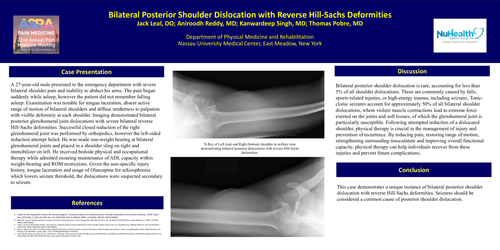
A 27-year-old male presented to the emergency department with severe bilateral shoulder pain and inability to abduct his arms. The pain began suddenly while asleep, however the patient did not remember falling asleep. Examination was notable for tongue laceration, absent active range of motion of bilateral shoulders and diffuse tenderness to palpation with visible deformity at each shoulder. Imaging demonstrated bilateral posterior glenohumeral joint dislocations with severe bilateral reverse Hill-Sachs deformities. Successful closed reduction of the right glenohumeral joint was performed by orthopedics, however the left-sided reduction attempt failed. He was made non-weight bearing at bilateral glenohumeral joints and placed in a shoulder sling on right and immobilizer on left. He received bedside physical and occupational therapy while admitted ensuring maintenance of ADL capacity within weight-bearing and ROM restrictions. Given the non-specific injury history, tongue laceration and usage of Olanzapine for schizophrenia which lowers seizure threshold, the dislocations were suspected secondary to seizure.
Bilateral posterior shoulder dislocation is rare, accounting for less than 5% of all shoulder dislocations. These are commonly caused by falls, sports-related injuries, or high-energy trauma, including seizures. Tonic-clonic seizures account for approximately 50% of all bilateral shoulder dislocations, where violent muscle contractions lead to extreme force exerted on the joints and soft tissues, of which the glenohumeral joint is particularly susceptible. Following attempted reduction of a dislocated shoulder, physical therapy is crucial in the management of injury and prevention of recurrence. By reducing pain, restoring range of motion, strengthening surrounding musculature and improving overall functional capacity, physical therapy can help individuals recover from these injuries and prevent future complications.