425 posters, 1 videos, 9 audios, 8 topics, 53 sessions, 340 authors, 286 institutions
ePostersLive by SciGen Technologies S.A. All rights reserved.
22nd Annual Pain Medicine Meeting 2023
November 10 - 11, 2023 | New Orleans Marriott | New Orleans, Louisiana, USA

4494
STELLATE GANGLION BLOCK FOR A PATIENT DEVELOPING CRPS AFTER HERPES ZOSTER RASH: A CASE REPORT
Poster Presenter
Authors
Affiliations
Part of Topic
Medically Challenging Cases
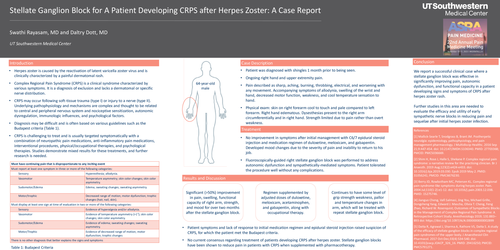
UT Southwestern Medical Center Swathi Rayasam, MD and Daltry Dott, MD Stellate Ganglion Block for A Patient Developing CRPS after Herpes Zoster: A Case Report Introduction • Herpes zoster is caused by the reactivation of latent varicella zoster virus and is clinically characterized by a painful dermatomal rash. • Complex Regional Pain Syndrome (CRPS) is a clinical syndrome characterized by various symptoms. It is a diagnosis of exclusion and lacks a dermatomal or specific nerve distribution. • CRPS may occur following soft-tissue trauma (type I) or injury to a nerve (type II). Underlying pathophysiology and mechanisms are complex and thought to be related to central and peripheral nervous system and nociceptive sensitization, autonomic dysregulation, immunologic influences, and psychological factors. • Diagnosis may be difficult and is often based on various guidelines such as the Budapest criteria (Table 1). • CRPS is challenging to treat and is usually targeted symptomatically with a combination of neuropathic pain medications, anti-inflammatory pain medications, interventional procedures, physical/occupational therapies, and psychological therapies. Studies demonstrate mixed results for these treatments, and further research is needed. Case Description • Patient symptoms and lack of response to initial medication regimen and epidural steroid injection raised suspicion of CRPS, for which the patient met the Budapest criteria. • No current consensus regarding treatment of patients developing CRPS after herpes zoster. Stellate ganglion blocks have been shown to reduce pain in patients with CRPS when supplemented with pharmacotherapy. Must have continuing pain that is disproportionate to any inciting event Must report at least one symptom in three or more of the following categories: Sensory Hyperesthesia; allodynia. Vasomotor Temperature asymmetry; skin color changes; skin color asymmetry. Sudomotor/Edema Edema; sweating changes; sweating asymmetry. Motor/trophic Decreased range of motion; motor dysfunction; trophic changes (hair, nail, skin). Must display at least one sign at time of evaluation in two or more of the following categories: Sensory Evidence of hyperalgesia and/or allodynia. Vasomotor Evidence of temperature asymmetry (>1°); skin color changes; skin color asymmetry. Sudomotor/Edema Evidence of edema; sweating changes; sweating asymmetry. Motor/Trophic Evidence of decreased range of motion; motor dysfunction; trophic changes There is no other diagnosis that better explains the signs and symptoms Table 1: Budapest Criteria Treatment Results and Discussion • Patient was diagnosed with shingles 1 month prior to being seen. • Ongoing right hand and upper extremity pain. • Pain described as sharp, aching, burning, throbbing, electrical, and worsening with any movement. Accompanying symptoms of allodynia, swelling of the wrist and hand, decreased motor function, weakness, and cool temperature sensation to hand. • Physical exam: skin on right forearm cool to touch and pale compared to left forearm. Right hand edematous. Dysesthesias present to the right arm circumferentially and in right hand. Strength limited due to pain rather than overt weakness. • No improvement in symptoms after initial management with C6/7 epidural steroid injection and medication regimen of duloxetine, meloxicam, and gabapentin. Developed mood changes due to the severity of pain and inability to return to his job. • Fluoroscopically-guided right stellate ganglion block was performed to address autonomic dysfunction and sympathetically-mediated symptoms. Patient tolerated the procedure well without any complications. 64-year-old male Significant (>50%) improvement in pain, swelling, functional capacity of right arm, strength, and mood for over two months after the stellate ganglion block. Regimen supplemented by adjusted doses of duloxetine, meloxicam, acetaminophen, and gabapentin, along with occupational therapy. Continues to have some level of grip strength weakness, pallor and temperature changes in arm, which will be treated with repeat stellate ganglion block. Conclusion We report a successful clinical case where a stellate ganglion block was effective in significantly improving pain, autonomic dysfunction, and functional capacity in a patient developing signs and symptoms of CRPS after herpes zoster rash. Further studies in this area are needed to evaluate the efficacy and utility of early sympathetic nerve blocks in reducing pain and sequelae after initial herpes zoster infection. References [1] Mallick-Searle T, Snodgrass B, Brant JM. Postherpetic neuralgia: epidemiology, pathophysiology, and pain management pharmacology. J Multidiscip Healthc. 2016 Sep 21;9:447-454. doi: 10.2147/JMDH.S106340. PMID: 27703368; PMCID: PMC5036669. [2] Shim H, Rose J, Halle S, Shekane P. Complex regional pain syndrome: a narrative review for the practising clinician. Br J Anaesth. 2019 Aug;123(2):e424-e433. doi: 10.1016/j.bja.2019.03.030. Epub 2019 May 2. PMID: 31056241; PMCID: PMC6676230. [3] Berry JD, Rowbotham MC, Petersen KL. Complex regional pain syndrome-like symptoms during herpes zoster. Pain. 2004 Jul;110(1-2):e1-12. doi: 10.1016/j.pain.2003.12.038. PMID: 15275746. [4] Jianguo Cheng, Vafi Salmasi, Jing You, Michael Grille, Dongsheng Yang, Edward J. Mascha, Olivia T. Cheng, Feng Zhao, Richard W. Rosenquist; Outcomes of Sympathetic Blocks in the Management of Complex Regional Pain Syndrome: A Retrospective Cohort Study. Anesthesiology 2019; 131:883– 893 doi: https://doi.org/10.1097/ALN.0000000000002899 [5] Datta R, Agrawal J, Sharma A, Rathore VS, Datta S. A study of the efficacy of stellate ganglion blocks in complex regional pain syndromes of the upper body. J Anaesthesiol Clin Pharmacol. 2017 Oct-Dec;33(4):534-540. doi: 10.4103/joacp.JOACP_326_16. PMID: 29416250; PMCID: PMC5791271.