425 posters, 1 videos, 9 audios, 8 topics, 53 sessions, 340 authors, 286 institutions
ePostersLive by SciGen Technologies S.A. All rights reserved.
22nd Annual Pain Medicine Meeting 2023
November 10 - 11, 2023 | New Orleans Marriott | New Orleans, Louisiana, USA

4845
OSGOOD SCHLATTER’S DISEASE ODDLY DIAGNOSED IN ADULTHOOD
Poster Presenter
Authors
Affiliations
Part of Topic
Medically Challenging Cases
Title: Osgood-Schlatter Disease Oddly Diagnosed in Adulthood
Introduction:
-
Knee pain can arise from a variety of orthopedic conditions.
-
Osgood-Schlatter disease (OSD) is a common diagnosis in the active adolescent population.
-
Sports and activities that heavily utilize the quadriceps can lead to OSD.
-
Repetitive quadriceps use can lead to stress on the tibial tubercle and lead to acute onset of anterior knee pain1.
-
It is luckily a self-resolving knee pain for adolescence.
-
OSD is seen atypically in adult populations.
-
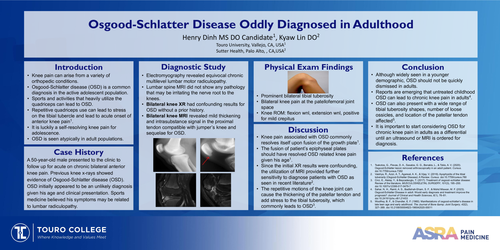
Electromyography revealed equivocal chronic multilevel lumbar motor radiculopathy.
-
Lumbar spine MRI did not show any pathology that may be irritating the nerve root to the knees.
-
Bilateral knee XR had confounding results for OSD without a prior history.
-
Bilateral knee MRI revealed mild thickening and intrasubstance signal in the proximal tendon compatible with jumper’s knee and sequelae for OSD.
Physical Findings
-
Prominent bilateral tibial tuberosity
-
Bilateral knee pain at the patellofemoral joint space
-
Knee ROM: flexion wnl, extension wnl, positive for mild crepitus
-
Knee pain associated with OSD commonly resolves itself upon fusion of the growth plate1.
-
The fusion of patient’s epiphyseal plates should have resolved OSD related knee pain given his age1.
-
Since the initial XR results were confounding, the utilization of MRI provided further sensitivity to diagnose patients with OSD as seen in recent literature.
-
The repetitive motions of the knee joint can cause the thickening of the patellar tendon and add stress to the tibial tuberosity, which commonly leads to OSD3.
Conclusion
-
Although widely seen in a younger demographic, OSD should not be quickly dismissed in adults.
-
Reports are emerging that untreated childhood OSD can lead to chronic knee pain in adults4.
-
OSD can also present with a wide range of tibial tuberosity shapes, number of loose ossicles, and location of the patellar tendon affected5.
-
It is important to start considering OSD for chronic knee pain in adults as a differential until an ultrasound or MRI is ordered for diagnosis.
-
Tsakotos, G., Flevas, D. A., Sasalos, G. G., Benakis, L., & Tokis, A. V. (2020). Osgood-Schlatter lesion removed arthroscopically in an adult patient. Cureus. doi:10.7759/cureus.7362
-
Vaishya, R., Azizi, A. T., Agarwal, A. K., & Vijay, V. (2016). Apophysitis of the tibial tuberosity (Osgood-Schlatter Disease): A Review. Cureus. doi:10.7759/cureus.780
-
Circi, E., Atalay, Y., & Beyzadeoglu, T. (2017). Treatment of osgood–schlatter disease: Review of the literature. MUSCULOSKELETAL SURGERY, 101(3), 195–200. doi:10.1007/s12306-017-0479-7
-
Sahar, N. H., Ramli, A. S., Badlishah-Sham, S. F., & Mohd Miswan, M. F. (2023). Osgood-Schlatter Disease in adult: Would early diagnosis and treatment improve the prognosis? Journal of Clinical and Health Sciences, 8(1), 76–81. doi:10.24191/jchs.v8i1.21453
-
Woolfrey, B. F., & Chandler, E. F. (1960). Manifestations of osgood-schlatterʼs disease in late teen age and early adulthood. The Journal of Bone & Joint Surgery, 42(2), 327–369. doi:10.2106/00004623-196042020-00011