425 posters, 1 videos, 9 audios, 8 topics, 53 sessions, 340 authors, 286 institutions
ePostersLive by SciGen Technologies S.A. All rights reserved.
22nd Annual Pain Medicine Meeting 2023
November 10 - 11, 2023 | New Orleans Marriott | New Orleans, Louisiana, USA

4603
INTERSCAPULAR PAIN ASSOCIATED WITH EPIDURAL UNDER LOSS OF RESISTANCE TO AIR: A RARE BUT TROUBLING PHENOMENON
Poster Presenter
Authors
Affiliations
Part of Topic
Medically Challenging Cases
Introduction:
Severe pain of the upper back, neck and interscapular region is an uncommon and difficult to treat complication of epidural anesthesia, with a reported incidence of 0.46% to 1.2% (1). Numerous case reports have been published attempting to elucidate the mechanism behind this pain, but a unifying pathophysiology has yet to be identified. This debilitating pain in the neck and upper back has been associated with increased length of stay and rate of cesarean section (1,2). We report a patient who developed interscapular, neck, and arm pain related to air entry into the epidural and/or subdural space.
Materials/Methods:
In accordance with our institutional guidelines, this case report concerns a single patient, is devoid of patient identifying information, and as such, is exempt from IRB review.
Results/Case Report:
A 43-year-old G1P0 parturient at 37 weeks, 2 days gestation with a past medical history of hypothyroidism, gestational diabetes and gestational hypertension presented for labor epidural. She weighed 76kg and had a BMI of 31. Informed consent was obtained and labor analgesia was initiated with a 17G Tuohy needle at the L3-L4 interspinous space using loss of resistance to air (LORTA). Less than 2 ml of air was injected and 10cc of a mixture of Fentanyl 2mcg/cc (20mcg total) + bupivacaine 0.125% was injected into the space without pain. The epidural catheter was threaded without difficulty and a test dose of lidocaine 1.5% with epinephrine 1:200,000 was negative. Epidural PCA was initiated with a continuous infusion at 10 ml/hr with 7ml boluses available every 20 minutes.
Immediately following the epidural, the patient began to complain of 9/10 pain in her neck radiating down into her interscapular region and right arm. Strength, range of motion and vascular exam were intact. She noted significant relief from contraction pain. As labor progressed, a physician administered bolus dose of 10cc mixture of fentanyl 2mcg/cc + bupivacaine 0.125% in normal saline was attempted but had to be aborted as the patient described a worsening of the pain upon injection. A one-time dose of butorphanol 1mg IV and acetaminophen 975 PO were given and the epidural infusion was slowed to 4cc/hr. Two hours later the patient continued to complain of the same neck and shoulder pain, and she was given 50mcg IV fentanyl, and the epidural was turned off. Throughout this time period, her blood pressures continued to be elevated necessitating PRN hydralazine and labetalol. One hour later, the neck and shoulder pain had resolved but the patient reported worsening contraction pain and requested the epidural be turned back on at the original rate of 7cc/hour. An informed discussion was had with the patient regarding replacement or discontinuation of epidural. She elected to bare the neck pain rather than bear the pain of her contractions or replace the epidural.
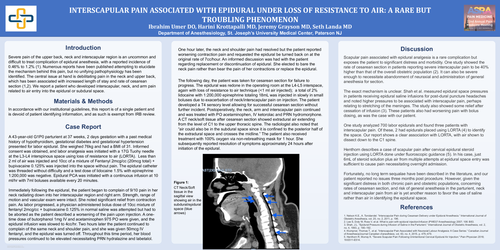
The following day, the patient was taken for cesarean section for failure to progress. The epidural was redone in the operating room at the L4-L5 interspace, again with loss of resistance to air technique (<1 ml air injected); a total of 2% lidocaine with 1:200,000 epinephrine totaling 18mL was injected in slowly in small boluses due to exacerbation of neck/interscapular pain on injection. The patient developed a T4 sensory level allowing for successful cesarean section without further incident. Postoperatively, the neck, arm and interscapular pain continued and was treated with PO acetaminophen, IV ketorolac and PRN hydromorphone. A CT neck/soft tissue after cesarean section showed extradural air extending from the level of C1 to the upper thoracic spine. The radiologist also noted that “air could also be in the subdural space since it is confined to the posterior half of the extradural space and crosses the midline.” The patient also received treatment with 100% oxygen via non-rebreathing mask for 1 hour. She subsequently reported resolution of symptoms approximately 24 hours after initiation of the epidural.
Discussion:
Scapular pain associated with epidural analgesia is a rare complication but exposes the patient to significant distress and morbidity. One study showed the rate of cesarean section in patients reporting severe interscapular pain to be 40% higher than that of the overall obstetric population (2). It can also be severe enough to necessitate abandonment of neuraxial and administration of general anesthesia for section.
The exact mechanism is unclear. Shah et al. measured epidural space pressures in patients receiving epidural saline infusions for post-dural puncture headaches and noted higher pressures to be associated with interscapular pain, perhaps relating to stretching of the meninges. The study also showed some relief after cessation of infusion (3). These patients also had worsening pain with bolus dosing, as was the case with our patient.
One study analyzed 700 labor epidurals and found three patients with interscapular pain. Of these, 2 had epidurals placed using LORTA (4) to identify the space. Our report shows a clear association with LORTA, with air shown to dissect down to the C1 spine.
Henthorn describes a case of scapular pain after cervical epidural steroid injection using LORTA done under fluoroscopic guidance (5). In his case, just 6mL of steroid solution plus air from multiple attempts at epidural space entry was sufficient to cause pain necessitating overnight admission.
Fortunately, no long term sequalae have been described in the literature, and our patient reported no issues three months post procedure. However, given the significant distress in both chronic pain and obstetric populations, concerning rates of cesarean section, and risk of general anesthesia in the parturient, neck and interscapular pain from air is yet another reason to favor the use of saline rather than air in identifying the epidural space.