425 posters, 1 videos, 9 audios, 8 topics, 53 sessions, 340 authors, 286 institutions
ePostersLive by SciGen Technologies S.A. All rights reserved.
22nd Annual Pain Medicine Meeting 2023
November 10 - 11, 2023 | New Orleans Marriott | New Orleans, Louisiana, USA

4586
COOLED RADIOFREQUENCY ABLATION FOR CHRONIC SHOULDER PAIN IN INFLAMMATORY DEMYELINATING PERIPHERAL NEUROPATHY: A CASE REPORT
Poster Presenter
Authors
Affiliations
Part of Topic
Medically Challenging Cases
Introduction
Shoulder pain is a prevalent medical condition affecting a substantial percentage of the population in the United States. Its point prevalence is as high as 26%, with a lifetime prevalence of up to 67% (1,2). Many patients continue to experience functionally limiting pain months after its onset, with approximately 20% accounting for a staggering 91% of future costs (2,3). Managing shoulder pain proves challenging due to the intricate anatomy of the joint and surrounding tissues and the complexities of everyday movements. Several treatment options, such as topical and oral medication, therapy, injection, neuromodulation, and surgery, are available to address this ailment.
Among the treatment modalities, traditional radiofrequency ablation (TRFA) has shown promise in relieving chronic pain and improving physical function in conditions related to spinal arthritis and various peripheral neuralgias. However, cooled radiofrequency ablation (CRFA) has emerged as a potentially more advantageous approach over TRFA. By incorporating active cooling of the probe, CRFA allows for creating more extensive and spherical lesions at lower electrode temperatures (3). While CRFA has demonstrated efficacy in treating moderate-to-severe glenohumeral osteoarthritis (OA), with successful image-guided treatment of the axillary, lateral pectoral, and suprascapular nerves, its application in inflammatory demyelinating peripheral neuropathies remains relatively unexplored. This case report presents an individual with a chronic history of inflammatory demyelinating peripheral neuropathy (CIDP) and associated left shoulder OA who underwent CRFA, resulting in 100% pain relief for three months.
Materials and Methods
This study was performed at a single tertiary care academic medical center. As the case report is devoid of patient-identifiable information, it is exempt from IRB review requirements as per Baylor College of Medicine policy. Informed consent was obtained from the patient prior to CRFA and prior to the penning of the case report.
Results/Case Report
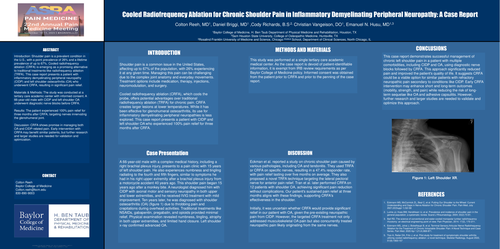
A 66-year-old male with a complex medical history, including right traumatic brachial plexopathy injury, presents to a pain management clinic with a complaint of 15 years of left shoulder pain. The patient reported intermittent pain, numbness, and "electric-like tingling" radiating from the left shoulder to the fourth and fifth fingers. The symptoms were akin to those experienced in his right upper extremity following a brachial plexus injury sustained forty years prior due to a motorcycle accident. This shoulder pain began 15 years ago, several weeks after being bitten by a primate. Subsequent evaluation by a neurologist, who performed EMG/NCS, revealed a CIDP with axonal motor and sensory peripheral neuropathy in the bilateral upper and lower extremities. The patient received intravenous immunoglobulin (IVIG) treatment, resulting in mild symptomatic improvement. Ten years after the initial symptoms, the patient developed throbbing left shoulder pain accompanied by crepitations during overhead activities, leading to an OA diagnosis. Traditional treatments, including non-steroidal anti-inflammatory agents, gabapentin, pregabalin, and opioids, provided minimal relief for the refractory pain. On physical examination, the left shoulder exhibited continuous numbness and tingling sensations radiating to the fourth and fifth fingers. Generalized atrophy was observed in the bilateral upper extremities, notably in the left shoulder girdle. The patient had limited hand closure causing difficulty with performing such as gripping and holding objects. Left shoulder x-ray showed advanced OA. The patient underwent diagnostic nerve blocks targeting the lateral pectoral, suprascapular, and axillary nerves resulting in a 50% reduction in pain intensity and a transition from the characteristic "electrical" quality of pain to a "dull" sensation. The patient subsequently received CRFA of the same nerves providing 100% pain relief for three months after which the pain returned.
Discussion
Eckman et al. reported one of the first cohorts of patients with chronic intractable shoulder pain due to various shoulder pathologies, including OA and tendonitis treated with either TRFA or CRFA of the suprascapular nerve, axillary nerve, and subscapular nerves (4). The study demonstrated a 47.4% responder rate, defined as >50% pain improvement for at least three months. Responders experienced an average of over five months of pain relief, with some patients reporting benefits lasting nearly one year (4). Subsequently, Eckman et al proposed a novel TRFA technique targeting the lateral pectoral nerve to provide anterior pain relief without causing motor weakness (4). Targeting these nerves with CRFA proves useful in the shoulder region, as it allows for specific innervation targeting of the glenohumeral joint. Recently, Tran et al. performed CRFA on 12 patients with shoulder OA, targeting these nerves, and found significant improvements in the Visual Analog Scale (VAS) scores from 8.8 ± 0.6 to 2.2 ± 0.4 six months after CRFA treatment, without complications (5). The patient's sustained pain relief at three months (with functional ADL gains) supports the findings of Tran and Eckman, bolstering the existing literature on CRFA in the shoulder.
While it was initially thought that performing CRFA on our patient with OA would alleviate musculoskeletal, OA-driven shoulder pain, it remained unclear if the patient would experience significant relief given the presence of intense neuropathic pain secondary to CIDP, which was present over 10 years prior to the development of OA. In the case presented, the targeted CRFA treatment aimed at ablating the three peripheral nerves responsible for innervating the glenohumeral joint not only addressed the musculoskeletal pain associated with OA but also concurrently treated the neuropathic pain secondary to CIDP, likely affecting these same nerves. This case report demonstrates the successful management of chronic left shoulder pain in a patient with multiple comorbidities, including CIDP and OA. Utilizing a procedural approach with diagnostic nerve blocks followed by CRFA resulted in significant pain reduction and improved quality of life, per the patient. These outcomes suggest that such intervention could be a viable option for similar patients experiencing refractory neuropathic pain secondary to diseases like CIDP in the future. Early intervention with CRFA could improve short and long term outcome measures including mobility, strength, and pain while reducing the chance of long term sequelae of chronic shoulder pain (OA, adhesive capsulitis, etc). However, further research and larger studies are warranted to validate and optimize this approach.
References
-
Eckmann MS, McCormick ZL, Beal C, et al. Putting Our Shoulder to the Wheel: Current Understanding and Gaps in Nerve Ablation for Chronic Shoulder Pain. Pain Med. July 2021;22(Suppl 1):S2-S8
-
Luime JJ, Koes BW, Hendriksen IJ, et al. Prevalence and incidence of shoulder pain in the general population; a systematic review. Scand J Rheumatology. 2004; 33(2):73-81.
-
Ball RD. The science of conventional and water-cooled monopolar lumbar radiofrequency rhizotomy: an electrical engineering point of view. Pain Physician, 2014. 17(2), 175–211.
-
Eckmann MS, Johal J, Bickelhaupt B, et al. Terminal Sensory Articular Nerve Radiofrequency Ablation for the Treatment of Chronic Intractable Shoulder Pain: A Novel Technique and Case Series. Pain Med. 2020 Apr 1;21(4):868-871.
-
Tran A, Reiter DA, Fritz J, et al. Pilot study for treatment of symptomatic shoulder arthritis utilizing cooled radiofrequency ablation: a novel technique. Skeletal Radiology. August 2022, 51(8):1563-1570