425 posters, 1 videos, 9 audios, 8 topics, 53 sessions, 340 authors, 286 institutions
ePostersLive by SciGen Technologies S.A. All rights reserved.
22nd Annual Pain Medicine Meeting 2023
November 10 - 11, 2023 | New Orleans Marriott | New Orleans, Louisiana, USA

4924
BOTOX INJECTIONS FOR THE TREATMENT OF ATYPICAL FACIAL PAIN: A CASE REPORT
Poster Presenter
Authors
Affiliations
Part of Topic
Medically Challenging Cases
Botox Injections for the Treatment of Atypical Facial Pain: A Case Report
Yashar Eshraghi, MD; Macey Sutherland, DO; Matthew Cutrer, MD; Tanaya Pulisetty, MS
Introduction:
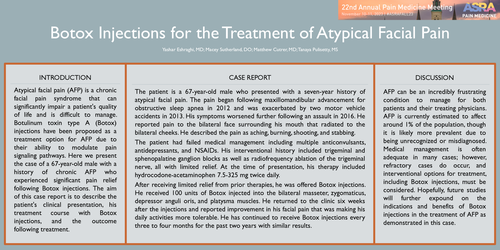
Atypical facial pain (AFP) is a chronic facial pain syndrome that can significantly impair a patient's quality of life and is difficult to manage. Botulinum toxin type A (Botox) injections have been proposed as a treatment option for AFP due to their ability to modulate pain signaling pathways. Here we present the case of a 67-year-old male with a history of chronic AFP who experienced significant pain relief following Botox injections. The aim of this case report is to describe the patient's clinical presentation, his treatment course with Botox injections, and the outcome following treatment.
Methods and Materials:
Informed consent was obtained from the patient. This case report was written using chart review and literature review. As the case report is devoid of patient identifiable information, it is exempt from IRB review requirements as per Ochsner Clinic Foundation policy.
Case:
The patient is a 67-year-old male who presented with a seven-year history of atypical facial pain. The pain began following maxillomandibular advancement for obstructive sleep apnea in 2012 and was exacerbated by two motor vehicle accidents in 2013. His symptoms worsened further following an assault in 2016. He reported pain to the bilateral face surrounding his mouth that radiated to the bilateral cheeks. He described the pain as aching, burning, shooting, and stabbing.
The patient had failed medical management including multiple anticonvulsants, antidepressants, and NSAIDs. His interventional history included trigeminal and sphenopalatine ganglion blocks as well as radiofrequency ablation of the trigeminal nerve, all with limited relief. At the time of presentation, his therapy included hydrocodone-acetaminophen 7.5-325 mg twice daily.
After receiving limited relief from prior therapies, he was offered Botox injections. He received 100 units of Botox injected into the bilateral masseter, zygomaticus, depressor anguli oris, and platysma muscles. He returned to the clinic six weeks after the injections and reported improvement in his facial pain that was making his daily activities more tolerable. He has continued to receive Botox injections every three to four months for the past two years with similar results.
Discussion:
AFP can be an incredibly frustrating condition to manage for both patients and their treating physicians. AFP is currently estimated to affect around 1% of the population, though it is likely more prevalent due to being unrecognized or misdiagnosed. Medical management is often adequate in many cases; however, refractory cases do occur, and interventional options for treatment, including Botox injections, must be considered. Hopefully, future studies will further expound on the indications and benefits of Botox injections in the treatment of AFP as demonstrated in this case.
Literature Review:
Atypical facial pain (AFP) and trigeminal neuralgia (TN) are two types of chronic facial pain syndromes that can severely impact a patient's quality of life. While the etiology of these conditions remains unclear, several treatment modalities have been proposed, including pharmacological agents, surgical interventions, and botulinum toxin type A (Botox) injections. Botox is a neurotoxin that inhibits acetylcholine release from presynaptic nerve terminals, leading to temporary muscle paralysis. It has been proposed as a treatment option for AFP and TN due to its ability to modulate pain signaling pathways. In this review, we will examine the existing medical literature on Botox as a treatment for AFP and TN, focusing on its efficacy, safety, and potential side effects.
Several studies have investigated the use of Botox injections in the management of AFP and TN. One prospective cohort study compared the analgesic effects of Botox injections in patients with trigeminal neuralgia, myofascial temporomandibular disorders, and oromandibular dystonia. The visual analog, pain frequency, and pain scales at baseline were reduced two, four, eight, and twelve weeks after the first botulinum toxin therapy and at the endpoint without significant adverse effects. This study suggests Botox injections are a safe and effective method for reducing pain severity and frequency in all three conditions.
A retrospective case series study evaluated the clinical outcomes of treatment of non-odontogenic atypical orofacial pain using Botox injections. It involved seven patients who had non-odontogenic orofacial pain (neuropathic pain and atypical orofacial pain), five of which had significant relief. The study concluded it is more effective to administer Botox injections in combination with other medications and physical therapy to improve pain.
One case report studied the effects of local injections of Botox on pain relief and long-term control in a 75-year-old patient with intractable trigeminal neuralgia. The study used a visual analog scale to evaluate pain intensity, quality, and location to establish the efficacy of Botox injections measured at baseline and at 7, 30, 60, and 90 days after treatment, noting a significant reduction in his pain.
A prospective cohort study assessed the effect and safety of Botox injections in a series of patients with atypical odontalgia, a form of persistent idiopathic facial pain. Four patients with refractory atypical odontalgia were treated with local injections with significant analgesic effect after a latency period of 3-14 days, and the effect persisted for 2-6 months. No adverse events were reported from any of the interventions performed.
A systematic review was conducted to evaluate the effectiveness of neuromodulating agents for the management of atypical facial pain and primary facial neuralgias. Twenty-four different pharmacological agents were assessed; carbamazepine was the most frequently studied while Botox injections demonstrated the highest consistency in reduction of symptom scores. A pooled estimate of three randomized controlled trials revealed that patients with trigeminal neuralgia who received Botox injections had higher odds of achieving a ≥50% reduction in visual analog scale scores compared to controls.
One study reviewed current data for the use of Botox injections in TN. Seven studies were examined, and all found Botox injections to be an effective treatment in most patients. Most studies used an intradermal or subcutaneous injection technique. The most common side effect was transient facial paresis. The study concluded that Botox injections can be considered in patients who have failed, become refractory to, or are unable to tolerate first-line pharmacologic treatments.
While the existing literature suggests that Botox injections may be an effective treatment option for AFP and TN, several limitations should be considered. The studies conducted thus far have been small and heterogeneous. Further research is needed to determine optimal dosing, injection sites, and long-term safety and efficacy. However, the available evidence suggests that Botox injections may be a promising treatment option for these disorders. Botox injections appear to be well-tolerated, with minimal adverse effects, and may offer an alternative treatment for patients who do not respond to traditional pharmacological therapies
Discussion:
While AFP is currently estimated to affect around 1% of the population, likely far more patients are misdiagnosed and could benefit from treatment. Medical management is adequate in a number of these, but, as seen in this case, some patients will be refractory to first-line medication therapies. Therefore, it is important that our practice has multiple treatment modalities that may be used systematically. Interventional options can make an impressive impact on those patients who are refractory or tolerant to more conservative treatments.
This case is one such example of a patient with refractory AFP. It also supports what is seen in much of the literature available. He experienced an improvement in his daily pain while not enduring any significant adverse effects. This is an encouraging case, as AFP can be incredibly frustrating for the affected patient as well as for the providers attempting to control it. As with any other disease process, the more options available, the more likely we will be able to successfully manage this pain. Hopefully, future studies may further expound upon the populations that may benefit from Botox injections as this patient did.
References:
Burmeister J., Holle D., Bock E. et. al. Botulinum neurotoxin type A in the treatment of classical Trigeminal Neuralgia (BoTN): study protocol for a randomized controlled trial. Trials 2015 Dec 3;16:550. doi: 10.1186/s13063-015-1052-z.
Cuadrado M., García-Moreno H., Arias J. et al. Botulinum Neurotoxin Type-A for the Treatment of Atypical Odontalgia. Pain Med. 2016 Sep;17(9):1717-21. doi: 10.1093/pm/pnw040. Epub 2016 Apr 12.
Do T., Unis G., Kattar N. et al. Neuromodulators for Atypical Facial Pain and Neuralgias: A Systematic Review and Meta-Analysis. Laryngoscope. 2021 Jun;131(6):1235-1253. doi: 10.1002/lary.29162. Epub 2020 Oct 10.
Kim S., Kim Y., Yun P. et al. Treatment of non-odontogenic orofacial pain using botulinum toxin-A: a retrospective case series study. Maxillofac Plast Reconstr Surg 2018. https://doi.org/10.1186/s40902-018-0159-z
Yoshida K. Effects of Botulinum Toxin Type A on Pain among Trigeminal Neuralgia, Myofascial Temporomandibular Disorders, and Oromandibular Dystonia. Toxins (Basel). 2021 Aug 29;13(9):605. doi: 10.3390/toxins13090605.