425 posters, 1 videos, 9 audios, 8 topics, 53 sessions, 340 authors, 286 institutions
ePostersLive by SciGen Technologies S.A. All rights reserved.
22nd Annual Pain Medicine Meeting 2023
November 10 - 11, 2023 | New Orleans Marriott | New Orleans, Louisiana, USA

4885
CASE REPORT: REPEATED STELLATE GANGLION BLOCKS FOR THE TREATMENT OF PTSD
Poster Presenter
Authors
Affiliations
Part of Topic
Medically Challenging Cases
Case Report: Repeated Stellate Ganglion Blocks for the Treatment of PTSD
Gabriel Sotomayor, MD MS, Ahmed Elsahy, MD
Indiana University School of Medicine, Indianapolis, Indiana
Background
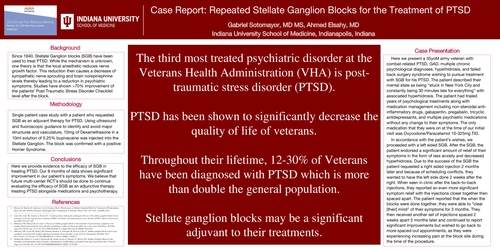
Since 1940, Stellate Ganglion blocks (SGB) have been used to treat PTSD. While the mechanism is unknown, one theory is that the local anesthetic reduces nerve growth factor. This reduction then causes a decrease of sympathetic nerve sprouting and brain norepinephrine levels thereby leading to a reduction in psychiatric symptoms. Studies have shown >70% improvement of the patients’ Post Traumatic Stress Disorder Checklist level after the block.
Methodology
Single patient case study with a patient who requested SGB as an adjuvant therapy for PTSD. Using ultrasound and fluoroscopic guidance to identify and avoid major structures and vasculature, 10mg of Dexamethasone in a 10ml solution of 0.25% bupivacaine was injected into the Stellate Ganglion. The block was confirmed with a positive Horner Syndrome.
Conclusions
Here we provide evidence to the efficacy of SGB in treating PTSD. Our 8 months of data shows significant improvement in our patient’s symptoms. We believe that future multi-center RCT’s should be done to continue evaluating the efficacy of SGB as an adjunctive therapy treating PTSD alongside medications and psychotherapy.
case presentation
Here we present a 35yoM army veteran with combat-related PTSD, GAD, multiple chronic psychological diagnoses, hyperhidrosis, and failed back surgery syndrome wishing to pursue treatment with SGB for his PTSD. The patient described their mental state as being “stuck in New York City and constantly being 30 minutes late for everything” with associated hyperhidrosis. The patient had trialed years of psychological treatments along with medication management including non-steroidal anti-inflammatory drugs, gabapentin, pregabalin, tricyclic antidepressants, and multiple psychiatric medications without any change to their symptoms. The only medication that they were on at the time of our initial visit was Oxycodone/Paracetamol 10-325mg TID.
In accordance with the patient’s wishes, we proceeded with a left sided SGB. After the SGB, the patient endorsed a significant amount of relief of their symptoms in the form of less anxiety and decreased hyperhidrosis. Due to the success of the SGB the patient requested a right sided injection 2 months later and because of scheduling conflicts, they wanted to have the left side done 2 weeks after the right. When seen in clinic after the back-to-back injections, they reported an even more significant symptom relief with the injections closer together then spaced apart. The patient reported that the when the blocks were done together, they were able to “clear [their] mind” of their symptoms for 3 months. They then received another set of injections spaced 2 weeks apart 5 months later and continued to report significant improvements but wished to go back to more spaced-out appointments, as they were experiencing increasing pain at the block site during the time of the procedure.