425 posters, 1 videos, 9 audios, 8 topics, 53 sessions, 340 authors, 286 institutions
ePostersLive by SciGen Technologies S.A. All rights reserved.
22nd Annual Pain Medicine Meeting 2023
November 10 - 11, 2023 | New Orleans Marriott | New Orleans, Louisiana, USA

4864
MULTIMODAL MONITORING OF SYMPATHETIC NERVOUS SYSTEM OUTFLOW IN A PATIENT UNDERGOING LUMBAR SYMPATHETIC BLOCKADE: A CASE STUDY
Poster Presenter
Authors
Affiliations
Part of Topic
Medically Challenging Cases
Multimodal monitoring of sympathetic nervous system outflow in a patient undergoing lumbar sympathetic blockade: a case study
Peter Ricci Pellegrino, Redgy Fuller, Hanjun Wang, Alicia M. Schiller
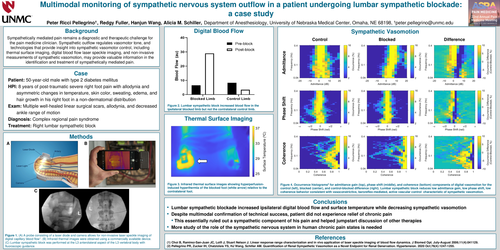
Sympathetically mediated pain remains a diagnostic and therapeutic challenge for the pain medicine clinician. Sympathetic outflow regulates vasomotor tone, and technologies that provide insight into sympathetic vasomotor control, including thermal surface imaging, digital blood flow laser speckle imaging, and non-invasive measurements of sympathetic vasomotion, may provide valuable information in the identification and treatment of sympathetically mediated pain. We present the case of a 50-year-old male with a past medical history of type 2 diabetes who reported eight years of post-traumatic severe right foot pain with allodynia, decreased range of motion, and asymmetric changes in temperature, skin color, sweating, edema, and hair growth in his right foot in a non-neural distribution. The patient was diagnosed with complex regional pain syndrome and underwent a diagnostic lumbar sympathetic block. Sympathetic neurolysis was confirmed with thermal surface imaging, digital blood flow laser speckle imaging, and sympathetic vasomotion. Unfortunately, the patient reported no palliation from the block at his follow-up clinic visit. The multimodal post-procedural validation of sympathetic neurolysis suggested that repeat blockade was unlikely to be beneficial, and he was referred for a spinal cord stimulator trial. Multimodal periprocedural sympathetic monitoring provides an objective validation of sympathetic blockade, ruling out block failure as a cause of procedural non-efficacy and providing additional diagnostic clarity for such patients. The development of novel, non-invasive diagnostic indexes for sympathetically mediated pain to better identify patients who would benefit from sympathetic blockade warrants further investigation.