425 posters, 1 videos, 9 audios, 8 topics, 53 sessions, 340 authors, 286 institutions
ePostersLive by SciGen Technologies S.A. All rights reserved.
22nd Annual Pain Medicine Meeting 2023
November 10 - 11, 2023 | New Orleans Marriott | New Orleans, Louisiana, USA

4738
PLACEMENT OF LABOR EPIDURAL IN A PARTURIENT PATIENT WITH SPINAL CORD STIMULATOR FOR CHRONIC REGIONAL PAIN SYNDROME (CRPS)
Poster Presenter
Authors
Affiliations
Part of Topic
Medically Challenging Cases
Tittle
Placement of Labor Epidural in a Parturient Patient with Spinal Cord Stimulator for Chronic Regional Pain Syndrome (CRPS)
Introduction
Spinal Cord Stimulation (SCS) is increasingly becoming popular as a treatment approach for some chronic pain conditions1-2 .
It has been utilized in the management of intractable spinal pain, neuropathic pain, and CRPS2.
The number of SCS placement in the United States is rapidly increasing, resulting in billions of dollars in expenditures2.
There has been increasing report of SCS placement in younger patients especially in the treatment of CRPS.
However, there is sparsity of literature on the management of labor epidural in parturient patients with spinal cord stimulator implant.
The objective of this report is to describe a successful placement and management of labor epidural in a parturient patient with spinal cord stimulator implant for CRPS.
Case Description
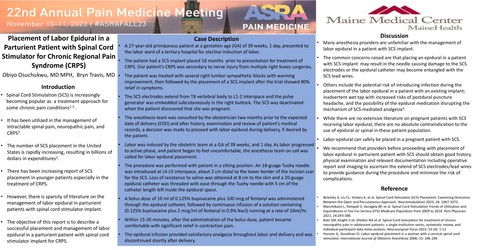
A 27-year-old primiparous patient at a gestation age (GA) of 39 weeks, 1 day, presented to the labor ward of a tertiary hospital for elective induction of labor.
The patient had a SCS implant placed 16 months prior to presentation for treatment of CRPS. Our patient’s CRPS was secondary to nerve injury from multiple right knees surgeries.
The patient was treated with several right lumbar sympathetic blocks with wanning improvement, then followed by the placement of a SCS implant after the trial showed 80% relief in symptoms.
The SCS electrodes extend from T8 vertebral body to L1-2 interspace and the pulse generator was embedded subcutaneously in the right buttock. The SCS was deactivated when the patient discovered that she was pregnant.
The anesthesia team was consulted by the obstetrician two months prior to the expected date of delivery (EDD) and after history, examination and review of patient’s medical records, a decision was made to proceed with labor epidural during delivery, if desired by the patient.
Labor was induced by the obstetric team at a GA of 39 weeks, and 1 day. As labor progressed to active phase, and patient began to feel uncomfortable, the anesthesia team on call was called for labor epidural placement.
The procedure was performed with patient in a sitting position. An 18-guage Tuohy needle was introduced at L4-L5 interspace, about 2 cm distal to the lower border of the incision scar for the SCS. Loss of resistance to saline was obtained at 8 cm to the skin and a 20-guage epidural catheter was threaded with ease through the Tuohy needle with 5 cm of the catheter length left inside the epidural space.
A bolus dose of 10 ml of 0.125% bupivacaine plus 100 mcg of fentanyl was administered through the epidural catheter, followed by continuous infusion of a solution containing (0.125% bupivacaine plus 2 mcg/ml of fentanyl in 0.9% Nacl) running at a rate of 10ml/hr.
Within 15-20 minutes, after the administration of the bolus dose, patient became comfortable with significant relief in contraction pain.
The epidural infusion provided satisfactory analgesia throughout labor and delivery and was discontinued shortly after delivery.
Discusion
Many anesthesia providers are unfamiliar with the management of labor epidural in a patient with SCS implant.
The common concerns raised are that placing an epidural in a patient with SCS implant may result in the needle causing damage to the SCS electrodes or the epidural catheter may become entangled with the SCS lead wires.
Others include the potential risk of introducing infection during the placement of the labor epidural in a patient with an existing implant; inadvertent wet tap with increased risks of postdural puncture headache, and the possibility of the epidural medication disrupting the mechanism of SCS-mediated analgesia4.
While there are no extensive literature on pregnant patients with SCS receiving labor epidural, there are no absolute contraindication to the use of epidural or spinal in these patient population.
Labor epidural can safely be placed in a pregnant patient with SCS.
We recommend that providers before proceeding with placement of labor epidural in parturient patient with SCS should obtain good history, physical examination and relevant documentation including operative report and imaging to ascertain the extend of SCS electrodes/lead wires to provide guidance during the procedure and minimize the risk of complications.