425 posters, 1 videos, 9 audios, 8 topics, 53 sessions, 340 authors, 286 institutions
ePostersLive by SciGen Technologies S.A. All rights reserved.
22nd Annual Pain Medicine Meeting 2023
November 10 - 11, 2023 | New Orleans Marriott | New Orleans, Louisiana, USA

4526
REGIONAL ANESTHESIA IN TRAUMATIC INJURY- IMPLICATIONS FOR ACUTE AND CHRONIC PAIN
Poster Presenter
Authors
Affiliations
Part of Topic
Medically Challenging Cases
Regional Anesthesia in Traumatic Injury- Implications for Acute and Chronic Pain
Katherine Durant, MD1,2, Emmanuel Perez, MD1, Michael Block, MD1,2, Mark Schlesinger, MD1,2
1Hackensack University Medical Center, Department of Anesthesiology, Hackensack NJ
2Hackensack Meridian School of Medicine
INTRODUCTION
Background: Patients who sustain
orthopedic traumatic injuries are more
likely than the general population to
suffer from chronic pain syndromes and
opioid misuse.
Guideline: Multimodal analgesia is the
recommended way to manage trauma
patients’ pain
Gap: Most patients are treated with
opioids and face barriers to receiving
regional anesthesia in the acute setting
CASE 1
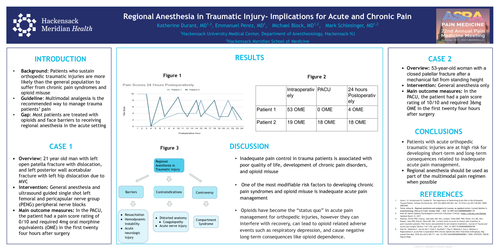
Overview: 21 year old man with left
open patella fracture with dislocation,
and left posterior wall acetabular
fracture with left hip dislocation due to
MVC
Intervention: General anesthesia and
ultrasound guided single shot left
femoral and pericapsular nerve group
(PENG) peripheral nerve blocks
Main outcome measures: In the PACU,
the patient had a pain score rating of
0/10 and required 4mg oral morphine
equivalents (OME) in the first twenty
four hours after surgery
CASE 2
Overview: 53-year-old woman with a
closed patellar fracture after a
mechanical fall from standing height
Intervention: General anesthesia only
Main outcome measures: In the
PACU, the patient had a pain score
rating of 10/10 and required 36mg
OME in the first twenty four hours
after surgery
DISCUSSION
Inadequate pain control in trauma patients is associated with
poor quality of life, development of chronic pain disorders,
and opioid misuse
One of the most modifiable risk factors to developing chronic
pain syndromes and opioid misuse is inadequate acute pain
management
Opioids have become the “status quo” in acute pain
management for orthopedic injuries, however they can
interfere with recovery, can lead to opioid related adverse
events such as respiratory depression, and cause negative
long-term consequences like opioid dependence.
CONCLUSIONS
Patients with acute orthopedic
traumatic injuries are at high risk for
developing short-term and long-term
consequences related to inadequate
acute pain management.
Regional anesthesia should be used as
part of the multimodal pain regimen
when possible
REFERENCES
1. Jones J Jr, Southerland W, Catalani B. The Importance of Optimizing Acute Pain in the Orthopedic
Trauma Patient. Orthop Clin North Am. 2017 Oct;48(4):445-465. doi: 10.1016/j.ocl.2017.06.003. PMID:
28870305.
2. Torrie, Arissa M.. Regional anesthesia and analgesia for trauma: an updated review. Current Opinion in
Anaesthesiology 35(5):p 613-620, October 2022. | DOI: 10.1097/ACO.0000000000001172
3. Kane SP. Opioid (Opiate) Equianalgesia Conversion Calculator. ClinCalc: https://clincalc.com/Opioids.
Updated March 12, 2017.
4. Radresa, Olivier PhD; Chauny, Jean-Marc MD, MSc; Lavigne, Gilles DMD, PhD; Piette, Eric MD, MSc;
Paquet, Jean PhD; Daoust, Raoul MD, MSc. Current views on acute to chronic pain transition in
post-traumatic patients: Risk factors and potential for pre-emptive treatments. Journal of Trauma and
Acute Care Surgery 76(4):p 1142-1150, April 2014. | DOI: 10.1097/TA.0000000000000188
5. Hsia HL, Takemoto S, van de Ven T, Pyati S, Buchheit T, Ray N, Wellman S, Kuo A, Wallace A,
Raghunathan K. Acute Pain Is Associated With Chronic Opioid Use After Total Knee Arthroplasty. Reg
Anesth Pain Med. 2018 Oct;43(7):705-711. doi: 10.1097/AAP.0000000000000831. PMID: 29975257; PMCID:
PMC6319560.