425 posters, 1 videos, 9 audios, 8 topics, 53 sessions, 340 authors, 286 institutions
ePostersLive by SciGen Technologies S.A. All rights reserved.
22nd Annual Pain Medicine Meeting 2023
November 10 - 11, 2023 | New Orleans Marriott | New Orleans, Louisiana, USA

4891
MILD: AN UNEXPECTED IMPROVEMENT AFTER YEARS OF SYMPTOMS
Poster Presenter
Authors
Affiliations
Part of Topic
Medically Challenging Cases
MILD: An Unexpected Improvement after Years of Symptoms
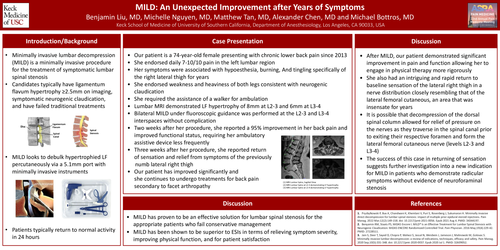
Minimally invasive lumbar decompression (MILD) is a minimally invasive procedure for the treatment of symptomatic lumbar spinal stenosis. Candidates typically have ligamentum flavum hypertrophy ≥2.5mm on imaging, symptomatic neurogenic claudication, and have failed traditional treatments. MILD looks to debulk hypertrophied LF percutaneously via a 5.1mm port with minimally invasive instruments. Patients typically return to normal activity in 24 hours.
Our patient is a 74-year-old female presenting with chronic lower back pain since 2013. She endorsed daily 7-10/10 pain in the left lumbar region. Her symptoms were associated with hypoesthesia, burning, And tingling specifically of the right lateral thigh for years. She endorsed weakness and heaviness of both legs consistent with neurogenic claudication. She required the assistance of a walker for ambulation. Lumbar MRI demonstrated LF hypertrophy of 8mm at L2-3 and 6mm at L3-4. Bilateral MILD under fluoroscopic guidance was performed at the L2-3 and L3-4 interspaces without complication. Two weeks after her procedure, she reported a 95% improvement in her back pain and improved functional status, requiring her ambulatory
assistive device less frequently. Three weeks after her procedure, she reported return of sensation and relief from symptoms of the previously numb lateral right thigh. Our patient has improved significantly and shecontinues to undergo treatments for back pain secondary to facet arthropathy.
MILD has proven to be an effective solution for lumbar spinal stenosis for the appropriate patients who fail conservative management. MILD has been shown to be superior to ESIs in terms of relieving symptom severity, improving physical function, and for patient satisfaction. After MILD, our patient demonstrated significant improvement in pain and function allowing her to engage in physical therapy more rigorously. She also had an intriguing and rapid return to baseline sensation of the lateral right thigh in a nerve distribution closely resembling that of the lateral femoral cutaneous, an area that was insensate for years. It is possible that decompression of the dorsal spinal column allowed for relief of pressure on the nerves as they traverse in the spinal canal prior to exiting their respective foramen and form the lateral femoral cutaneous nerve (levels L2-3 and L3-4). The success of this case in returning of sensation suggests further investigation into a new indication for MILD in patients who demonstrate radicular symptoms without evidence of neuroforaminal stenosis.