425 posters, 1 videos, 9 audios, 8 topics, 53 sessions, 340 authors, 286 institutions
ePostersLive by SciGen Technologies S.A. All rights reserved.
22nd Annual Pain Medicine Meeting 2023
November 10 - 11, 2023 | New Orleans Marriott | New Orleans, Louisiana, USA

4872
INTRAARTICULAR MORPHINE INJECTION FOR SHOULDER OSTEOARTHRITIS
Poster Presenter
Authors
Affiliations
Part of Topic
Medically Challenging Cases
Osteoarthritis affects more than 10% of men and 18% of women over age 60 worldwide and costs between 1.0% to 2.5% of gross domestic product in developed countries.1 Specifically, musculoskeletal shoulder pain is estimated to be the third most common cause of primary care consultation.2 While a multimodal approach can be beneficial in treating this disease state, we present a patient who required a more tailored approach. Our patient is a 68-year-old female with Systolic HF Failure c/b Atrial Fibrillation s/p BiVICD on apixaban, HIV, ESRD on HD, adrenal insufficiency on chronic steroid therapy with additional history of substance use disorder. She presented to our pain management clinic with bilateral chronic shoulder pain 2/2 severe osteoarthritis. Pain was 10/10 on VAS and caused significant functional impairment. The patient had failed conservative therapy with acetaminophen and a 6-week course of a physician directed home exercise program. The patient had tried bilateral glenohumeral joint injections with ketorolac + bupivacaine; however, effects were temporary.
While intra-articular injections of opioids are commonly used for acute pain management and produce potent analgesia, there is little literature on the use of intra-articular joint injections for patients with chronic pain.
Given the patient's comorbid conditions, we attempted an intra-articular joint injection with morphine and 0.25% bupivacaine to help reduce the patient’s pain and improve her quality of life. It is important to note that by utilizing bilateral single shot injections of bupivacaine, the risks of chondrotoxicity were minimized. Single shot intra-articular injections of local anesthetics are well established, and the risk of chondrotoxicity is a dose and time dependent factor.3
After discussing the risks, benefits and alternative therapies, the patient was consented for the procedure. The patient was placed in the sitting position. A timeout was performed to verify the correct patient, side and procedure. The posterior aspect of the patient’s bilateral shoulders was prepped and draped in usual sterile fashion and sterile technique was adhered to during the entire procedure. Sonosite ultrasound guidance was utilized to confirm needle and injectate localization.
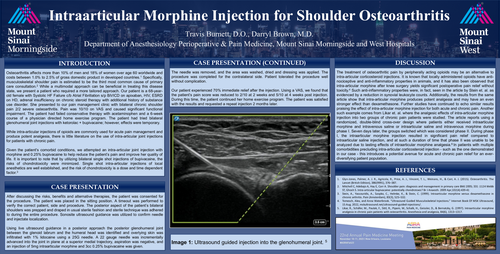
Using live ultrasound guidance in a posterior approach the posterior glenohumeral joint between the glenoid labrum and the humeral head was identified and overlying skin was infiltrated with 1% lidocaine using a 25G needle. A 22 gauge needle was incrementally advanced into the joint in plane at a superior medial trajectory, aspiration was negative, and an injection of 5mg intraarticular morphine and 3cc 0.25% bupivacaine was given.
The needle was removed, and the area was washed, dried and dressing was applied. The procedure was completed for the contralateral side. Patient tolerated the procedure well without complication.
Our patient experienced 70% immediate relief after the injection. Using a VAS, we found that the patient’s pain score was reduced to 2/10 at 2 weeks and 5/10 at 4 weeks post injection. During this time, the patient continued her home exercise program. The patient was satisfied with the results and requested a repeat injection 2 months later.
The treatment of osteoarthritic pain by peripherally acting opioids may be an alternative to intra-articular corticosteroid injections. It is known that locally administered opioids have anti-nociceptive and anti-inflammatory properties in animals, and it has also been observed that intra-articular morphine after knee surgery yields significant postoperative pain relief without toxicity.4 Such anti-inflammatory properties were, in fact, seen in the article by Stein et. al. as evidenced by a reduction in synovial leukocyte counts. Additionally, the results from the same article show that intra-articular morphine produces potent analgesia and may have an even stronger effect than dexamethasone. Further studies have continued to echo similar results praising the effect of intra-articular morphine injection for both acute and chronic pain. Another such example comes from Likar et. al. where the analgesic effects of intra-articular morphine injection into two groups of chronic pain patients were studied. The article reports using a randomized, double-blind cross-over design where patients either received intraarticular morphine and intravenous saline or intraarticular saline and intravenous morphine during phase I. Seven days later, the groups switched which was considered phase II. During phase I, the intraarticular morphine injection resulted in significant pain relief compared to intraarticular saline injection, and at such a duration of time that phase II was unable to be analyzed due to lasting effects of intraarticular morphine analgesia.6 In patients with multiple comorbidities precluding intra-articular corticosteroid injection - such as the one demonstrated in our case - this introduces a potential avenue for acute and chronic pain relief for an ever-diversifying patient population.