425 posters, 1 videos, 9 audios, 8 topics, 53 sessions, 340 authors, 286 institutions
ePostersLive by SciGen Technologies S.A. All rights reserved.
22nd Annual Pain Medicine Meeting 2023
November 10 - 11, 2023 | New Orleans Marriott | New Orleans, Louisiana, USA

4790
PATIENT WITH RECENTLY DIAGNOSED PROSTATE CANCER PRESENTING WITH LUMBAR RADICULOPATHY CAUSED BY A CYSTIC NEUROGENIC TUMOR
Poster Presenter
Authors
Affiliations
Part of Topic
Medically Challenging Cases
Patient with Recently Diagnosed Prostate Cancer Presenting With Lumbar Radiculopathy Caused by a Cystic Neurogenic Tumor
INTRODUCTION
Lumbar Radiculopathy is common and encountered in 3-5% of the population
Causes can be numerous including disc herniation, spondylolisthesis, neoplasms, facet arthrosis or anything causing compressive forces on a nerve root causing irritation.
CASE DESCRIPTION
55 year old male with a history of recently diagnosed prostate cancer presented to the pain clinic with chronic low back pain with recent left lower extremity radicular symptoms.
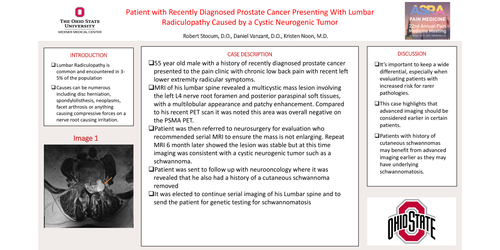
MRI of his lumbar spine revealed a multicystic mass lesion involving the left L4 nerve root foramen and posterior paraspinal soft tissues, with a multilobular appearance and patchy enhancement. Compared to his recent PET scan it was noted this area was overall negative on the PSMA PET.
Patient was then referred to neurosurgery for evaluation who recommended serial MRI to ensure the mass is not enlarging. Repeat MRI 6 month later showed the lesion was stable but at this time imaging was consistent with a cystic neurogenic tumor such as a schwannoma.
Patient was sent to follow up with neurooncology where it was revealed that he also had a history of a cutaneous schwannoma removed
It was elected to continue serial imaging of his Lumbar spine and to send the patient for genetic testing for schwannomatosis
DISCUSSION
It’s important to keep a wide differential, especially when evaluating patients with increased risk for rarer pathologies.
This case highlights that advanced imaging should be considered earlier in certain patients.
Patients with history of cutaneous schwannomas may benefit from advanced imaging earlier as they may have underlying schwannomatosis.