425 posters, 1 videos, 9 audios, 8 topics, 53 sessions, 340 authors, 286 institutions
ePostersLive by SciGen Technologies S.A. All rights reserved.
22nd Annual Pain Medicine Meeting 2023
November 10 - 11, 2023 | New Orleans Marriott | New Orleans, Louisiana, USA

4779
THE RELATIONSHIP BETWEEN PAIN PERCEPTION AND COGNITIVE IMPAIRMENT
Poster Presenter
Authors
Affiliations
Part of Topic
Medically Challenging Cases
The Relationship Between Pain Perception and Cognitive Impairment
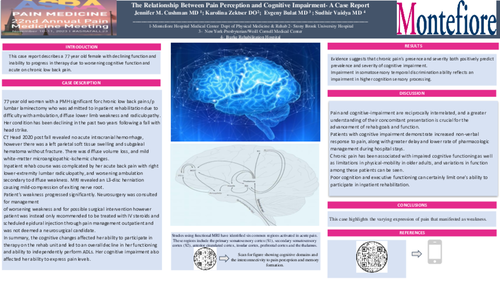
Introduction: This case report describes a 77 year old female with declining function and inability to progress in therapy due to worsening cognitive function and acute on chronic low back pain.
Case Description
77 year old woman with a PMH significant for chronic low back pain s/p lumbar laminectomy who was admitted to inpatient rehabilitation due to difficulty with ambulation, diffuse lower limb weakness and radiculopathy. Her condition has been declining in the past two years following a fall with head strike. CT Head 2020 post fall revealed no acute intracranial hemorrhage, however there was a left parietal soft tissue swelling and subgaleal hematoma without fracture. There was diffuse volume loss, and mild white-matter microangiopathic-ischemic changes. Inpatient rehab course was complicated by her acute back pain with right lower-extremity lumbar radiculopathy, and worsening ambulation secondary to diffuse weakness. MRI revealed an L3-disc herniation causing mild-compression of exiting nerve root. Patient’s weakness progressed significantly. Neurosurgery was consulted for management of worsening weakness and for possible surgical intervention however patient was instead only recommended to be treated with IV steroids and scheduled epidural injection through pain management outpatient and was not deemed a neurosurgical candidate. In summary, the cognitive changes affected her ability to participate in therapy on the rehab unit and led to an overall decline in her functioning and ability to independently perform ADLs.
Results:
Evidence suggests that chronic pain’s presence and severity both positively predict prevalence and severity of cognitive impairment. Impairment in somatosensory temporal discrimination ability reflects an impairment in higher cognition sensory processing.
Discussion:
Pain and cognitive-impairment are reciprocally interrelated, and a greater understanding of their concomitant presentation is crucial for the advancement of rehab goals and function. Patients with cognitive impairment demonstrate increased non-verbal response to pain, along with greater delay and lower rate of pharmacologic management during hospital stays. Chronic pain has been associated with impaired cognitive functioning as well as limitations in physical-mobility in older adults, and variations in function among these patients can be seen. Poor cognition and executive functioning can certainly limit one’s ability to participate in inpatient rehabilitation
Conclusion:
This case highlights the varying expression of pain that manifested as weakness.
Refer to Barcode for references